MINI: Photo Box Billboard

A billboard that turns fans into the creative

MINI has launched an innovative electronic billboard on Berlin’s Kurfürstendamm shopping boulevard. The billboard is connected to a Photo Box booth that captures the faces of MINI fans and puts them onto a massive screen along with each participant’s favourite MINI model, for a chance to win their preferred car.

Contestants have four colours and four models to choose from, including the MINI Hatch, Convertible, Clubman and Countryman.

The mechanic: Photo Box in Berlin. Facebook everywhere else

On the street, you step into the Photo Box, clamp on a pair of headphones, pick your colour and model, and the system outputs a ready-to-share moment on a giant public screen.

Fans from around the world can also join through the MINI Facebook app, where you can snap a picture with your webcam wearing a pair of virtual headphones in your favourite MINI colour.

In high-footfall city retail corridors, interactive out-of-home turns passersby into opt-in media by making participation itself the content.

Why it feels modern: ecommerce choice, but on a building

The experience borrows the best part of online shopping. Configuration. without forcing the rest of it. Specs, comparisons, and checkout. The “product” is self-expression, delivered in seconds, in public.

That public context matters. It creates instant social proof, and it makes the moment feel bigger than a personal post because it physically occupies the street.

The business intent: acquisition through identity

This is acquisition marketing that avoids hard selling. MINI lets people declare a preference. model plus colour. and then wraps that declaration in a contest mechanic. The brand gets reach, participation data, and a stream of shareable assets without asking people to create anything from scratch.

What to steal for your next interactive OOH build

  • Make the choice set small and satisfying. Four colours and four models is enough to feel personal, without feeling complex.
  • Design one iconic prop. Here, the headphones act as a visual signature that unifies street and Facebook participation.
  • Let the environment do the distribution. A giant screen creates built-in attention and bystander reach.
  • Mirror the experience online. The Facebook version keeps the same core mechanic so the idea travels beyond the location.

A few fast answers before you act

What is MINI’s Photo Box billboard activation?

It is an interactive out-of-home experience where fans take a photo, choose a MINI model and colour, and see themselves displayed on a massive screen, with a chance to win their preferred car.

How does the Facebook app extend the idea?

It recreates the same participation loop online. People take a webcam photo, add the virtual headphones in their chosen colour, pick a model, and join the same campaign experience from anywhere.

Why does this work as acquisition marketing?

It converts brand preference into a public, shareable artifact. The configuration step makes it feel personal, and the big-screen moment adds social proof and reach.

Banrock Station: 100K Live Bees Billboard

An SOS written by a living swarm

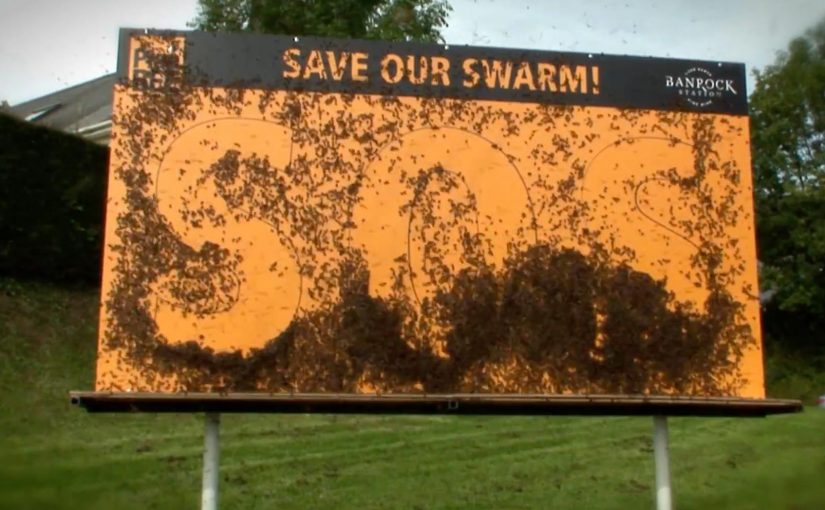
Honey-bee populations are mysteriously dwindling worldwide. In England, the Banrock Station winery created what it described as the world’s first ad with live bees to call attention to the problem.

Using queen-bee pheromones, the team attracted a giant swarm of bees, as many as 100,000, from a nearby honey farm to spell out an “SOS” message on a billboard.

Queen-bee pheromones are chemical signals that draw worker bees toward what they perceive as the queen’s location, making it possible to guide where a swarm clusters.

How it works: make the message unavoidable

The mechanism is blunt and brilliant. Use the medium itself as proof. A billboard about bees becomes a billboard made of bees, so the problem is not explained. It is witnessed.

In UK cause marketing, a conservation message that becomes a public spectacle can travel faster because it creates a stoppable moment people feel compelled to verify and share.

Why it lands: it turns concern into a physical reaction

This works because it compresses a complex topic into one immediate sensation. Surprise first, meaning second. You see the swarm, you read “SOS”, and only then do you connect it to the decline story.

Mechanism to why sentence: because the billboard is literally formed by the subject of the campaign, the message feels less like persuasion and more like evidence, which increases attention and recall.

The business intent: build salience and fund the cause

The film earns awareness, but it also links the stunt to action. Banrock Station also donates 5p to the honey-bee cause for every bottle sold, turning attention into a measurable contribution.

What to steal if you want cause marketing to feel real

  • Make the medium the proof. If you can embody the issue in the execution, you do not need long explanation.
  • Design for a “verify it” reaction. People share what they feel they need to show others to be believed.
  • Connect attention to a concrete contribution. Pair the story with a simple, trackable give-back mechanic.
  • Keep the message legible at a glance. “SOS” works because it is instantly readable even before context arrives.

Extractable takeaway: The most effective cause marketing often turns an abstract problem into a physical moment, then ties that moment to a simple action that funds or advances the cause.


A few fast answers before you act

What is Banrock Station’s “live bees billboard” in one sentence?

An out-of-home awareness piece that uses a real, visible “live bees” element to make the environmental message feel tangible rather than symbolic.

What is the core mechanism?

The medium becomes the proof. The execution embodies the issue in a way passers-by can immediately see, which makes the story inherently shareable.

Why does this kind of cause marketing earn attention?

Because it triggers a “verify it” reaction. People are more likely to share something they feel others need to see to believe.

What business intent does it serve beyond awareness?

It links brand meaning to a concrete, memorable moment, and can be paired with a trackable give-back or action mechanic to convert attention into contribution.

What is the most transferable takeaway?

If you can turn a cause into a physical, legible proof-point, you reduce explanation and increase both recall and retellability.

McDonald’s digital billboard game

Menu items bounce and fly through a digital billboard screen. If you are quick enough to capture one in a cell-phone picture, it is yours for free at the nearest McDonald’s.

The idea. Speed turns attention into reward

DDB Stockholm creates a clever and simple interactive billboard game for McDonald’s that turns a familiar format. The outdoor ad. Into a real-time challenge with a tangible payoff.

How it works. Capture the moment

  • Menu items animate across the billboard screen.
  • People try to “catch” an item by snapping it with their phone camera at the right moment.
  • The captured item becomes the proof that unlocks the free product at the nearest McDonald’s.

Why it works. A physical moment that feels earned

The mechanic is immediate and legible from a distance. It is also fair in a way people understand. If you are fast, you win. That converts passive viewing into active participation without asking anyone to download an app or learn a new interface.


A few fast answers before you act

What is McDonald’s digital billboard game?
An interactive billboard activation where animated menu items move across the screen and people try to capture one with a phone photo to win it.

What do you have to do to win?
Take a cell-phone picture fast enough to capture a flying menu item on the billboard.

What do you get if you succeed?
The captured item is redeemed for free at the nearest McDonald’s.

Who creates the activation?
DDB Stockholm.

What is the transferable pattern?
Turn a high-reach format into a simple, visible challenge. Then reward the behavior with an immediate, local redemption loop.