
Flair: Fashiontag

Women are always looking for inspiration for their wardrobe and most of the time they find this inspiration by looking at other women.

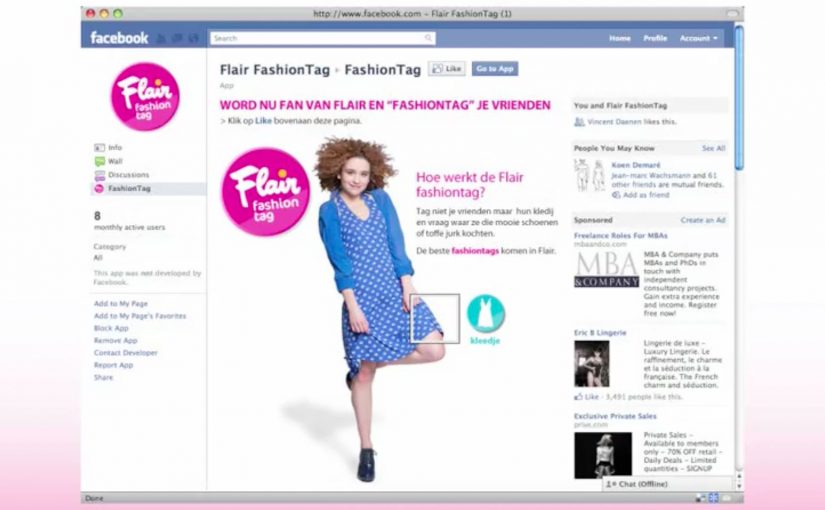
This inspired agency Duval Guillaume to create a Flair Fashiontag Facebook app for Belgian women’s magazine Flair. In the app, instead of tagging people, you can tag people’s clothes or accessories and ask them where they got them.

All fashiontags are displayed in a Facebook gallery, and the best are published in the weekly edition of Flair. This way there is constant interaction between the Facebook application and the magazine itself.

Turning social curiosity into a repeatable format

The mechanism is a simple swap. Replace social tagging of people with social tagging of products. A photo becomes a shoppable question. The owner of the outfit becomes the source. The magazine becomes the curator that elevates the best finds from feed to print.

In fashion and lifestyle publishing, converting casual “where did you get that” moments into a structured loop is a practical way to keep community activity and editorial output feeding each other.

The smart move here is to treat wardrobe curiosity as a content engine, not as a side effect of social chatter. The real question is how to turn that curiosity into a repeatable loop that helps readers in the moment and gives the magazine something worth curating.

Why it lands

This works because it formalizes a behavior that already exists. People already look at outfits, notice details, and ask friends for sources. Fashiontag simply gives that behavior a native interface and a public gallery, then adds a prestige layer by featuring the best tags in the weekly magazine.

Extractable takeaway: If your audience already asks each other for product sources, build a lightweight format that captures those questions in the moment and rewards the best contributions with visible amplification.

What to steal from Fashiontag

  • Swap the object of attention: tag the item, not the person, when product discovery is the real intent.
  • Close the loop with curation: a gallery is useful. Editorial selection makes it aspirational.
  • Make participation low-friction: one tag, one question, one shareable output.
  • Bridge channels on purpose: use print, site, and social as a single system, not separate campaigns.
  • Protect the social contract: ensure the person in the photo is comfortable with tagging and featuring, especially when content moves into a magazine.

A few fast answers before you act

What is Flair Fashiontag?

It is a Facebook app for Flair magazine that lets users tag clothes or accessories in photos and ask where those items were purchased.

What makes it different from normal photo tagging?

Normal tagging identifies people. Fashiontag identifies items. It turns fashion curiosity into a structured question-and-answer interaction.

How does the magazine benefit from the Facebook app?

The app creates a steady flow of wardrobe inspiration and real questions from readers. The magazine then curates and publishes the best tags, which reinforces participation.

Why is this a strong community mechanic?

Because it rewards helpfulness. People contribute sources and recommendations, and the gallery plus print selection turns that help into recognition.

What is the biggest risk in this format?

Consent and comfort. Tagging items in someone’s photo can feel intrusive if the person did not opt in, especially if content can be featured publicly in print.
The Schweppes Facebook Profile App

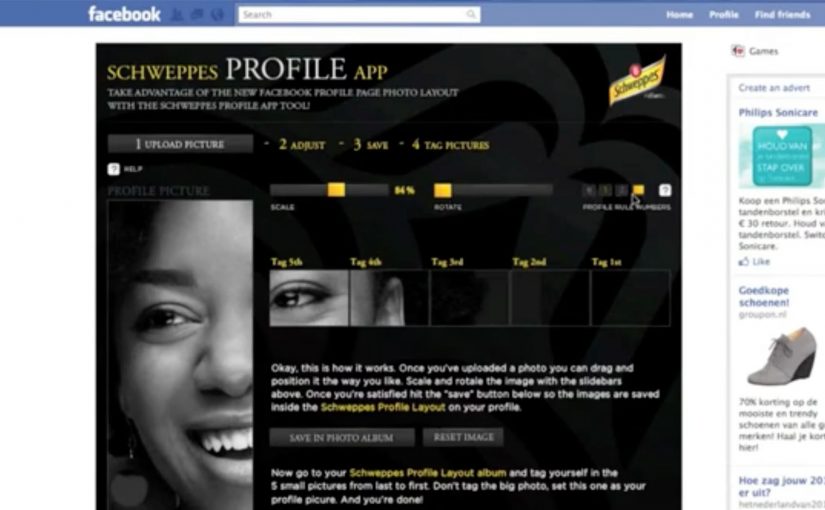
You want a standout Facebook profile, but you do not have Photoshop skills. Schweppes solves it with a Profile App that helps you build a polished new profile design in minutes, using simple templates instead of design tools.

What changed on Facebook that triggered this

Facebook rolled out improvements to the profile experience that made it easier to tell your story and learn about your friends. Creative people quickly started experimenting with the new profile design, turning profiles into personal canvases.

What did Schweppes build

That wave inspired Schweppes to develop the Schweppes Profile App on Facebook. It gave anyone who did not have Photoshop skills, and does not have much time, a way to create a great new profile.

On social platforms where the profile itself is part of how people present themselves publicly, the strongest brand utility is the one that makes visible self-expression easier.

The real question is whether the brand can make a rising social behaviour easier to join without making the experience feel like advertising.

Why this is a smart brand move

This is a smart brand move because it provides a service that becomes increasingly popular as the trend catches on. Templates matter here because they turn a design behaviour into something ordinary users can complete quickly, which is why Schweppes gets used inside the trend instead of interrupting it from the outside.

Extractable takeaway: When a platform change creates a new expression trend, the most effective branded response is often a simple utility that removes skill and time barriers so more people can participate.

What Schweppes is really buying

The business intent is not just profile creations. It is to link Schweppes to an emerging Facebook behaviour at the moment people are actively shaping how they appear to others, which gives the brand relevance through participation rather than message repetition.

What to steal if you build branded social tools

  • Ship a tool that helps people express themselves. Identity improvements get repeated use because the user cares about the output.
  • Ride an emerging behaviour with utility, not messaging. When a platform change sparks a trend, a simple enabler scales faster than a campaign claim.
  • Make quality accessible for non-experts. Templates turn “I need skills” into “I can do this in minutes”.
  • Measure what stays live, not just what gets tried. Adoption is about how many people keep the output active and visible to others over time.

A few fast answers before you act

What is the Schweppes Facebook Profile App?

It is a branded Facebook app that helps people create a customised profile look without needing Photoshop or design skills.

Why does this work as content people actually use?

Because the output is identity-based. People are motivated to improve how they present themselves, so a tool that makes it easy gets adoption.

What is the core pattern to copy?

Spot an emerging behaviour, then ship a simple tool that helps people do it better. The brand earns attention by enabling, not interrupting.

Why does accessibility matter more than creative polish here?

Because the idea scales only if ordinary people can complete it quickly. Templates beat complexity when the goal is broad participation, not elite design output.

What should you measure if you run something similar?

Creations completed, share and usage rate, how many people keep it live, referral loops from friends viewing profiles, and repeat usage over time.