
Ben & Jerry’s: Fair Tweets

How can an ice cream maker use social media to help provide farmers a fair income across the globe. Ben & Jerry’s positions itself as a Fairtrade-first mover in ice cream, then takes on the challenge with a deceptively simple Twitter utility called Fair Tweets.

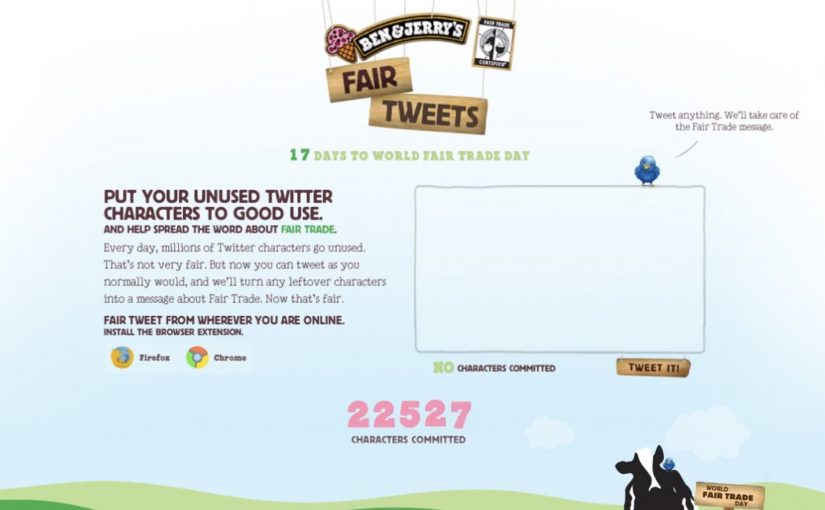
The idea is to let followers donate their unused tweet space to the cause. “Unused social media space” here means the leftover characters inside a tweet that does not hit the then-standard 140 character limit. Fair Tweets fills those remaining characters with an advocacy message that promotes World Fair Trade Day (May 14) and Fair Trade issues more broadly.

Turning leftover characters into a donation mechanic

The mechanism is a lightweight interface that behaves like a plug-in for your behavior. You tweet as normal. The system automatically appends a Fair Trade message into the empty character space you did not use. It is a small “opt-in constraint” that converts millions of tiny, personal broadcasts into consistent campaign impressions. By “opt-in constraint,” I mean a voluntary limit the user accepts, so the campaign can add a message without hijacking their voice.

In global consumer brands with always-on social channels, this pattern scales because it turns everyday posting into distributed, opt-in media inventory.

The real question is whether you can piggyback on an existing habit without hijacking what people meant to say.

In brand-led cause marketing, the fastest way to earn participation is to reduce effort to one familiar action inside a channel people already use daily.

Why it lands

It does not ask people to change who they are on Twitter. It asks them to keep tweeting, while quietly upgrading the payload. This pattern is worth copying only when the appended message stays clearly secondary to the user’s own voice. The constraint is the hook. It makes the act feel clever rather than preachy, and it turns participation into a visible badge that friends can copy in seconds.

Extractable takeaway: If you want a cause message to spread without feeling like an ad, attach it to a behavior users already repeat, then “tax” only the slack in that behavior. The slack is where adoption hides.

What to steal for your next social utility

  • Exploit a real constraint. The character limit is not a creative brief. It is a platform rule that makes the idea instantly understandable.
  • Make the value exchange obvious. Users give you what they were going to waste anyway, then they get an identity signal for supporting the cause.
  • Keep the activation single-step. One click, one tweet, done. Every additional step kills the multiplier.
  • Design for imitation. The best proof is not a campaign site. It is seeing friends do it in-feed.

A few fast answers before you act

What is the Fair Tweets idea in one line?

It automatically fills the unused characters in a tweet with a Fair Trade message, so normal tweeting becomes lightweight cause promotion.

Why does “unused characters” work as a donation model?

Because it feels free. Users are not giving money or time. They are donating spare capacity inside something they were already doing.

What makes this approach different from a hashtag campaign?

A hashtag asks users to change their message. Fair Tweets rides along with any message, which increases participation without forcing people into campaign language.

What is the biggest risk when brands copy this pattern?

Over-automation. If the appended message feels spammy, repetitive, or hijacks the user’s voice, people will stop using it and may resent the brand.

How do you write the appended message so it feels shareable?

Keep it short, clearly optional, and visibly additive to the user’s tweet. If it reads like a branded footer or repeats too aggressively, it stops feeling like a badge and starts feeling like spam.
Keep a Child Alive: Digital Death

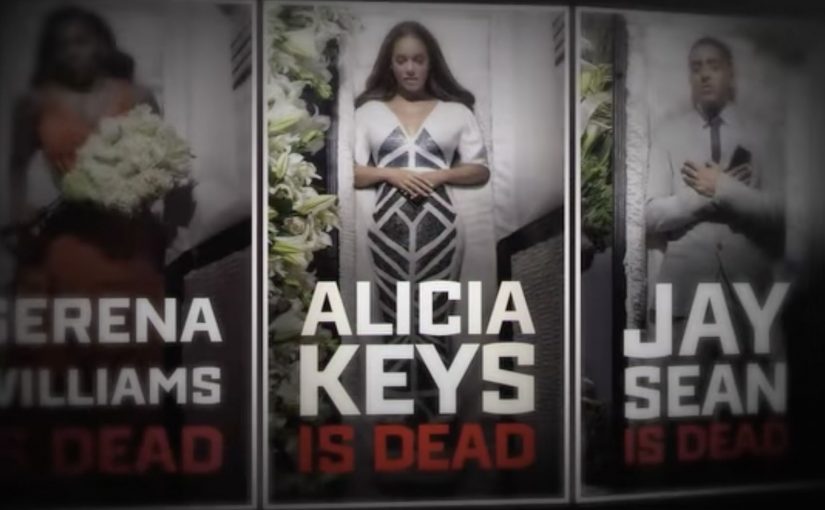
On December 1st, Hollywood died a digital death. Here, “digital death” means celebrities voluntarily going silent on social platforms until donations reach a public fundraising goal. The world’s top celebrity tweeters sacrificed their digital lives to give real life to millions of people affected by HIV/AIDS in Africa and India. Here are their full last tweets and testaments until $1,000,000 is raised to buy their lives back via www.buylife.org.

How “digital death” is made to feel real

The mechanism is brutally simple. Celebrities stop posting. Their accounts point fans toward a donation goal. The audience “buys back” each digital life by contributing toward the $1,000,000 target, with last messages and testament-style videos used as the emotional fuel for the ask.

In celebrity-led social media culture, attention is often treated like currency, and this campaign makes that trade explicit.

Why the stunt spreads

It is built on a clean tension. Fans want access. The cause needs money. Turning silence into a paywall is provocative enough to spark debate, and that debate becomes distribution.

Extractable takeaway: If you need a fundraising idea to travel fast, create a single, legible “lock and unlock” mechanic that people can explain in one sentence, then tie the unlock to a fixed, public goal.

What the campaign is really optimizing

The real question is whether borrowed celebrity attention can be converted into meaningful action for the cause before the stunt burns out.

This is not only about donations. It is about forcing a moment of self-awareness. If people can mobilize instantly for celebrity updates, can they mobilize the same way for lives impacted by HIV/AIDS. The smart part is not the silence itself, but the way it converts attention into a public, measurable ask.

Update: Celebrity Twitter Ban Campaign a Bust, Can’t Raise $1 Million; Stars Freak Out

On December 07, 2010, the New York Post reported that the campaign was struggling to reach the $1 million target at the expected pace, and that a wealthy supporter contributed $500,000 to help move the total forward so participating celebrities could resume posting.

What to steal from this mechanic

  • Make the action loop explainable in one sentence. “Donate to unlock them” is instantly repeatable.
  • Use a fixed, public target. It makes progress visible and easier for others to join.
  • Turn participation into an artifact. “Last tweets” and “testaments” give supporters something to share that carries the ask.
  • Design for pacing, not just launch. If the goal is ambitious, plan how the middle period stays energized when novelty fades.
  • Keep the cause visually present. The celebrity hook gets attention, but the beneficiary story must stay foregrounded.
  • Anticipate backlash and write the guardrails. Scarcity mechanics can feel manipulative. Be explicit about why the constraint exists and where the money goes.

A few fast answers before you act

What was “Digital Death”?

A fundraising stunt where celebrities stopped posting on social platforms, directing fans to donate toward a $1,000,000 goal to “buy back” their digital lives.

Why use “last tweets and testaments”?

It heightens the emotional stakes, and gives fans a final message to react to and share, which helps the donation mechanic travel.

What is the core mechanic that makes it work?

Silence as scarcity. The celebrity’s absence creates demand, and the public donation goal turns that demand into a measurable collective action.

What was the main criticism?

That tying celebrity access to donations can feel manipulative, and that the stunt risks turning a serious cause into a spectacle about famous people.

What is the transferable lesson for cause campaigns?

Build a single, explainable action loop, then make the outcome visible. People give more readily when they can see progress toward a clear target.

dotHIV: .hiv Domain

A familiar website address. One small change at the end. And suddenly the act of browsing is framed as a contribution.

.hiv is a global idea positioned to fight HIV and AIDS. Campaign materials claimed that by the end of 2010, the number of people diagnosed with HIV would have reached 150 million.

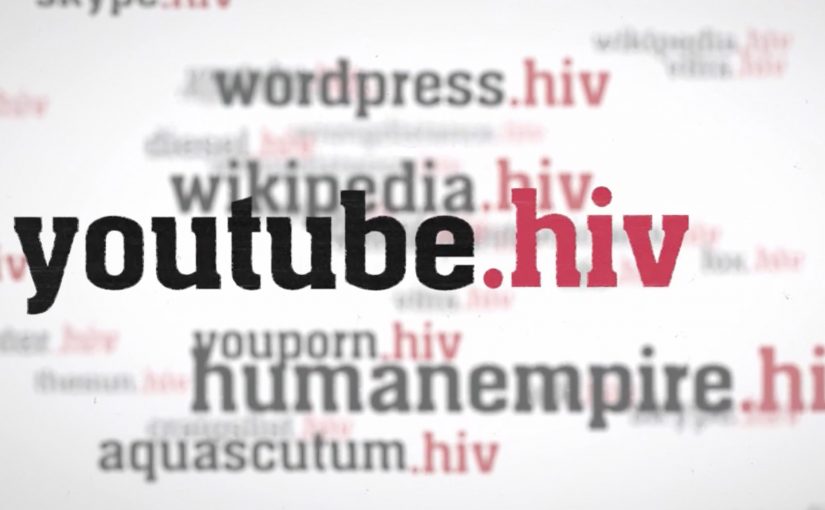
AIDS continued to be a deadly diagnosis, so nonprofit organization dotHIV and Hamburg-based agency KemperTrautmann launched a Facebook-led campaign with a specific ambition. Establish a new top-level domain, .hiv, alongside endings such as .com or .org.

The proposed mechanism is straightforward. Any website could soon have a .hiv version. The content stays the same, but using the .hiv version is framed as “doing some good”. Every visit would trigger a small donation to dotHIV, or the website owner would pay a monthly rate for using the .hiv ending, with proceeds routed toward the cause.

Why the domain idea is the message

This works because it turns a familiar object, the URL, into a symbol. A domain ending is tiny, but it is also persistent. It appears everywhere the link appears, and it travels without needing a new explanation each time. The “digital red ribbon” effect is built into the mechanics, not added on top. Here, “digital red ribbon” means a visible, repeatable sign of support that appears wherever the link appears. That matters because persistent, low-effort visibility lowers the cognitive cost of participation and helps the cause travel with the behavior.

Extractable takeaway: If you want scale for a social cause, design participation so it sits inside a behavior people already repeat daily, and make the proof of participation visible every time the behavior happens.

In global cause-led digital initiatives, the scalable advantage comes from attaching support to a habit people already repeat without thinking.

What the campaign is really trying to unlock

The real question is whether the cause can become part of a daily digital behavior instead of remaining a separate appeal.

The visible pitch is fundraising. The deeper play is normalization. If .hiv becomes a usable, recognizable address ending, it makes the cause present in everyday digital life, which can reduce stigma through repetition and visibility rather than messaging alone.

The more strategic value here is normalization, not just fundraising.

What cause-led marketers can borrow

  • Attach impact to habit. Make the “good” happen when people do something they already do.
  • Make participation visible. A marker people can see and share helps the idea spread without extra media.
  • Keep the mechanism explainable in one sentence. If it needs a diagram, adoption collapses.
  • Design for opt-in trust. Cause mechanics live or die on clarity about where money flows and why.

A few fast answers before you act

What is the .hiv idea in one line?

A proposed top-level domain intended to turn everyday browsing into support for HIV and AIDS work by routing fees or visit-linked donations through dotHIV.

How is it supposed to work for normal websites?

A site could have a .hiv version that mirrors the existing content, while usage or registration is framed as generating funds for dotHIV.

Why use a domain ending instead of a normal donation page?

Because a domain ending is persistent and repeatable. It can travel with links and become a visible marker of participation everywhere it appears.

What makes this idea credible or not credible to audiences?

Transparency about governance, pricing, and where proceeds go. The mechanism needs to be as clear as the promise.

What is the biggest risk with “donation-by-browsing” concepts?

If the value exchange is unclear, or the impact feels too small or too opaque, people disengage or suspect cause-washing.