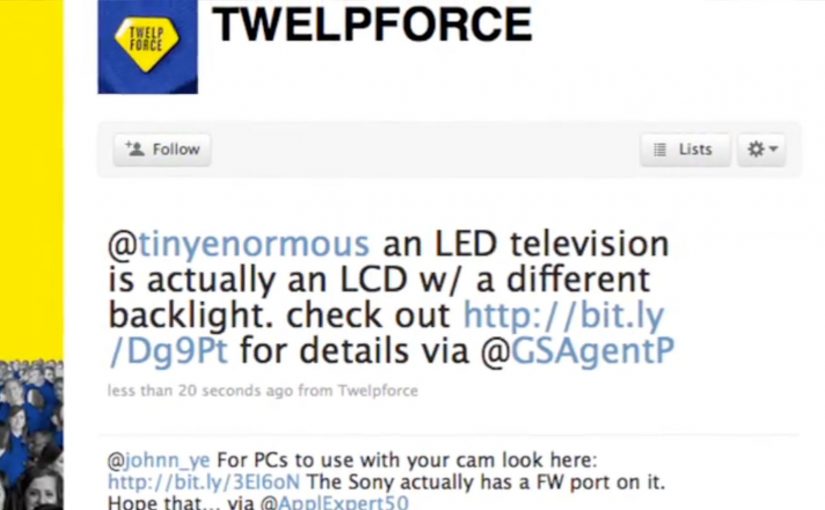
Here is a truly new-age way of addressing customer needs in real time by harnessing Twitter. Instead of pushing promotions, Best Buy puts help in the timeline and lets customers pull value when they actually need it.
A help desk that lives in public
Twelpforce is built on a simple premise. Twelpforce is Best Buy’s Twitter-based customer support program, built to connect customer questions with employees who can answer them. The people who know the answers are already inside the company. Put them on Twitter, let them respond directly, and make the answers visible to everyone else with the same question.
It turns customer service into a living knowledge base. Every reply is both a resolution for one person and reassurance for the next hundred who are watching.
How Twelpforce works
The mechanic is straightforward:
- Customer asks a question on Twitter.
- Trained employees respond in real time from within their area of expertise.
- The conversation stays public, so answers become searchable and shareable.
- Trust compounds, because the brand is seen helping, not just selling.
In consumer electronics retail, service is often the fastest signal of trust and competence.
The real question is whether public, real-time help can build more trust than another stream of promotional posts.
Why it lands: help is a stronger hook than hype
Most brand communication tries to create desire. Twelpforce starts with a different human truth. When something breaks or confuses you, you want a competent person, quickly. The campaign meets that moment and makes the brand useful on demand. This is a stronger brand move than another promotional burst, because visible help makes expertise tangible at the exact moment of need.
Extractable takeaway: If your category creates frequent questions, treat support as a scalable content engine. Public answers reduce repeat effort, improve perceived expertise, and create credibility that paid media struggles to buy.
That publicness is the multiplier because one useful answer reduces uncertainty for the asker and for everyone else who sees it. A private call solves one case. A public answer signals, repeatedly, that the brand shows up when it matters.
Recognition that follows the idea
The campaign is credited to Crispin Porter + Bogusky for Best Buy. It goes on to win a Gold Clio Award in Interactive, under the “Innovative Use of Technology” category.
What to steal for your own social support play
- Design for repeat questions: build templates and escalation paths so answers stay fast without becoming robotic.
- Make expertise discoverable: route topics to specialists, not a generic handle that slows everything down.
- Write for the invisible audience: every reply should help the original asker and anyone who finds it later.
- Set clear guardrails: define what can be solved publicly and what must move to private channels.
- Measure more than volume: track time-to-first-response, resolution rate, sentiment shift, and deflection of repeat issues.
A few fast answers before you act
What is Twelpforce in one sentence?
It is a Twitter-based customer help program where employees answer questions publicly in real time, turning support into a visible brand asset.
Why does public support change the marketing equation?
Because every answered question doubles as proof. People trust what they see a brand do for others, especially when the moment is unscripted and timely.
What makes this “interactive” rather than just social posting?
The customer initiates the experience with a question, and the brand responds in a two-way exchange that creates a usable outcome, not just awareness.
What is the biggest operational risk?
Inconsistency. If response times, tone, or accuracy vary widely, the same public visibility that builds trust can also expose gaps.
How do you know if a program like this is working?
Look for faster response times, high resolution rates, fewer repeated questions, improved sentiment, and a growing perception that the brand is genuinely helpful.