
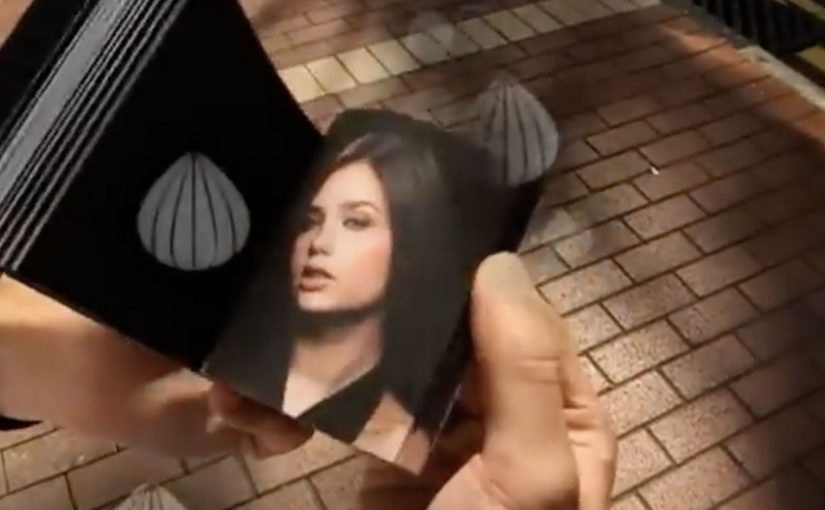
Listerine: Flipbook With Bad Breath

Bad breath is one of the most embarrassing issues for people when they socialize. Listerine decided to bring this experience to life with a flipbook that released a pungent onion scent.

To induce trials, a coupon was attached to the back of the flipbook and people could redeem it for a free Listerine bottle at nearby locations. Reported redemption rates reached 66%.

How the flipbook makes “bad breath” real

The mechanism is sensory contrast. By sensory contrast, the idea uses an unpleasant smell to make the problem felt before presenting relief. The flipbook invites curiosity, then the onion scent turns the message into a physical reaction rather than a line of copy. The coupon sits at the exact moment of discomfort, offering a clean, immediate next step.

In personal care and FMCG trial programs, multi-sensory sampling can convert awareness into action by making the problem visceral and the solution frictionless.

Why it lands

This works because it skips explanation and goes straight to feeling. The real question is whether the brand can make an invisible hygiene problem feel urgent without needing a long explanation. People do not need to be persuaded that bad breath is awkward. The scent creates instant empathy, and the coupon makes the brand’s role clear. This works because the unpleasant smell collapses the distance between message and felt need, so the offer lands exactly when the problem feels most real. It is not just “remember Listerine”. It is “fix this now”.

Extractable takeaway: If you can make an invisible problem tangible in seconds, you earn attention. When the solution is placed immediately at the point of reaction, trial becomes the natural next move.

What to steal from this trial mechanic

  • Use one sensory punch: pick a single sense and make the idea unmistakable, not subtle.
  • Place the offer at peak relevance: the call to action should appear exactly when the user feels the problem.
  • Keep the conversion step simple: a clear redemption path beats a complex signup flow.
  • Design for public reaction: when people react visibly, the activation creates its own distribution.
  • Measure beyond reach: redemption and repeat behavior are the real KPIs, not just views.

A few fast answers before you act

What is the Listerine “flipbook with bad breath” activation?

It is a flipbook handout infused with an onion scent to simulate bad breath, paired with a coupon for a free bottle to drive trial.

Why add scent instead of just showing a message?

Scent turns an abstract problem into an immediate, physical experience. That speed is what makes the idea memorable and shareable.

What role does the coupon play?

It converts the reaction into a next step. The coupon makes the solution actionable at the exact moment people feel the discomfort.

Is the 66% redemption figure reliable?

It is reported in trade coverage. If you need it as a hard metric, keep it but treat it as reported unless you have the primary source.

Where does this pattern work best?

When the product solves a problem people already recognize, and when you can make the problem instantly tangible without crossing into humiliation or offense.

American Express “Twitter Sync”

You sync your American Express card to Twitter, retweet an offer with a specific hashtag, and the reward loads to your card without printing a coupon. For example, tweeting #AmexWholeFoods loads a $20 statement credit that applies when you spend $75 or more at Whole Foods.

A statement credit is a credit applied to your card account after a qualifying purchase.

The foundation. Couponless offers via Facebook

In July last year, American Express launched a first of its kind application on Facebook called “Link, Like, Love” that allowed card members to link their cards to the app and receive deals based on the likes, interests and social connections of the card members and their Facebook friends.

Members who used this service did not have to print coupons to redeem at a store. Instead, they loaded deals onto their AmEx account by hitting an online button in the app, and the reward was given when they swiped the card at the time of purchase.

The latest move. Sync your card with Twitter

Now, in its latest social venture, American Express allows card members to sync their cards with their Twitter account at sync.americanexpress.com/twitter. After the sync, card members follow @AmericanExpress and re-tweet its special offers that come with exclusive hashtags. The re-tweet loads the card with a couponless reward.

In US consumer retail programs, card-linked offers live or die on how little friction sits between discovery, activation, and redemption.

The real question is whether you can make offer activation feel like normal feed behavior while keeping redemption invisible at checkout.

Why this lands. Activation becomes a social reflex

The mechanism is the point. The retweet is the activation event, and the statement credit is the reward. That matters because activation moves into a habit people already perform in the feed, while redemption stays automatic at swipe. This is a strong pattern when you want offers to be used without asking people to print, clip, or remember anything.

Extractable takeaway: If redemption happens at the point of payment, your biggest lever is activation friction. Make activation feel like ordinary behavior, not like work.

The constraint. Availability by market

The Facebook and Twitter sync work only for US card holders.

What to copy. Couponless offer mechanics

  • Trigger in the moment of attention: Use a lightweight action people already do in the channel as the activation step.
  • Redeem where trust is highest: Deliver the benefit at purchase via the existing payment instrument, not via a separate coupon ritual.
  • Make the rule explicit: Tie every offer to one clear condition and one clear reward so it is easy to repeat and explain.

A few fast answers before you act

What is American Express Twitter Sync?

A program that lets card members sync an AmEx card to Twitter and load couponless offers by retweeting hashtagged deals.

What does a retweet actually do?

It activates an offer and loads the reward to the synced card, so redemption happens automatically when the card is used.

What is a concrete example of an offer?

Tweeting #AmexWholeFoods loads a $20 statement credit that applies when a purchase of $75 or more at Whole Foods is made.

What do you need to do after syncing?

Follow @AmericanExpress and retweet its special offers that include the required hashtag.

Who can use it?

It is positioned for US card holders.

Opticana Eyewear’s $500 Campaign

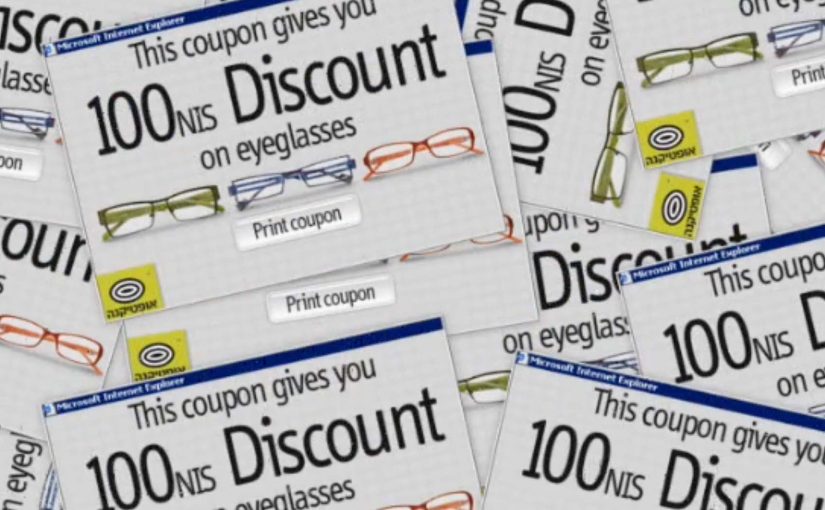
You see an online coupon that reads “100 NIS Discount on eyeglasses” with a single call-to-action. “Print coupon”. It is simple, direct, and designed to convert immediately.

The campaign in one line

Here is a $500 campaign done by Mccann Erickson Israel for Opticana Eyewear.

The real question is whether a plain offer with almost no production spend can still move people from browser to store.

This is a strong example of low-budget marketing because it spends almost nothing on explanation and everything on conversion clarity.

The business intent is straightforward: drive measurable store traffic and coupon redemption without wasting spend on awareness theatre.

Why the “print coupon” mechanic works

The offer is obvious, the action is frictionless, and the value is tangible. By “print coupon” mechanic, the ad uses a digital message to create a physical redemption trigger people can carry into the store.

That works because the printed coupon turns vague interest into a concrete next step and gives the store a simple way to connect attention to redemption.

In retail categories where the final decision still happens in store, digital work gets stronger when it creates a clear handoff into the physical purchase moment.

Why this lands when budgets are tight

When budget is constrained, clarity becomes the creative advantage. A single strong offer, a single next step, and a design that makes the benefit impossible to miss can outperform “bigger” ideas that ask too much of the audience.

Extractable takeaway: If you cannot outspend the category, remove friction so completely that the offer itself becomes the creative.

What to borrow for offer-led retail work

  • Lead with the benefit. Show the value before anything else.
  • Reduce the path to action. One next step is often stronger than multiple choices.
  • Design for redemption. Make it easy for people to carry intent from screen to store.

A few fast answers before you act

What is the core idea of this $500 Opticana campaign?

A printable discount coupon that is easy to understand and easy to act on.

Why does a printable coupon still matter in retail?

It bridges online intent to offline purchase. It gives the customer a reason to visit, and it gives the store a clear redemption trigger.

What makes a low-budget campaign feel smart instead of cheap?

One clear promise, one clear action, and a design that prioritises the benefit over decoration.

What should you measure on an offer like this?

Prints, redemptions, and incremental sales during the offer window. If possible, track coupon code usage to separate organic uplift from campaign-driven traffic.

What kind of brands suit this approach best?

Brands with a clear retail offer and a store-based purchase moment. It works best when the value exchange is immediate and easy to redeem.