
When a Second Brain Becomes an Operating Model

A few weeks ago, I asked ChatGPT a question that required it to read my Second Brain. A Second Brain is a structured personal knowledge system designed to preserve and retrieve useful context. The system answered confidently. The reasoning was coherent. The answer was wrong.

The system had relied on an older cached copy instead of retrieving the current canonical source from Google Drive. By canonical source, I mean the designated current record that should control the answer. This was not a spectacular hallucination. It was a source-selection failure. Intelligent reasoning on the wrong truth is still wrong.

That small failure exposed a much larger enterprise problem. As AI moves from answering questions to maintaining knowledge and taking action, the challenge shifts from finding information to governing what the system may treat as true, what it may change, and when it must stop. I would like to take a moment to explain why that shift matters and where an organization should begin.

The experiment: give AI persistent context

I started building my Second Brain in March 2026. The early work was deliberately unglamorous. I maintained the system meticulously by hand in Obsidian, using separate subject areas, clear file names, consistent conventions, and disciplined decisions about which source was current. I was not trying to build an autonomous agent. I was building a knowledge foundation that I could trust and that would make me AI agnostic.

By late June, I read that ChatGPT could retrieve and reason over that material through Google Drive. So after my summer break, in August, I deliberately enabled controlled read and write access rather than giving the system unrestricted authority. Within roughly a week, the experiment moved toward governed autonomous operation. Tasks such as identifying missing files, flagging duplicate or conflicting versions, updating indexes and maps of content, drafting summaries, and preparing proposed changes for review could proceed without step-by-step prompting, while write access, approval, and human oversight remained explicit.

The foundations took months. Once those foundations existed, the jump from knowledge retrieval to governed autonomous operation happened extraordinarily quickly.

That acceleration is what makes Dan Martell’s video useful. He shows a personal AI system built around persistent files for people, projects, decisions, preferences, and lessons. Meeting transcripts feed the system. A scheduled task can identify missing files, consolidate duplicates, update maps of content, and flag strategic items. The attraction is not simply better note-taking. It is context that an AI can maintain and use.

His demonstration is a helpful picture of the destination, not evidence that the enterprise problem is solved. A personal system has one principal owner and a comparatively small permission boundary. An enterprise has contested facts, inherited access, regulatory duties, multiple systems of record, and decisions whose consequences spread across teams and customers.

The mechanism: memory becomes operational

I use enterprise operating memory here as shorthand for the shift. An enterprise operating memory is a governed capability that turns selected organizational knowledge into source-traceable context for people and AI agents, while controlling who can retrieve it and when it may be updated or used to act.

Organizational memory has been studied for decades, and current AI-enabled platforms already combine enterprise search, permission-aware retrieval, knowledge graphs, citations, agent memory, and actions. What those components do not solve on their own is the operating model that decides which source controls, how conflicts are handled, and who is accountable for reviewing, approving, reversing, and learning from a harmful change.

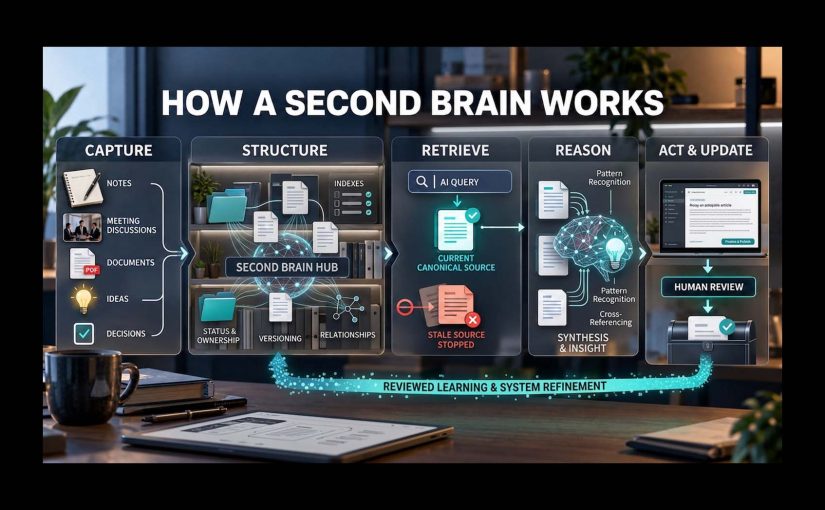
At its simplest, the mechanism is a loop. The system retrieves relevant material, reasons across it, drafts a conclusion or action, and, if authorized, writes the result back or acts in another system. Because the system can write its interpretation back into the knowledge layer, one source-selection error can become persistent and influence later decisions.

For a consumer-experience organization, the same mechanism could connect brand standards, product data, consent rules, campaign decisions and performance history.

Suppose the system retrieves an older consent rule that is no longer current while preparing a global website update. In read-only mode, the error creates a flawed summary. With write access, it could spread the rule to a campaign brief, delivery backlog, or customer-facing configuration. A source-status check should reject the outdated version. A staged comparison should show the proposed change, and the privacy owner should approve or stop it. The same system that saves time can also magnify weak source controls.

That creates more leverage than enterprise search. Search finds what exists. A knowledge graph connects it. Agent memory preserves context. Operating memory governs what is current, why it is authoritative, what it replaces, and under what bounded authority AI may change it.

Here, executable knowledge does not mean literal code. It means knowledge has become an operational input capable of shaping a decision or triggering an action.

The failure: retrieval is not truth

My stale-file incident was minor and reversible. Its value was diagnostic. The system had access to relevant material, but relevance was not enough. It needed a rule that required the current canonical source for that task and a safe response that flagged the uncertainty and stopped rather than guessing when it could not determine which source was authoritative.

The incident changed how I work. I now treat source selection as a control decision, not an invisible retrieval step, and I require the current canonical source before giving high-impact answers. In my Second Brain, I use YAML properties, structured metadata at the top of each file, to record status, owner, version, effective date, review date, canonical-source designation, and links to earlier or replaced versions. If those properties are missing, the file’s date and time may help identify the likely latest version, but recency does not prove authority. For high-impact tasks, unclear source status should trigger a stop, not a guess. This is the practical pattern I trust most: turn failure modes into governance controls.

Source citations and access permissions help, but neither proves that an answer is correct. A citation shows where a statement came from, not whether that source was approved, current, or controlling. Permission-aware retrieval shows that a person can access something, not that the material is appropriate for every purpose.

The real question is not whether AI can read organizational knowledge, but whether it can be trusted to maintain and act on it.

My stance is simple: organizations should treat AI-maintained knowledge as a controlled operational asset, not as a smarter search box.

The value: remove the coordination tax

Coordination tax is the time people lose finding owners, rebuilding context, reconciling versions, and repeating decisions.

The business case is not that expertise becomes unnecessary. It is that expertise no longer has to be the bottleneck for reconstructing context.

Imagine a specialist is absent during a critical decision. An authorized colleague could ask for the current state, the decisions already made, the rationale behind them, open issues, safe next actions, and matters that still require approval. The system could assemble that context from governed sources, while the specialist or accountable owner remains responsible for judgment.

Or consider a manager preparing a decision across product, analytics, privacy, brand, localization, and marketing technology. Today, the manager may spend days finding the right people, reconciling versions, and rebuilding the history. An operating-memory layer could draft the status, expose contradictions, identify dependencies, and prepare the decision narrative. The relevant specialists would still validate the consequential parts.

In August 2026, Google submitted the winning $10 million bid for a Spirit Airlines data package containing roughly 100 million emails and 500 million Microsoft Teams messages, alongside source code and extensive operational and financial records. The proposed transfer was subject to court approval and de-identification, and the price covered the complete package, not the messages alone. Even so, the bid signals that the decisions, workflows, and institutional context buried inside enterprise systems are becoming valuable inputs for AI. For a living company, the greater opportunity is not to sell that memory, but to govern and reuse it for its own benefit.

That is where the potential productivity gain sits: less context reconstruction, fewer repeated explanations, and faster handoffs. It is a reduction in coordination tax, not a promise to remove people.

AI helps the organization reuse what it already knows. People create what it needs to know next.

The countercase: scale magnifies weak controls

The strongest objection is also the reason to act carefully. A successful personal Second Brain does not transfer its safety to an enterprise. It transfers the organization’s stale documents, overshared folders, conflicting policies, ambiguous ownership, and missing decision history into a probabilistic system with tool access.

Permission-aware retrieval can reproduce bad permissions. A current index can faithfully retrieve a document that was never authoritative. A cited answer can still apply the wrong policy version. An approval prompt can become a rubber stamp. A write can create a circular knowledge loop in which AI stores a conclusion and later cites that conclusion as independent evidence.

Unwritten expertise creates another limit. Not everything important has been captured, and not every exception can be inferred from documents. The system represents selected organizational knowledge; it does not contain everything the organization knows.

This does not argue for keeping AI read-only forever. It argues for earning autonomy one action type at a time. Reading is different from drafting. Drafting is different from staging a visible change. Staging is different from publishing, deleting, or triggering a customer-facing action.

The controls: make authority explicit

The practical design is federated. Federated means domain and team spaces can remain close to the people who understand them while shared rules govern how knowledge becomes authoritative and how AI may use it. The alternative is either hundreds of disconnected personal brains or one unrestricted corporate brain.

Six controls matter first:

  1. Truth: Name the canonical source, accountable owner, status, effective date, review date, and superseded version.
  2. Access: Enforce identity, authorization, sensitivity, and legitimate need at retrieval time. Seniority alone is not a permission model.
  3. Authority: Separate permission to read, draft, stage, write, publish, delete, and act. Let downstream systems enforce authorization.
  4. Provenance: Preserve the exact source versions, model and tool context, policy checks, approvals, output, and resulting action for material changes.
  5. Verification: Test whether the source is current and controlling, expose unresolved conflicts, and require the system to abstain when evidence is insufficient.
  6. Escalation: Assign a human owner with the competence, time, authority, and ability to stop or reverse the action.

Put those controls into practice with one team and one bounded, reversible workflow, such as producing a weekly cross-market website status brief. Before starting, record the current cycle time, coordination effort, unresolved source conflicts, and rework caused by stale information. First, let AI retrieve and cite named canonical sources. Then let it draft the brief and stage proposed updates to a decision log for an accountable owner to approve. Measure canonical-source selection, correction rates, and time saved against the baseline. Only after agreed thresholds are met should low-risk maintenance run autonomously. Publishing, deletion, and customer-facing changes should remain approval-gated and reversible.

When AI moves from retrieving information to changing organizational state, governance rules must be enforced at the moment the system retrieves, writes, or acts.

The starting point: govern truth before action

The purpose of the pilot is not merely to prove that AI can retrieve and draft. It is to prove that the organization can identify authoritative sources, measure improvement against a baseline, expose uncertainty, assign approval, and reverse a bad change before scaling. Once those foundations hold, the harder question becomes: what happens when organizational knowledge becomes executable, not merely searchable?

The practical takeaway is this: start by governing truth before granting autonomy. In one bounded, reversible workflow, identify the canonical sources, assign accountable owners, define freshness and access rules, and measure how often the system selects the correct source. Then separate read, draft, stage, write, publish, delete, and action authority; require human approval for consequential changes; preserve provenance; and make every material change reversible. Only expand autonomous permissions when the pilot shows that the system reliably selects authoritative sources, exposes uncertainty, reduces coordination effort, and can be stopped or corrected when it fails.


A few fast answers before you act

What is an enterprise operating memory?

An enterprise operating memory is a governed, federated capability that makes selected organizational knowledge available as permission-aware, source-traceable context for people and AI agents, with explicit controls over updates and actions.

Is it just enterprise search or retrieval-augmented generation (RAG)?

No. Search and retrieval-augmented generation can find and synthesize relevant content. An operating-memory model also governs source authority, lifecycle, write permissions, verification, escalation, and the consequences of changing organizational knowledge.

Does it replace specialists?

No. It can reduce the time specialists and colleagues spend reconstructing context, but specialists remain essential for creating new knowledge, interpreting exceptions, and validating consequential decisions.

What should organizations govern first?

Organizations should first define canonical sources, accountable owners, source status, freshness rules, access boundaries, and the conditions under which the system must expose a conflict or abstain.

Where should an enterprise pilot start?

Start with one team and one bounded, reversible workflow inside the shared governance model. Record the current cycle time, coordination effort, source conflicts, and rework before the pilot begins. Progress from retrieval to drafting and staged changes with named approval. Add low-risk autonomous maintenance only when agreed accuracy and control thresholds are met. Scale only when the measured gains persist and the governance model continues to hold.

What is the biggest failure mode?

The biggest failure mode is authoritative-looking action based on knowledge that is relevant but stale, incomplete, noncanonical, or inappropriate for the user’s purpose. Good reasoning cannot rescue the wrong source of truth.

From AI Tool List to Working AI Tech Stack

From “pick 20 tools” to “run a working stack”

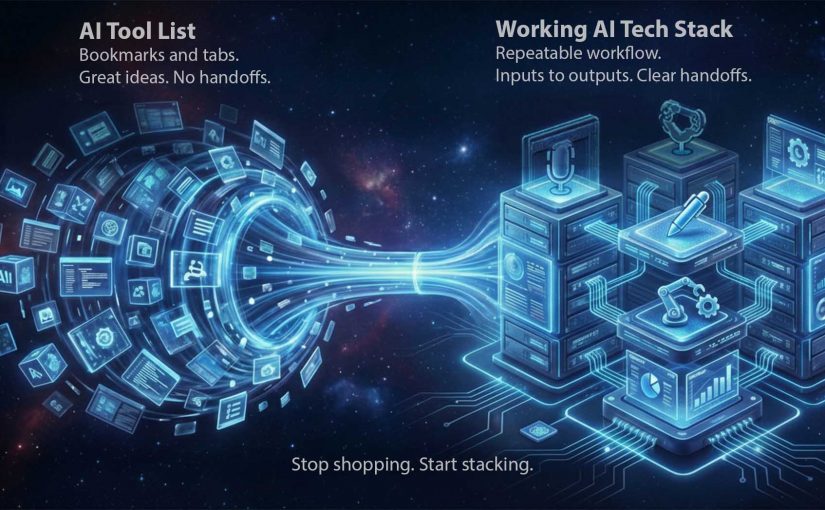
I recently came across the below video from Dan Martell which frames “zero-code million-dollar business” as a tool-selection problem. That framing is useful. However the right conclusion for marketers and brands watching is not “go pick 20 tools”. The right conclusion is “stop shopping. Start stacking”. In 2026, you should start focusing more on the ability to pick, connect, and operationalize capabilities.

By “working AI tech stack” I mean a small, repeatable set of tools that moves work from input to output with the least friction. It is not a folder of bookmarks. It is a production line.

The useful takeaway isn’t the list. It’s the operating model.

Most people consume AI content and walk away with a shopping list. That is the wrong takeaway. The useful takeaway is operational. Arrange capabilities into a workflow that consistently produces outputs. Briefs, assets, approvals, launches, responses, and measurable improvements.

A list creates options. A stack creates throughput. Throughput is how reliably your team converts intent into shipped work, week after week, without rebuilding the process every time.

The mechanism: a stack is just clean handoffs

A working AI tech stack is a sequence with explicit handoffs:

Inputs → Synthesis → Creation → Automation → Distribution → Measurement

Each step has one job. Each step produces an artifact someone else can use. Each handoff is defined so the work does not stall in Slack, email, or “waiting for approval”.

In global FMCG and retail marketing organizations, the bottleneck is rarely ideas but the handoffs between people, tools, and approvals.

Why this lands with leaders

Tool lists feel like progress because they are concrete and low-commitment. You can bookmark them and feel “covered”. Stacks feel harder because they force decisions: what is the workflow, who owns each step, where do we enforce quality and risk controls.

Extractable takeaway: If you cannot name the exact step a tool owns in a repeatable workflow (input → transformation → handoff → output), it is not part of your stack yet. It is just potential.

The business intent: less software. More shipped outcomes

For marketers and brands, the goal is not “using AI”. The goal is operational leverage:

The real question is not how many AI tools you can name, but whether your team can move work through a repeatable line with clear ownership and handoffs.

  • Faster cycle time from brief to asset.
  • Fewer revision loops because synthesis and constraints are done upfront.
  • Fewer dropped balls because handoffs are automated.
  • More reuse of institutional knowledge because answers are captured once and searchable.
  • Higher output without lowering standards.

This is also where governance belongs. A stack needs rules about what data can go where, who can approve what, and which steps require a human decision.

In enterprise teams, that also means deciding how the stack connects to existing systems of record such as CMS, DAM, CRM, analytics, and approval workflows, instead of creating a parallel shadow process.

The working stack blueprint: tools mapped from Inputs to Measurement

Below are the 20 tools referenced in the video, placed where they most naturally fit in the production line. You can use fewer than 20. The point is the flow.

The hard part is rarely access to another model. It is integration, ownership, QA thresholds, and escalation logic across the workflow.

Inputs: capture raw material without losing signal

Manus

Manus is designed to act more like a task runner than a chatbot. You give it a goal and it works through steps to deliver outputs, not just advice. Example: collect competitor screenshots, extract claims, summarize patterns, and deliver a brief plus a slide outline.

SocialSweep

SocialSweep is positioned as a way to search your network and relationship graph with context. It helps you identify who you know, why they are relevant, and what to say. Example: find warm paths to retail media decision-makers, then draft an intro message that references shared context.

HireAlli

HireAlli is positioned around capturing commercial intent from website traffic so teams can follow up faster. Example: flag repeat visits to pricing pages, then route the lead to sales with a summary of pages viewed and a recommended next message.

Synthesis: turn messy inputs into a usable brief and plan

NotebookLM

NotebookLM is useful when you want answers grounded in the sources you provide. It helps you summarize, compare, and extract structure from documents. Example: upload research PDFs and prior campaign docs, then generate a launch FAQ and a messaging hierarchy that stays consistent with those materials.

Claude

Claude is a general assistant that excels at drafting, rewriting, and structuring thinking. Use it to turn raw notes into clear decisions and action plans. Example: paste a workshop transcript and request a decision log, assumptions, risks, and a one-page brief for stakeholders.

ChatGPT

ChatGPT is a general-purpose assistant for ideation, drafting, analysis, and reusable workflows. It is especially useful when you iterate toward a spec. Example: ask clarifying questions for a campaign brief, then output a structured creative and media spec the team can execute.

Creation: produce assets that are actually shippable

Gamma

Gamma helps turn rough thinking into a structured deck or document quickly. It is strong when the bottleneck is narrative structure, not visual polish. Example: paste the brief, generate a 10-slide storyline, then refine the argument and flow before design.

Descript

Descript lets you edit audio and video through text. You edit the transcript like a document and the media follows. Example: clean up a leadership video by removing filler words, tightening sections, and exporting both a long version and short clips.

ElevenLabs

ElevenLabs generates natural-sounding speech from text and supports scalable voice workflows. It is useful for narration, localization, and voiceovers. Example: create a consistent “brand voice” narration for product explainers, then generate localized voiceovers without re-recording.

Lovable

Lovable is positioned as an AI-assisted way to build apps or web experiences without traditional engineering. Think prototypes, internal tools, and simple customer experiences. Example: describe an internal campaign intake tool, generate a prototype, then iterate requirements until it is usable.

Automation: make the handoffs run without nagging humans

Make

Make connects apps into workflows using triggers and actions. It is the plumbing that turns “good tools” into “a working line”. Example: when a brief is approved, create tasks, notify stakeholders, generate a first draft, and route it to review automatically.

ChatAid

ChatAid is positioned as an AI support layer that can answer recurring questions and route issues. It fits both internal enablement and customer-facing support when designed with escalation rules. Example: answer “where is the latest asset” or “what is the policy”, and escalate to a human when confidence is low.

Distribution: move outputs into channels that drive outcomes

Revio

Revio is positioned around managing inbound conversations across social channels in one place. It helps teams respond consistently and not miss high-intent messages. Example: unify DMs so customer questions and sales inquiries do not get lost across platforms.

YourAtlas

YourAtlas is positioned around AI agents that can handle inbound qualification and booking. This matters in service businesses and lead-driven funnels. Example: handle inbound calls or requests 24/7, capture required details, then hand off qualified appointments to humans.

Membership.io

Membership.io supports structured memberships and gated content experiences. It is a distribution layer for expertise and ongoing value, not just content hosting. Example: package a learning path for partners or teams, with searchable resources and a community layer to reduce repeated questions.

BuddyPro

BuddyPro is positioned around turning your content and methods into an always-on assistant people can query. It is a distribution mechanism for expertise at scale. Example: clients query your “playbook assistant” for next steps between calls, and you control what it can and cannot answer.

Measurement: close the loop so the stack improves every cycle

Hiro Finance

Hiro Finance is positioned around cash-flow visibility and planning. It helps decision-makers see financial reality without spreadsheet archaeology. Example: run a weekly check on runway, recurring costs, and upcoming risk points before you scale spend.

HelloFrank

HelloFrank is positioned around deeper business-context finance insights. It can help detect spend anomalies and surface what changed month-over-month. Example: find subscription creep and cost spikes, then turn it into a prioritized cleanup plan.

Revaly

Revaly is positioned around payment performance and reducing failed transactions that create involuntary churn. It matters most where recurring revenue is sensitive to declines. Example: identify where legitimate payments fail and improve recovery rates without harming customer trust.

Precision

Precision is positioned around turning KPIs into a practical operating rhythm. It helps teams focus attention on what moved and what to do next. Example: generate a weekly performance brief. These metrics shifted, here are likely drivers, here is what we should test or fix this week.

What a marketing operations leader should implement first

  • Start with one workflow you ship weekly. Assign a named owner and baseline cycle time, rework, and approval latency before you expand the stack.
  • Assign ownership per step. Tools without owners become clutter.
  • Build the handoffs before you add more tools. Automation is what turns tools into a line.
  • Define where humans must decide. Brand-sensitive, compliance-sensitive, and customer-sensitive steps need a review point.
  • Run a monthly keep-or-kill review. If a tool is not improving cycle time or quality, remove it.

A few fast answers before you act

What is the single biggest mistake teams make with AI tools right now?

They treat AI as a chat window to copy and paste from, instead of an execution layer connected to a workflow that ships outputs.

What is a “working AI tech stack” in one sentence?

A working AI tech stack is a small set of connected tools that reliably turns inputs like notes and briefs into shippable outputs, with minimal friction and clear handoffs.

How do I decide if a tool belongs in my stack?

If you cannot name the exact step it owns and the handoff it triggers, it is not part of the stack yet.

What should a marketing leader implement first?

One throughput line, end to end. Inputs → Synthesis → Creation → Automation → Distribution → Measurement. Then automate handoffs before adding new tools.

How do I avoid tool sprawl?

Set constraints: one tool per job, a clear owner, and a monthly keep-or-kill review tied to measured outcomes.

AI Trends 2026: 9 Shifts Changing Work & Home

AI will impact everything in 2026, from your fridge to your finances. The interesting part is not “more AI features”. It is AI becoming an execution layer that can decide and act across systems, not just advise inside a chat box. That shift matters because once AI can execute, throughput and experience depend less on prompts and more on integration, permissions, and policy.

The nine trends below are a useful provocation. I outline each shift, then add the operator lens: what is realistically visible in the market this year, and what still needs a breakthrough proof point before it goes mainstream.

The 9 trends, plus what you can realistically expect to see this year

Trend 1: AI will buy from AI

We move from “people shopping with AI help” to agents transacting with other agents, purchasing that is initiated, negotiated, confirmed, and tracked with minimal human intervention. This shows up first inside high-integration ecosystems. Enterprise procurement, marketplaces, and platforms with clean APIs, strong identity controls, and policy layers. Mass adoption needs serious integration across catalogs, pricing, budgets, approvals, payments, and compliance, so this needs high-profile integration before it becomes mainstream behavior.

Trend 2: Everything gets smart

Not just more connected devices, but environments that sense context, adapt, and coordinate, from home energy to health to kitchen routines. You will start seeing this more clearly, but it requires consumers to spend money to upgrade. The early phase looks like pockets of “smart” inside one ecosystem because upgrade cycles are slow and households hate complexity. It will be visible this year, but it is gated by consumer investment.

Trend 3: Everyone will have an AI assistant

The tangible version is not a chatbot you consult. It is a persistent layer that can take actions across your tools: triage inbox, draft and send, schedule, summarize, file, create tasks, pull data, and nudge you when a decision is needed. This year, the realistic signals are assistants embedded in software people already live in, email, calendar, docs, messaging, CRM. In enterprise terms, the shift matters when assistants move from chat surfaces into governed actions across CRM, service, commerce, and content workflows. You will see “do it for me” actions that work reliably inside one suite. You will not yet see one universal assistant that flawlessly operates across every app and identity boundary, because permissions and integration are still the hard limit.

Trend 4: No more waiting on hold

AI takes first contact, resolves routine requests, and escalates when needed. This is one of the clearest near-term value cases because it hits cost, speed, and experience. Expect fast adoption because the workflows are structured and the economics are obvious. The difference between “good” and “painful” will be escalation design and continuous quality loops. Otherwise you just replace “waiting on hold” with “arguing with a bot”. The hard part is not model quality alone. It is orchestration across knowledge sources, case history, identity, entitlements, handoff rules, and QA.

Trend 5: AI agents running entire departments

Agents coordinate end-to-end processes across functions, with humans supervising outcomes rather than executing every task. Mainstream is still a few years out. First we need a high-profile proof of concept that survives audit, risk, and operational messiness. This year, the credible signal is narrower agent deployments: specific workflows, explicit boundaries, measurable KPIs. By “agentic workflows” I mean systems that can plan a sequence of steps and take tool actions, within explicit boundaries, to complete a task. “Entire departments” comes later, once governance and integration maturity catch up.

Trend 6: Household AI robots

Robots handle basic household tasks. The near-term reality is that cost and reliability keep this premium and limited for now. This year you may see early adopters, pilots, and narrow-function home robots and services. Mainstream needs prices to fall significantly, plus safety, support, and maintenance models to mature. This is expensive investment until it gets cheaper.

Trend 7: AI robots will drive your car

This spans autonomous driving and even robots physically operating existing cars. The bottleneck is public safety, liability, and regulation. Mainstream is still some years away largely due to government frameworks and insurance constraints. The earlier signals show up in controlled environments, private roads, campuses, warehouses, and geofenced routes where risk can be bounded.

Trend 8: AI-powered delivery

Automation expands across delivery chains, from warehouse robotics to last-mile drones and ground robots. Adoption will be uneven. You will see faster rollout where regulation is lighter or clearer, and in constrained zones like campuses and planned communities. More regulated markets will follow slowly, which means this trend will look “real” in some countries earlier than others.

Trend 9: Knowing AI = career advantage

AI literacy becomes an operating advantage when teams can turn model use into repeatable workflows with governance, accountability, and measurable impact. Prompting is table stakes. The advantage compounds when you can move from using AI to integrating it into repeatable workflows with governance and measurable impact. The speed of that shift, from “use” to “integrate”, determines how quickly this advantage becomes visible at scale.

The real question is whether you are treating AI as a feature add-on, or as an execution layer with integration, explicit permissions, and measurement.

If you want durable advantage in 2026, build the integration and guardrails first, then scale the “do it for me” moments.

In enterprise and consumer ecosystems, the practical winners are the organizations that treat AI as an execution layer with integration, governance, and measurement built in.

2026 is a signal year, not an endpoint

Do not treat these nine trends as predictions you must “believe”. Treat them as signals that AI is moving from assistance into action.

Extractable takeaway: When AI starts taking action, advantage shifts to teams that can connect systems, grant permissions safely, and prove outcomes with measurement.

Some shifts will show up quickly because the economics are clean and the workflows are structured. Others need a breakthrough proof point, cheaper hardware, or regulatory clarity. Commercial value will appear first in a narrow set of high-volume workflows where integration, compliance, and measurement can be proven early. The leaders who pull ahead this year will be the ones who build integration, guardrails, and measurement early, so when the wave accelerates, they are scaling from a foundation, not improvising in a panic.

What to operationalize from these 2026 shifts

  • Pick a few workflows, not “AI everywhere”. Start with bounded tasks where inputs, approvals, and outputs are clear.
  • Make permissions and escalation explicit. Define what the assistant can do, when it must ask, and how humans take over cleanly.
  • Invest in integration and data hygiene. Catalogs, identity, policies, and reliable APIs are what make “do it for me” work.
  • Measure the delta. Track cycle time, resolution quality, and error handling so automation improves instead of drifting.

A few fast answers before you act

What are the biggest AI trends to watch in 2026?

The nine shifts to watch are agent-to-agent buying, smarter consumer tech, mainstream AI assistants, AI-first customer service, narrower agent deployments in business functions, household robots, autonomous driving progress, AI-powered delivery, and AI literacy becoming a career differentiator.

Which AI trends will show visible adoption this year?

Customer service automation (no more waiting on hold) will scale fastest because the workflows are structured and the economics are clear. You will also see clearer signals in “smart everything” and AI assistants, mainly inside closed ecosystems and major software suites.

What will slow down “AI buying from AI”?

Integration and policy. Autonomous purchasing needs clean product data, pricing, payments, approvals, identity, and compliance across multiple systems. Expect early signals in high-integration marketplaces and enterprise procurement before mass adoption.

Are “AI agents running entire departments” realistic in 2026?

You will see more narrow, high-impact agentic workflows. Department-level autonomy is likely still a few years out because it needs high-profile proof points that survive audit, risk, and real operational complexity.

When will robots in homes and cars become mainstream?

Not yet. The early phase is expensive and limited. Mainstream adoption depends on price drops, reliability, safety standards, and support models, plus regulation, liability, and insurance frameworks that make autonomy feel dependable at scale.

Why does AI literacy become a career advantage in 2026?

Because advantage compounds when people move from using AI to integrating it into repeatable workflows with governance and measurable impact. Prompting helps. Integration changes throughput and business outcomes.