
The Kentucky Flying Object

KFC India turns a chicken box into a build-it-yourself tech toy. Select boxes for the newly announced Smoky Grilled Wings include the “Kentucky Flying Object,” also called “KFO,” a mini-drone you assemble yourself.

The limited-edition boxes are available in ten selected cities from January 25 to January 26.

If you receive one of the special boxes, you get your wings plus a fully functioning mini-drone, along with assembly instructions online at kfodrone.com.

The real question is whether your packaging can deliver a moment people want to prove, not just a message they can scan.

Why this is packaging-led “tech savvy” marketing

KFC is not adding a QR code or a one-off AR filter. It is putting the message inside the product experience. The packaging becomes the headline. The consumer gets something physical, surprising, and demonstrably “tech,” in the moment of consumption. Because the surprise is physical and immediate, it turns the claim into something people can demonstrate.

Extractable takeaway: “Tech savvy” marketing lands when the proof is inside the product experience, not bolted on as a scan, filter, or claim.

In quick-service restaurant marketing, packaging is often the only owned touchpoint guaranteed to be present at the moment of consumption.

This play is smart only if the object is safe, usable, and instantly explainable without a support ticket.

The behaviour it encourages

This is a meal that extends beyond eating.

  • Assemble.
  • Show someone.
  • Fly it.
  • Share the proof.

The drone is not just a giveaway. It is a social object that creates repeatable conversations, both offline and online. By “social object,” I mean a thing people naturally show, talk about, and pass around.

What to watch if you replicate this play

A high-novelty object inside a food pack raises immediate execution questions.

  • Safety and compliance. Especially around batteries, rotors, and usage guidance.
  • Availability clarity. Limited editions can frustrate if expectations are unclear.
  • Post-purchase support. Instructions, spare parts, and handling issues.

Make the pack the proof

  • Build the behaviour into the pack. If it cannot be assembled and shown in minutes, it will not travel.
  • Design for proof, not impressions. Give people something they can demonstrate, not just describe.
  • Pre-empt the three frictions. Safety guidance, availability clarity, and post-purchase support decide whether the stunt backfires.

A few fast answers before you act

What is the “Kentucky Flying Object”?

A limited-edition KFC India box concept where select Smoky Grilled Wings boxes include a DIY mini-drone.

When and where is it available?

In ten selected cities from January 25 to January 26.

What is the core marketing idea?

Turn packaging into the primary experience, then let the object create shareable proof that travels beyond the store.

Why is this stronger than adding a QR code or AR filter?

Because the “tech” proof is physical and immediate. It is experienced in-hand during consumption, then demonstrated, not just scanned or claimed.

What are the execution risks that decide whether it backfires?

Safety and compliance, availability clarity, and post-purchase support. If any of those fail, novelty turns into frustration.
Tooth Fairy: Pneumatic Transport

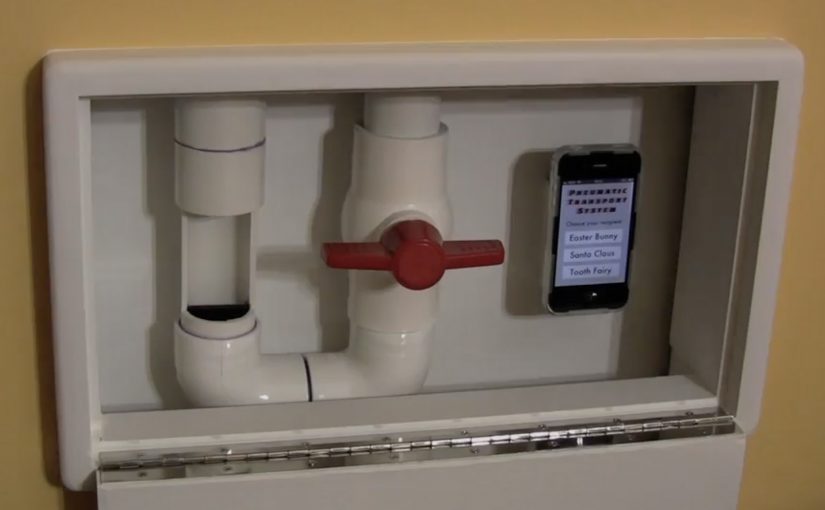
A child loses a tooth, drops it into a capsule, and sends it away through a pneumatic tube. A moment later, a second capsule arrives back with the Tooth Fairy’s payment.

Jeff Highsmith, a father of two, decided to re-write the Tooth Fairy routine with a pneumatic transport system built into his house. He set it up with 1.5" PVC pipes, a central vacuum in the attic, and two endpoint stations, one in each child’s room. When a tooth came out, it went into a small plastic bottle that travelled through the system, while a parent loaded money into another bottle at the other station and sent it back.

A ritual redesigned as a “send and return” loop

The mechanism is a closed-loop exchange. Tooth goes in. Capsule moves. Payment comes back. This matters because visible movement turns an invisible promise into something kids can witness, which makes the ritual feel more credible. The stations make the experience legible and ceremonial, while the vacuum-driven transport makes it feel like the Tooth Fairy is “on the other end” even though the system stays entirely within the home.

In maker households, the quickest way to modernize a family ritual is to turn it into a tangible, repeatable system that feels magical to kids and practical for parents.

Why it lands as modern folklore

This works because it preserves the core emotion of the Tooth Fairy. Anticipation, mystery, reward. Here, “modern folklore” means a familiar family story made credible through a repeatable household ritual. The real question is not how to digitize the Tooth Fairy, but how to make the ritual feel more believable without making it feel less magical. This is a smarter update than adding more screens or complexity, because the physical loop strengthens the illusion while simplifying the parent job. The build also lets the story scale across siblings, since each child has their own station and repeatable moment.

Extractable takeaway: If you want to update a tradition without losing its charm, keep the same emotional arc, then redesign only the delivery mechanism so the magic feels more believable, not more complicated.

More details about the pneumatic system and the Python code for the mobile web interface can be found here.

What to steal for playful “systems thinking” at home

  • Make the interface physical. A station or ritual object matters more than hidden automation.
  • Design for repeatability. If it can run the same way every time, kids trust it and look forward to it.
  • Separate mystery from maintenance. Keep the “magic side” visible and the parent side easy to operate.
  • Document the build. A clear write-up turns a one-off family project into something others can replicate.

A few fast answers before you act

What is the core idea of the pneumatic Tooth Fairy system?

A home pneumatic tube loop that lets kids send teeth in a capsule and receive the Tooth Fairy’s payment back through a return capsule.

What materials and layout does the build use?

1.5" PVC pipes, a central vacuum in the attic, and endpoint stations in each child’s room, with small bottles used as capsules.

Why is this better than the traditional “money under the pillow” routine?

It keeps the same reward moment but makes the exchange visible and immediate, while reducing the need for parents to sneak around at night.

What makes the experience feel magical rather than mechanical?

The station ritual and the movement of the capsule. The child can see the “sending” happen, which reinforces the story.

Who should build something like this?

Anyone comfortable with a basic DIY project involving PVC piping and a vacuum-driven transport loop, and who wants to create a repeatable family ritual.

Carlsberg: Probably the Best Ad in the World

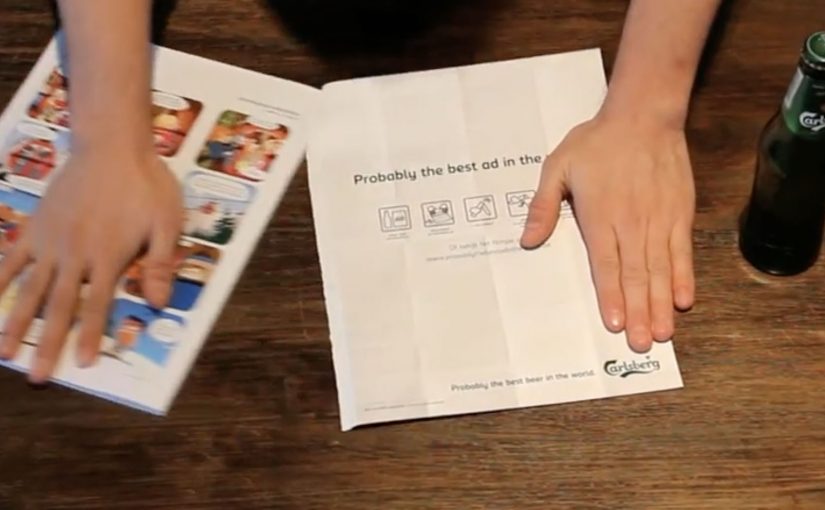
You can debate the effectiveness of magazine advertising all day long, but this Carlsberg ad from Belgian agency Duval Guillaume is undeniably useful. The advertisement reportedly appeared in Men’s magazine Menzo. Follow its instructions and you can use the flimsy piece of paper to open a bottle of Carlsberg.

How the idea is built

The mechanic is the message: the page is not just media. It is a tool. The ad teaches you how to tear and fold it into a working opener, which turns “try the product” into a physical action inside the magazine.

In print-led FMCG marketing, the fastest way to earn attention is to make the medium do something the viewer can immediately test.

The real question is whether your medium can deliver proof, not promises.

Why it lands

It turns a claim into proof. There is no argument to win and no feature list to remember. You either open the bottle, or you do not.

Extractable takeaway: Interactive print works when the action is the demonstration. Here, “interactive print” means the paper itself triggers a physical action, not just reading or looking. If the audience can do the product benefit with their hands in under a minute, the ad becomes memorable because it turns attention into a small personal “win”.

It forces participation. The reader cannot stay passive. The ad only completes itself when someone follows the instructions.

It earns a second look. Utility creates curiosity. People keep it, show it, and try it, which is the opposite of how most print gets treated.

Try it out yourself by downloading the advertisement from: www.probablythebestadintheworld.be.

But does it make this “probably the best ad in the world”? Not if you consider the likely inspiration below. The video shows someone using a piece of paper to open a bottle of Carlsberg.

Steal this: make the page a tool

  • Make the medium carry the benefit. If the product is about a moment. Build an execution that creates that moment.
  • Keep the instruction set frictionless. Fewer steps. Clear folds. Obvious success condition.
  • Design for sharing in the real world. The best print innovations get passed around physically before they get shared digitally.

A few fast answers before you act

What makes this print ad “interactive”?

It is not just read. It is folded into a functional bottle opener, so the reader completes the ad by doing something.

Why is a bottle-opener mechanic effective for beer?

It links the ad directly to the consumption moment. The ad becomes part of opening the product, not just talking about it.

Does utility automatically make a print ad effective?

It improves attention and memorability, but effectiveness still depends on distribution and whether people actually try it.

What is the biggest risk with “useful” print ideas?

If the build is fiddly or fails, the novelty collapses. The interaction must work reliably with minimal effort.

What is the most transferable lesson for advertisers?

When possible, replace messaging with demonstration. If the audience can experience the benefit through a simple action, persuasion gets easier.