
Supreme Security: Job Offer in Luggage Scanner

Supreme Security is an international company offering security services ranging from personal security to dog squad assignments, as well as access and baggage checks. To deliver that, it continually needs specially trained personnel, but only a small pool of specialists fits this narrow job profile in Switzerland, and many of them work in border patrol or airport police.

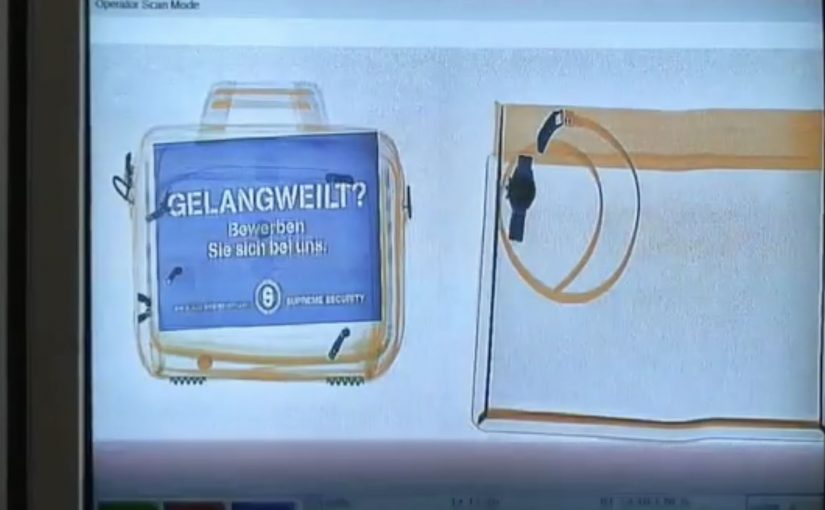
So the company equips its own employees with machined metal bars and sends them on business trips with those bars packed in their hand luggage. When the bags go through security, the X-ray image reveals a clear recruitment message to the people operating the scanner.

The X-ray reveal: a job ad delivered inside the checkpoint

The execution is almost stubbornly physical. No QR codes. No landing pages in the moment. Just a piece of metal engineered so its silhouette becomes readable text on a baggage scanner screen.

That design choice matters because it matches the audience’s reality. These candidates spend their day looking at X-ray images. The campaign puts the job offer exactly where their attention already lives.

In specialist recruitment markets, placing your job offer inside the candidate’s daily workflow can outperform broad awareness media.

Why it lands: it respects expertise and filters for it

This is not a mass recruitment message pretending to be clever. It is a targeted signal aimed at a professional who will immediately understand what they are seeing, and why it was made for them. The real question is whether your recruitment message shows up inside the exact workflow that signals real fit. This is smart recruitment because the medium itself does part of the qualification work.

Extractable takeaway: The fastest way to reach scarce talent is to design a “high-signal artifact”, meaning a message carrier whose form already screens for relevance, so only the right audience will notice and appreciate it. If the medium itself acts like a competency filter, you get fewer leads, but better ones.

The low-budget constraint is part of the story too. The campaign is described as being produced for under 5,000 Swiss francs and as recruiting eight highly qualified employees in two months. That makes the idea feel replicable, not reserved for brands with giant hiring spends.

What to steal for your next hard-to-hire role

  • Recruit inside the work context: deliver the message where the target audience already concentrates.
  • Make the medium do the targeting: if only the right people “get it”, you reduce noise.
  • Keep the message legible in one glance: no one at work wants to decode your campaign.
  • Design for retellability: the story should travel as “did you see this” even without a link.
  • Use constraints as credibility: low-production realism can read as confidence, not lack of polish.

A few fast answers before you act

What is the core idea here?

A job offer is embedded into a metal object so it becomes readable when scanned by an airport X-ray system, reaching security professionals while they work.

Why is this better than a normal recruitment ad for this audience?

Because it targets scarce specialists in their professional environment and feels like an insider message rather than generic hiring noise.

What makes it “experience-based”?

The candidate does not just see a message. They experience the reveal in a real workflow moment, which makes it memorable and easy to retell.

What’s the biggest risk if you copy this approach?

Operational and reputational risk. If the artifact disrupts operations, causes safety concerns, or feels deceptive, the idea backfires. The execution must be safe, respectful, and clearly non-threatening.

How do you measure success beyond hires?

Track qualified inbound leads, interview-to-offer ratio, time-to-hire for the target profile, and earned mentions within the professional community you are trying to reach.
Yellow Pages: Hidden Pizza Restaurant

Yellow Pages has broken away from its traditional testimonial style in its Hidden Pizza Restaurant campaign. Created by Clemenger Proximity Melbourne, the campaign is part of Yellow Pages’ annual work designed to show potential advertisers how effective advertising in the Yellow Pages can be.

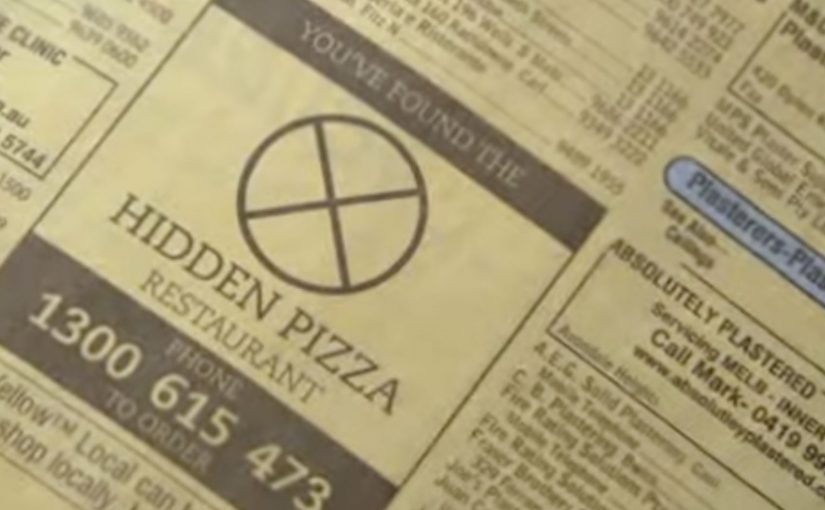
The idea is as direct as it is bold. Build a hidden pizza restaurant, then do not give customers its contact details. Instead, ask people to look for it the way they would any other business. While the restaurant is open, Clemenger Proximity is busy filming a series of TV ads, supported by print, radio and online executions.

A live proof stunt, not a promise

The mechanism is the message. The restaurant is real, the demand is real, and discovery is intentionally constrained. Reported coverage describes an initial tease via simple local seeding, then a single official path to the contact details. Find the listing in Yellow Pages, call, and receive the location.

In Australian small-business advertising, proof-based stunts like this can reframe a directory from “legacy media” into measurable demand generation.

Why the hunt sticks

It sticks because it converts a boring claim. “we help people find you”. into a public challenge with a reward. The lack of signage and the “go find it” instruction turns search behavior into entertainment, and the filming layer turns real customer effort into reusable evidence for advertisers.

Extractable takeaway: If your product is a utility people take for granted, create a short-lived live test where the only route to success runs through your product. Then document the outcome as proof, not persuasion.

What Yellow Pages is really selling

This is a credibility reset. In practice, that means replacing a weak category claim with a live, public proof that advertisers can understand in seconds.

The real question is whether Yellow Pages can still prove it creates demand when the business itself gives people almost nothing to work with.

The campaign is aimed at advertisers who doubt the channel. By engineering the toughest possible conditions. a business with hidden contact details. Yellow Pages turns its core value into a dramatic, easily explained case. Reported results from award and trade write-ups cite thousands of people successfully finding the restaurant, with a majority doing so through Yellow Pages.

What to steal from Hidden Pizza Restaurant

  • Design a test with an unfair constraint. The constraint is what makes the proof meaningful.
  • Make the behavior the headline. “People found it anyway” is the story.
  • Film real participation. Authentic effort beats polished testimonial scripts.
  • Keep the rule explainable. “Look for it like any other business” is instantly repeatable.
  • Let one channel own the solve. If discovery is the claim, discovery must be the mechanic.

A few fast answers before you act

What is the Hidden Pizza Restaurant campaign?

A Yellow Pages campaign that created a real hidden pizza restaurant and challenged people to find it using Yellow Pages, then documented the results through an integrated rollout.

Why hide the contact details?

To create a clean test of discoverability. If people can still find the business, the directory’s value becomes visible and provable.

What makes this more convincing than testimonial ads?

It replaces opinions with behavior. People either find it or they do not. The footage shows the finding happening.

What is the biggest risk in a stunt like this?

Leakage. If the address spreads through uncontrolled channels, the test loses clarity and the proof becomes disputable.

How can a smaller brand apply the same logic?

Create a short, controlled challenge where your product is the only legitimate path to the reward, then publish the documented outcome as evidence.

Skoda Yeti: Park Assist in Your Pocket

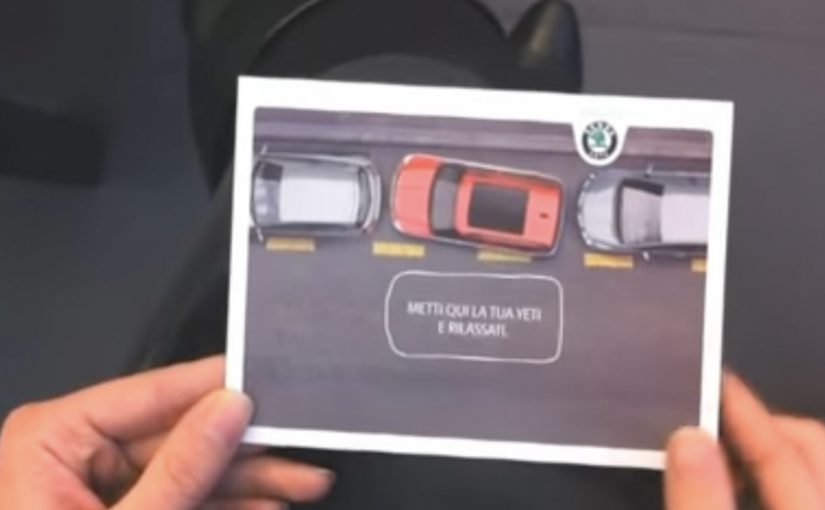
The new Skoda Yeti comes with Park Assist, a driver-assistance feature designed to help the vehicle steer into a parking space. Cayenne Milan came up with a simple idea to show the benefit in a way you can understand instantly. A card that demonstrates “parking without the driver.” The card in the video is described as being distributed at the Bologna Motor Show.

A postcard that explains the feature in seconds

The brilliance is that it does not try to teach the technology. It teaches the outcome. You interact with a physical object and immediately get the promise: the car can handle the parking maneuver for you.

In European auto shows and showroom marketing, tactile direct marketing often outperforms brochures because it delivers the feature benefit in the hand, not as a paragraph of explanation.

The real question is whether your feature can be understood through a one-step interaction before anyone explains it.

A strong feature demo does two jobs at once. It reduces cognitive load to one obvious takeaway, and it gives the audience a story they can retell without technical vocabulary. Outcome-first demos should be the default when the audience has seconds, not minutes.

Why this lands at an auto show

Auto shows are crowded with claims. Faster. safer. smarter. Most of them blur together. A direct mail object creates a private moment in the middle of a public environment, and that moment makes the feature memorable.

Extractable takeaway: If your feature benefit cannot be demonstrated as a simple interaction that survives a noisy environment, it will get flattened into “just another claim.”

  • It is self-explanatory. No staff pitch required.
  • It is portable. The idea travels with the visitor after they leave the booth.
  • It is repeatable. People can show it to someone else and replay the explanation.

And here is the video showing how the Skoda Yeti can actually park itself

The second film shifts from metaphor to proof. It shows the Park Assist function as a real maneuver, reinforcing that the postcard is not just a clever visual. It is pointing at a real capability.

Outcome-first moves for feature launches

  • Demo the outcome, not the mechanism. People buy benefits. Engineers buy systems.
  • Use a physical prop to earn attention. Something you can hold cuts through show-floor noise.
  • Pair metaphor with proof. One piece that makes it simple, one piece that makes it believable.
  • Design for pass-along. If visitors can show it to friends, your booth message keeps working off-site.

A few fast answers before you act

What is Park Assist in this context?

A driver-assistance feature designed to help the vehicle steer into a parking space, reducing the manual effort and stress of parking.

Why use a postcard instead of a normal leaflet?

Because interaction teaches faster than reading. A simple physical demo makes the benefit obvious in seconds.

Why include a second video after the postcard film?

The postcard creates understanding. The feature demonstration creates belief. Together they cover both comprehension and credibility.

What kind of features benefit most from this approach?

Features with a clear, visible outcome. Parking. safety assists. convenience automation. Anything a person can recognize immediately when shown.

What is the biggest risk with “clever prop” marketing?

If the prop is memorable but the feature link is weak, people remember the gimmick and forget the product. The prop must map cleanly to the benefit.