
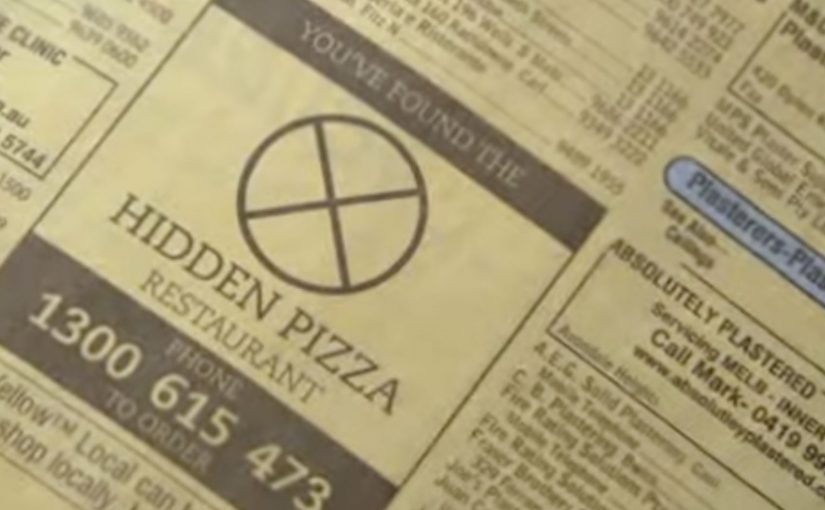
Yellow Pages: Hidden Pizza Restaurant

Yellow Pages: Hidden Pizza Restaurant

Yellow Pages has broken away from its traditional testimonial style in its Hidden Pizza Restaurant campaign. Created by Clemenger Proximity Melbourne, the campaign is part of Yellow Pages’ annual work designed to show potential advertisers how effective advertising in the Yellow Pages can be.

The idea is as direct as it is bold. Build a hidden pizza restaurant, then do not give customers its contact details. Instead, ask people to look for it the way they would any other business. While the restaurant is open, Clemenger Proximity is busy filming a series of TV ads, supported by print, radio and online executions.

A live proof stunt, not a promise

The mechanism is the message. The restaurant is real, the demand is real, and discovery is intentionally constrained. Reported coverage describes an initial tease via simple local seeding, then a single official path to the contact details. Find the listing in Yellow Pages, call, and receive the location.

In Australian small-business advertising, proof-based stunts like this can reframe a directory from “legacy media” into measurable demand generation.

Why the hunt sticks

It sticks because it converts a boring claim. “we help people find you”. into a public challenge with a reward. The lack of signage and the “go find it” instruction turns search behavior into entertainment, and the filming layer turns real customer effort into reusable evidence for advertisers.

Extractable takeaway: If your product is a utility people take for granted, create a short-lived live test where the only route to success runs through your product. Then document the outcome as proof, not persuasion.

What Yellow Pages is really selling

This is a credibility reset. In practice, that means replacing a weak category claim with a live, public proof that advertisers can understand in seconds.

The real question is whether Yellow Pages can still prove it creates demand when the business itself gives people almost nothing to work with.

The campaign is aimed at advertisers who doubt the channel. By engineering the toughest possible conditions. a business with hidden contact details. Yellow Pages turns its core value into a dramatic, easily explained case. Reported results from award and trade write-ups cite thousands of people successfully finding the restaurant, with a majority doing so through Yellow Pages.

What to steal from Hidden Pizza Restaurant

  • Design a test with an unfair constraint. The constraint is what makes the proof meaningful.
  • Make the behavior the headline. “People found it anyway” is the story.
  • Film real participation. Authentic effort beats polished testimonial scripts.
  • Keep the rule explainable. “Look for it like any other business” is instantly repeatable.
  • Let one channel own the solve. If discovery is the claim, discovery must be the mechanic.

A few fast answers before you act

What is the Hidden Pizza Restaurant campaign?

A Yellow Pages campaign that created a real hidden pizza restaurant and challenged people to find it using Yellow Pages, then documented the results through an integrated rollout.

Why hide the contact details?

To create a clean test of discoverability. If people can still find the business, the directory’s value becomes visible and provable.

What makes this more convincing than testimonial ads?

It replaces opinions with behavior. People either find it or they do not. The footage shows the finding happening.

What is the biggest risk in a stunt like this?

Leakage. If the address spreads through uncontrolled channels, the test loses clarity and the proof becomes disputable.

How can a smaller brand apply the same logic?

Create a short, controlled challenge where your product is the only legitimate path to the reward, then publish the documented outcome as evidence.

Yellow Pages: Yellow Chocolate

Yellow Pages: Yellow Chocolate

A phone directory brand sells a real chocolate bar, and the public lines up to buy it. That is the core twist behind Yellow Pages New Zealand’s “Yellow Chocolate”.

When a “job to be done” becomes a product on a shelf

The premise is simple and weird enough to travel. A regular New Zealander, Josh Winger, is tasked with creating, marketing, and distributing a chocolate bar that “tastes like the colour yellow”, using only businesses he can source via Yellow Pages across print, online, and mobile.

Here, a “job to be done” means the practical outcome people need help achieving, not the channel they use to achieve it.

The campaign is described as starting with a call for entries and then turning Josh’s progress into episodic content that pulls people into the build, not just the reveal.

How it works as an integrated proof, not a stunt

The mechanism is a live product demonstration disguised as entertainment. The brand does not claim usefulness. It forces a public, time-boxed build where every dependency is a Yellow Pages lookup, and the finished output is a retail product that carries the proof story with it.

That works because a public build turns a vague claim of usefulness into a visible chain of evidence people can watch, judge, and later buy.

At Cannes Lions 2010, the work is listed as winning a Gold Lion in Media, a Silver Lion in Titanium and Integrated, and a Bronze Lion in Cyber.

In mature categories where a brand needs to prove relevance to a search-first audience, turning the proof into something people can buy and share compresses “brand promise” into observable behavior.

Why “taste like yellow” sticks

An abstract brief invites participation. People argue about what “yellow” should taste like, contribute ideas, and then follow the build to see whose intuition survives contact with manufacturing, packaging, distribution, and retail reality.

Extractable takeaway: If your product is a utility people underestimate, stage a public build where your tool is the only allowed method. Then ship a tangible artifact that carries the proof narrative into everyday life.

What Yellow Pages is really buying

This is repositioning by demonstration. The chocolate bar is a carrier for a bigger reset: Yellow Pages is not an “old book your parents used”. It is framed as a modern system that can still help anyone get a job done, end to end, under real constraints.

The real question is whether a legacy utility can make usefulness feel current again without leaning on nostalgia or category habit.

What the results are described as

Results are reported as unusually strong for something that is, technically, a piece of marketing communications. The bar sold for $2. Some supermarkets reportedly sold out on launch day, and some bars were later traded online for up to $320. The campaign is described as building an online audience of more than 80,000, including around 16,000 Facebook fans and about 800 Twitter followers.

What to steal for your next “prove it” campaign

  • Make the constraint the headline. “Only use businesses found via X” is clearer than any brand manifesto.
  • Design for contribution. Pick a problem the audience can argue about in public, then let them feed the build.
  • Ship an artifact. A real product, sample, tool, or output beats a landing page when you need belief, not awareness.
  • Carry the proof inside the thing. Packaging and POS that explain “how it was made” extends the story past the content moment.

A few fast answers before you act

What is the Yellow Pages “Yellow Chocolate” campaign?

It is an integrated campaign where Yellow Pages challenges a participant to create and launch a chocolate bar that “tastes like yellow” using only Yellow Pages listings to source everything needed. The finished bar becomes the proof artifact.

Why does a physical chocolate bar matter here?

Because it turns an abstract brand claim into observable reality. People can buy the output, and the story of how it was made becomes a portable demonstration of the directory’s usefulness.

Which Cannes Lions awards is it listed as winning?

Cannes Lions listings for 2010 show the work winning a Gold Lion in Media, a Silver Lion in Titanium and Integrated, and a Bronze Lion in Cyber.

What outcomes are reported?

Reported outcomes include rapid sell-outs in some supermarkets, bars traded online for high prices, and sizeable social followings. Some recall and usage-lift figures are also reported, but vary by secondary retellings.

What is the transferable principle?

When you need to change perception of a legacy utility, do not argue. Force a public build where your tool is the only allowed method, then ship the proof as a tangible artifact.

Yellow Pages: Location Based Banner

Yellow Pages: Location Based Banner

Here is the next generation of interactive web banners. Tel Aviv agency Shalmor Avnon Amichay/Y&R promoted the Yellow Pages augmented reality location-based app by creating a banner that does the same thing. Here “location-based” means it surfaces nearby businesses based on where you are.

The banner opens your webcam and lets you see the businesses around you. Wave your hand to switch between businesses. Click a business to jump straight to its Yellow Pages listing.

A banner that behaves like the product

The clever part is that this is not “interactive” for decoration. It is a working demo of the core value proposition. If the app helps you find what is near you, the banner proves that promise immediately, inside the placement, without asking you to imagine anything. Utility products should be advertised by demonstrating usefulness, not by describing features.

The mechanic: webcam as context, hand wave as UI

The flow is intentionally simple. Turn on the camera. Overlay nearby business options. Use a wave to move through results. Use a click to convert curiosity into action via the listing page.

In local discovery experiences, the strongest persuasion is a live, context-matched preview of usefulness rather than a feature claim.

Why it lands: it removes the “so what” gap

Most directory and local-search advertising dies in the space between promise and proof. The real question is whether your ad can turn a promise into proof without leaving the page. This banner collapses that gap, because it starts with your own context, then shows results, then lets you act. The interaction is the explanation.

Extractable takeaway: The fastest way to make a utility app feel essential is to let people experience the “aha” moment before they ever leave the page they are on.

What Yellow Pages is really trying to achieve

The business intent is to reposition Yellow Pages as modern, digital, and situationally useful, not just a legacy directory brand. The banner also creates a clear performance path. Engagement inside the unit, then click-out to a listing that can drive calls, visits, or follow-on app consideration.

Steal the demo-first local discovery pattern

  • Mirror the product in the ad. If the product is a tool, make the ad behave like the tool.
  • Use one gesture people understand. A wave as “next” is instantly legible. No tutorial needed.
  • Keep the ladder of commitment short. Preview. Browse. Click through. No extra steps.
  • Make the experience readable for bystanders. Obvious motion plus clear on-screen change sells the mechanic in shared environments.
  • Watch privacy optics. If you turn on a camera, be explicit that it is for interaction and context, not identification.

A few fast answers before you act

What is a “location based banner”?

It is a banner ad that adapts its content to the user’s situation, typically location or environment cues, so the ad can show relevant nearby options instead of generic messaging.

How does this Yellow Pages banner work?

It opens a webcam view, overlays nearby business options, lets you wave to cycle through businesses, and lets you click a result to open the corresponding Yellow Pages listing.

Why use a webcam at all?

Because it makes the experience feel immediate and personal. The ad becomes a live “finder” interface rather than a static claim about finding things.

What makes gesture-controlled banners risky?

Friction and variability. If the gesture detection fails or is unclear, users assume the ad is broken. The interaction must be forgiving and the feedback must be instant.

What is the safest way to replicate the idea today?

Keep the mechanic to one simple input, provide clear on-screen feedback, and ensure the user can still get value even if they do not enable the camera.