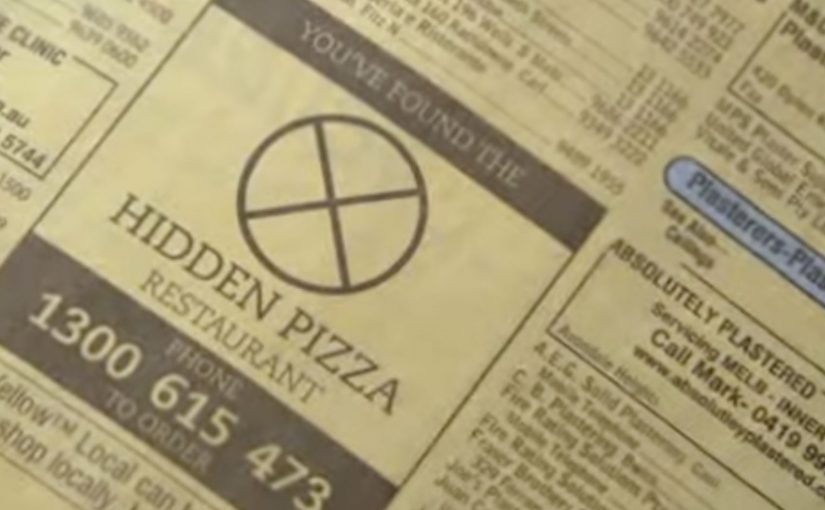
Yellow Pages has broken away from its traditional testimonial style in its Hidden Pizza Restaurant campaign. Created by Clemenger Proximity Melbourne, the campaign is part of Yellow Pages’ annual work designed to show potential advertisers how effective advertising in the Yellow Pages can be.
The idea is as direct as it is bold. Build a hidden pizza restaurant, then do not give customers its contact details. Instead, ask people to look for it the way they would any other business. While the restaurant is open, Clemenger Proximity is busy filming a series of TV ads, supported by print, radio and online executions.
A live proof stunt, not a promise
The mechanism is the message. The restaurant is real, the demand is real, and discovery is intentionally constrained. Reported coverage describes an initial tease via simple local seeding, then a single official path to the contact details. Find the listing in Yellow Pages, call, and receive the location.
In Australian small-business advertising, proof-based stunts like this can reframe a directory from “legacy media” into measurable demand generation.
Why the hunt sticks
It sticks because it converts a boring claim. “we help people find you”. into a public challenge with a reward. The lack of signage and the “go find it” instruction turns search behavior into entertainment, and the filming layer turns real customer effort into reusable evidence for advertisers.
Extractable takeaway: If your product is a utility people take for granted, create a short-lived live test where the only route to success runs through your product. Then document the outcome as proof, not persuasion.
What Yellow Pages is really selling
This is a credibility reset. In practice, that means replacing a weak category claim with a live, public proof that advertisers can understand in seconds.
The real question is whether Yellow Pages can still prove it creates demand when the business itself gives people almost nothing to work with.
The campaign is aimed at advertisers who doubt the channel. By engineering the toughest possible conditions. a business with hidden contact details. Yellow Pages turns its core value into a dramatic, easily explained case. Reported results from award and trade write-ups cite thousands of people successfully finding the restaurant, with a majority doing so through Yellow Pages.
What to steal from Hidden Pizza Restaurant
- Design a test with an unfair constraint. The constraint is what makes the proof meaningful.
- Make the behavior the headline. “People found it anyway” is the story.
- Film real participation. Authentic effort beats polished testimonial scripts.
- Keep the rule explainable. “Look for it like any other business” is instantly repeatable.
- Let one channel own the solve. If discovery is the claim, discovery must be the mechanic.
A few fast answers before you act
What is the Hidden Pizza Restaurant campaign?
A Yellow Pages campaign that created a real hidden pizza restaurant and challenged people to find it using Yellow Pages, then documented the results through an integrated rollout.
Why hide the contact details?
To create a clean test of discoverability. If people can still find the business, the directory’s value becomes visible and provable.
What makes this more convincing than testimonial ads?
It replaces opinions with behavior. People either find it or they do not. The footage shows the finding happening.
What is the biggest risk in a stunt like this?
Leakage. If the address spreads through uncontrolled channels, the test loses clarity and the proof becomes disputable.
How can a smaller brand apply the same logic?
Create a short, controlled challenge where your product is the only legitimate path to the reward, then publish the documented outcome as evidence.