
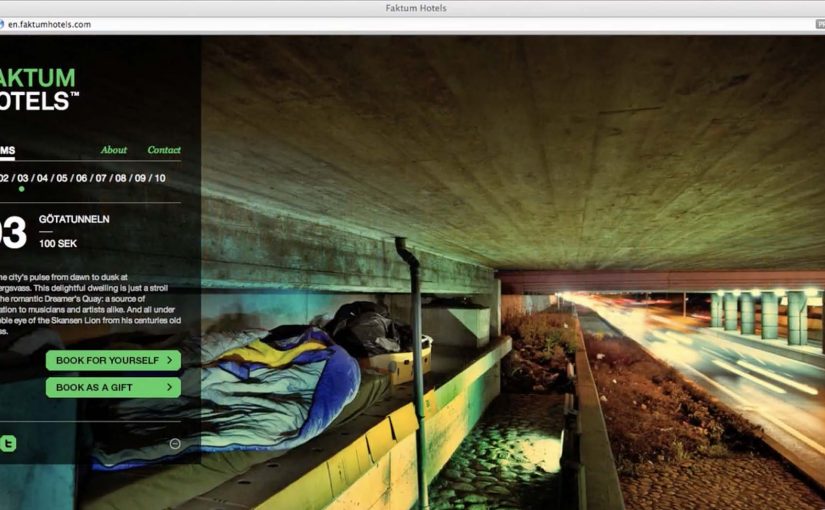
Faktum Hotels: Book a Night Outside

Gothenburg in Sweden is reported to have about 3,400 homeless people. Most find a roof over their heads with a friend or at a refuge, but some even sleep in the open air.

So in a charity campaign that tries to harness the spirit of giving and consideration, Forsman & Bodenfors chose ten places where people might spend the night and made it possible for any one of us to book them, just like any hotel. All the money raised through this www.faktumhotels.com project is then directed towards Faktum’s work for the homeless.

A hotel with no walls

The mechanism is brutally literal. Take locations that are normally ignored, photograph them like “rooms”, write the descriptions in the familiar language of travel booking, and put a price on the night. The booking flow becomes the donation flow, and the “inventory” is a list of public places that should not be inventory at all.

In European cities, social impact campaigns often struggle to turn sympathy into a concrete action that is simple, immediate, and shareable.

Why the idea hits so quickly

It works because it steals a format people trust. A hotel booking interface is a comfort ritual, full of predictable signals. Then it swaps the comfort for cold reality. That contrast creates instant moral clarity without a lecture, and it invites action without asking people to research charities or navigate guilt.

Extractable takeaway: When awareness is not the problem but inertia is, borrow a mainstream interface people already know, and map your desired behaviour onto it. Reduce the action to one familiar choice and one familiar transaction.

What the “booking” really means

Because these are public places, the booking is best understood as symbolic support, not a guaranteed reservation. In this case, symbolic support means paying to fund Faktum’s work, not claiming the place for personal use. The point is not to encourage tourism-by-hardship. The point is to make the hidden visible, and to route money to Faktum’s work through a frictionless, culturally legible mechanic.

The real question is how to turn a familiar commercial action into an ethical act of support without diluting the reality behind it.

This is not about selling the experience of homelessness. It is about converting recognition into support.

Proof, not a promise

The concept is also a craft statement. The photography and the deadpan hotel language do the persuasion work. The campaign received major industry recognition, including a Guldägg and a One Show Gold Pencil for its craft, which underlines how well the execution carries the idea.

What to steal from the booking mechanic

  • Hijack a trusted format. Use an interface or ritual your audience already understands, then subvert it with purpose.
  • Make the donation feel like a normal purchase. Familiar steps reduce hesitation and increase completion.
  • Let craft do the arguing. Straight photography and restrained copy can outperform emotive pleas when the concept is strong.
  • Design for sharing without adding share buttons. If the mechanic is surprising, people share it naturally.

A few fast answers before you act

What is Faktum Hotels?

It is a fundraising concept that presents outdoor sleeping locations as “hotel rooms” you can book online. The payment functions as a donation to support Faktum’s work related to homelessness.

Why use a hotel booking mechanic?

Because it is familiar and low-friction. The contrast between a comfortable interface and uncomfortable reality creates attention and makes the next step obvious.

Is the booking a real reservation?

No. The locations are public, so the booking is best treated as symbolic support rather than a guaranteed spot.

Who created the campaign?

It was created for Faktum with Forsman & Bodenfors credited as the agency behind the idea and execution.

What is the transferable lesson for other causes?

Turn support into a simple, recognisable transaction. Borrow a mainstream choice model, then route the payment directly into impact.
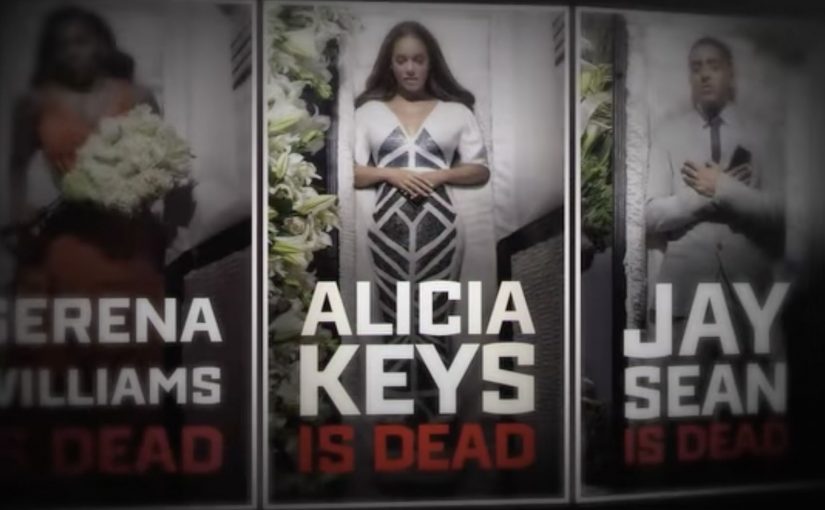
Keep a Child Alive: Digital Death

On December 1st, Hollywood died a digital death. Here, “digital death” means celebrities voluntarily going silent on social platforms until donations reach a public fundraising goal. The world’s top celebrity tweeters sacrificed their digital lives to give real life to millions of people affected by HIV/AIDS in Africa and India. Here are their full last tweets and testaments until $1,000,000 is raised to buy their lives back via www.buylife.org.

How “digital death” is made to feel real

The mechanism is brutally simple. Celebrities stop posting. Their accounts point fans toward a donation goal. The audience “buys back” each digital life by contributing toward the $1,000,000 target, with last messages and testament-style videos used as the emotional fuel for the ask.

In celebrity-led social media culture, attention is often treated like currency, and this campaign makes that trade explicit.

Why the stunt spreads

It is built on a clean tension. Fans want access. The cause needs money. Turning silence into a paywall is provocative enough to spark debate, and that debate becomes distribution.

Extractable takeaway: If you need a fundraising idea to travel fast, create a single, legible “lock and unlock” mechanic that people can explain in one sentence, then tie the unlock to a fixed, public goal.

What the campaign is really optimizing

The real question is whether borrowed celebrity attention can be converted into meaningful action for the cause before the stunt burns out.

This is not only about donations. It is about forcing a moment of self-awareness. If people can mobilize instantly for celebrity updates, can they mobilize the same way for lives impacted by HIV/AIDS. The smart part is not the silence itself, but the way it converts attention into a public, measurable ask.

Update: Celebrity Twitter Ban Campaign a Bust, Can’t Raise $1 Million; Stars Freak Out

On December 07, 2010, the New York Post reported that the campaign was struggling to reach the $1 million target at the expected pace, and that a wealthy supporter contributed $500,000 to help move the total forward so participating celebrities could resume posting.

What to steal from this mechanic

  • Make the action loop explainable in one sentence. “Donate to unlock them” is instantly repeatable.
  • Use a fixed, public target. It makes progress visible and easier for others to join.
  • Turn participation into an artifact. “Last tweets” and “testaments” give supporters something to share that carries the ask.
  • Design for pacing, not just launch. If the goal is ambitious, plan how the middle period stays energized when novelty fades.
  • Keep the cause visually present. The celebrity hook gets attention, but the beneficiary story must stay foregrounded.
  • Anticipate backlash and write the guardrails. Scarcity mechanics can feel manipulative. Be explicit about why the constraint exists and where the money goes.

A few fast answers before you act

What was “Digital Death”?

A fundraising stunt where celebrities stopped posting on social platforms, directing fans to donate toward a $1,000,000 goal to “buy back” their digital lives.

Why use “last tweets and testaments”?

It heightens the emotional stakes, and gives fans a final message to react to and share, which helps the donation mechanic travel.

What is the core mechanic that makes it work?

Silence as scarcity. The celebrity’s absence creates demand, and the public donation goal turns that demand into a measurable collective action.

What was the main criticism?

That tying celebrity access to donations can feel manipulative, and that the stunt risks turning a serious cause into a spectacle about famous people.

What is the transferable lesson for cause campaigns?

Build a single, explainable action loop, then make the outcome visible. People give more readily when they can see progress toward a clear target.

Fundación Altius: Message in a Bottle

Fundación Altius (Altius Foundation) runs education support for children in Latin America, and Leo Burnett Iberia builds a fundraising action around a simple, loaded object. A bottle that carries a message.

The case film frames it as a direct marketing idea where the bottle itself becomes the medium. It turns “support education” from an abstract appeal into a tangible artifact people can notice, hold, and pass along.

How Message in a Bottle turns packaging into fundraising

The mechanism is presented as promotional packaging used as a donation trigger. Instead of relying on a poster or a banner to explain the need, the action uses a familiar container and a clear message to pull attention toward the cause, then convert that attention into money for education.

In European cause and charity communications, physical objects still outperform pure awareness copy when the goal is to move someone from empathy to action.

Why it lands

A bottle is instantly readable. It signals “take me”, “open me”, “share me”. That makes it a natural carrier for a cause message because it invites interaction without asking for it. When the fundraising mechanism is embedded in a physical cue, people do not feel like they are entering a campaign. They feel like they are responding to something human.

Extractable takeaway: If you need donations, compress the story into a single object with one clear behavior attached to it. The object becomes both the message and the moment of conversion.

What this kind of action is optimized for

This is designed to work in the messy middle of everyday life, where people do not stop for “awareness”. Here, the messy middle means the in-between moments where people are busy, distracted, and not actively looking for a cause to support. A direct marketing action that lives on an object can travel further than its media buy, because the object itself carries the pitch into new contexts.

The real question is whether your cause can be reduced to one object and one behavior without losing meaning. For donation-driven work, object-led asks are stronger than awareness-led messaging when the job is immediate response.

What to steal for your own nonprofit or CSR work

  • Attach the ask to something people already touch. Physical interaction reduces friction compared with “go to a site and read”.
  • Keep the message single-minded. One object. One message. One intended next step.
  • Make the object do the explaining. If you need a paragraph to understand the mechanic, it will not scale.
  • Build for redistribution. The best fundraising artifacts are easy to pass on, not just easy to notice.

A few fast answers before you act

What is Message in a Bottle in one sentence?

A fundraising action for Fundación Altius where a bottle and its message act as the direct marketing device that nudges people to donate toward children’s education.

Why use packaging or a physical artifact for a charity ask?

Because objects create a natural pause. They are handled, noticed, and shared, which can move people from passive sympathy to a concrete action faster than awareness media.

What makes this different from a standard donation campaign?

The medium is also the mechanism. The object carries the story and cues the behavior, so the “how to help” is not separate from the “why to help”.

What is the main risk in copying this approach?

If the object is clever but the donation pathway is unclear, attention gets spent without conversion. The artifact must lead cleanly to giving.

When does this approach work best?

It works best when the cause can be expressed through one obvious object and one obvious next step. If people need too much explanation before they understand what to do, the artifact loses its power.