
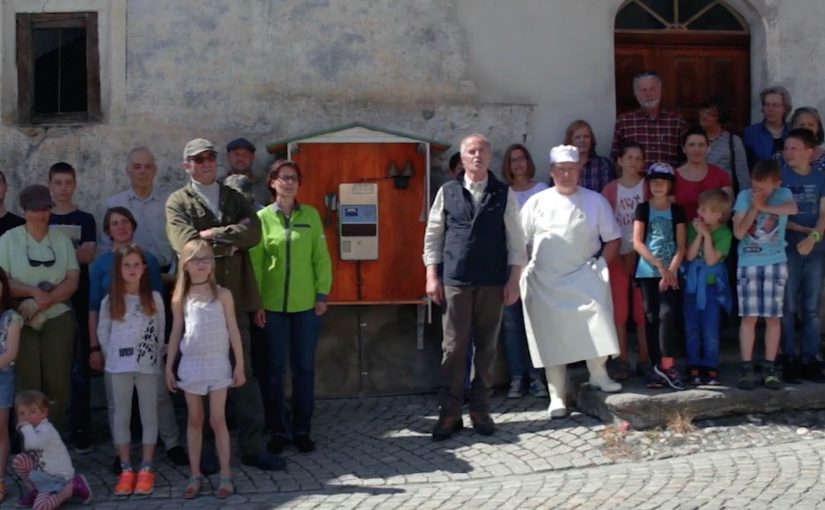
The Village Telephone

In the mountain village of Tschlin, it is so quiet that when the telephone in the village square rings, you can hear it from every corner of the village. So when that phone starts ringing, people move. The butcher. The innkeeper. The pastor. Whoever is closest. The whole premise is simple: if the phone rings and nobody makes it in time, the caller wins.

The hook

Turn “quietest place in Switzerland” from a claim into a game people can test in real time.

What Graubünden Tourism and Jung von Matt set up

Graubünden Tourism and Jung von Matt/Limmat publish the village phone number online and invite anyone to call it between 10:00 and 20:00. If a resident answers, you get a conversation with a real person from Tschlin. If the call goes unanswered, you win prizes such as free stays, dinner, or merchandise.

To prove that nobody is sitting next to the phone “waiting,” the campaign also runs a live view of the village square, so participants can see what is happening and who is answering. The transparency is part of the promise.

The real question is whether a destination promise can be verified by a stranger in seconds.

When the audience can run the proof themselves, the claim becomes dramatically more credible.

Why the village telephone lands

The mechanic, meaning the simple rule set people can try, creates tourism interest because the proof is experienced in the moment, then shared as a story.

Extractable takeaway: If your benefit is experiential (quiet, fast, safe, simple), build a public test that lets people attempt to disprove it. Then make the proof visible while they try.
It makes the destination benefit testable

Most tourism ads describe tranquility. This one lets you attempt to break it with a phone call.

It turns locals into the medium

No actors are needed. The villagers are the campaign, and that authenticity is visible in every answered call.

It creates a built-in story loop

Call. Ringing. Sprint. Answer. Or silence. Win. The narrative resets every time the phone rings, which is exactly why people keep trying.

In European destination marketing, a public, verifiable test is often what makes a small place feel real to people who have never been there.

The timeframe that makes it feel like an “event”

The action runs from Monday, June 6 to Saturday, June 11, 2016. It is short enough to create urgency, and long enough to become a talking point beyond Switzerland.

Signals that the stunt travels

Reported outcomes for the six-day activation include 30,000 attempted calls, 3,906 conversations, and 1.5 million video views, alongside significant media pickup.

The deeper point

This is a clean example of “proof marketing.” By “proof marketing,” I mean marketing that lets the audience verify the promise with their own action, not a brand assertion. The campaign does not ask you to believe that Tschlin is quiet. It gives you a simple action to attempt, shows you the village while you do it, and lets the locals validate the claim with their own behavior.

Steal the village phone pattern

  • Make the promise testable. Turn the adjective into one action people can try in real time.
  • Show the proof live. Use transparency (like a live view) so the audience trusts the rules.
  • Design a repeatable loop. Reset the story every time the trigger happens so people keep replaying it.
  • Time-box it like an event. A short window creates urgency and makes the stunt easier to talk about.

A few fast answers before you act

What is the core mechanic?

Call the village telephone between 10:00 and 20:00. If a resident answers, you talk. If the call goes unanswered, you win prizes.

Why is the live feed important?

It proves the fairness of the promise. People can see that nobody is waiting next to the phone, and they can see who they are speaking with.

Who is behind the campaign?

Graubünden Tourism (Graubünden Ferien) with Jung von Matt/Limmat.

When does it run?

June 6 to June 11, 2016.

What is the transferable pattern?

If your promise is experiential (quiet, fast, safe, simple), build a public test that lets people attempt to disprove it. Then make the proof visible while they try.

The Great Escape

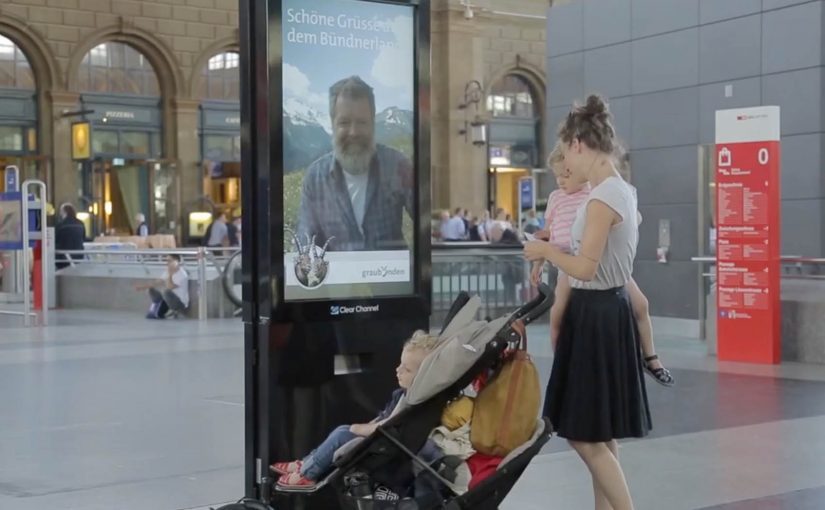
A stressed commuter walks through Zurich’s main train station, eyes forward, pace set to “late again.” Then a large interactive display stops them. On screen is a real Graubünden mountain man. He sees them. He speaks to them. He invites them to step out of the city and into the mountains. The offer is not “someday.” It is now. An all-expense-paid trip to Vrin, a mountain village in the Lumnezia Valley. The only catch is brutal and perfect. They have to drop everything and jump on the train leaving from the next platform.

Escape in one decision

Bring the mountain to the most hectic place in Switzerland, then make escape a one-decision act.

The context you already build on

In 2011, Graubünden Tourism and Jung von Matt had created a clever stunt to publicize the remote mountain village of Obermutten on Facebook. There they targeted people closer to home, specifically stressed urban commuters in a Zurich train station.

What happens at Zurich station

Step 1. Replace “beautiful scenery” with a human invitation

Instead of showing landscapes, the campaign puts a real local face in front of commuters. He can see and talk to people as they walk past. It feels personal, not broadcast.

Step 2. Turn interaction into an offer with real stakes

Anyone who engages is offered an all-expense-paid trip to Vrin. The offer is framed as a cure for stress, delivered at the exact moment stress is visible.

Step 3. Make the brand promise non-negotiable with one constraint

The only catch is the mechanism. By mechanism, I mean the single rule that turns the offer into a test. They have to drop everything and take the train that is about to leave from the next platform. That single constraint transforms the idea from a nice story into a real test of desire.

In European destination marketing, the hardest part is turning “someday” escape into a choice people will make on an ordinary weekday.

The real question is: can you turn “escape” from a promise into a decision someone can make in under a minute?

Why this works as live communication

Here, “live communication” means a real person responding in real time, not a pre-recorded loop.

Extractable takeaway: When you sell an experience, shorten the gap between promise and proof. Use live interaction plus one simple constraint so the choice becomes meaningful.

It collapses the distance between promise and proof

Tourism often sells “escape” as a future plan. Here, escape is immediate, and the decision is binary. Stay, or go.

It uses technology to create intimacy, not spectacle

The interactive display is not the point. The point is that someone in the mountains is speaking to you directly in the middle of the city.

The constraint is the creative

The “next train” rule is what makes it unforgettable. It forces commitment. It also creates the story people retell because it is a moment with consequence.

The deeper point

Escape marketing works best when it demands a real choice, not passive appreciation. If you want people to believe in a destination, do not just show it. Put a human being from that place in front of the audience, then convert emotion into action with a simple, immediate next step.

Practical moves for instant escape offers

  • Lead with a human: Put a real local face in front of people, not a montage of scenery.
  • Make “now” the default: Frame the reward as immediate, not a future plan or a delayed sweepstakes.
  • Use one constraint: Add a single rule like “next train” so the offer becomes a test of intent.
  • Design for retellability: Build a moment with consequence that people can summarize in one sentence.

A few fast answers before you act

What is The Great Escape in one sentence?

An interactive display in Zurich station lets a real Graubünden mountain man speak to commuters and invite them on an immediate trip to Vrin.

What makes it different from standard digital out of home?

It is not a looped video. It is a live, human interaction that turns attention into a real decision.

What is the key mechanic that creates urgency?

The “next platform, next train” constraint. People have to go now, not later.

How does it connect to the earlier Obermutten work?

It builds on the same strategy. Make a remote mountain place culturally visible through an idea that people actively participate in.

What is the reusable pattern for brands?

If your promise is experiential, create a live proof moment, then add a constraint that forces a meaningful choice.

Obermutten: A Little Village Goes Global

Obermutten is a little mountain village in the Canton of Graubünden, Switzerland. It has around seventy eight residents and is known to virtually no one except a few hikers passing through now and then.

Now, millions of people around the world have reportedly either read about or heard of Obermutten, after Jung von Matt/Limmat created a simple Facebook campaign for Graubünden Tourism that put this small village on the world map. Media reports have reportedly appeared across many countries, including mentions on mainstream TV news in South Korea.

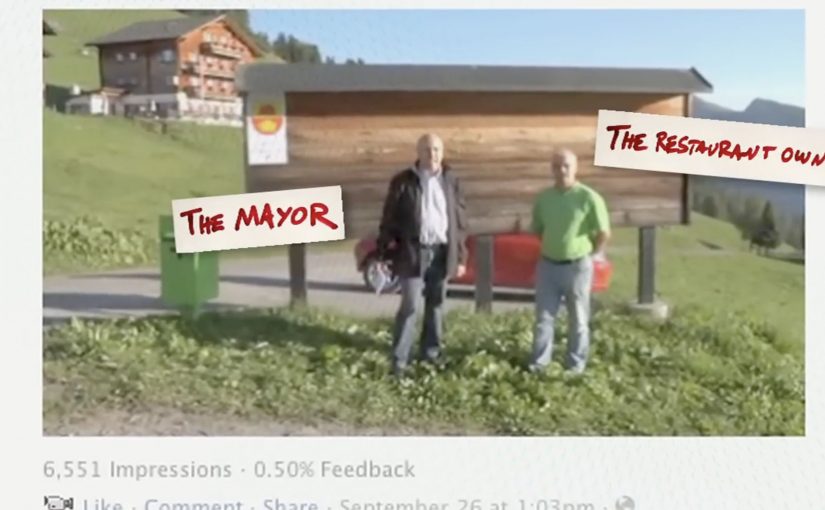
How? It began with a newly created village Facebook page where the local mayor made a remarkable promise via video: click “Like,” and your profile picture will be posted on the commune’s official notice board. In no time, the board was completely covered with fans. To deal with the flood of likes, they reportedly started hanging profile pictures on barn walls in the village. The community has reportedly grown to over 14,000 fans.

A promise that turns a “Like” into a physical souvenir

The mechanism is a simple exchange with a visible payoff. A tiny action online triggers a tangible reward offline. Your profile picture is printed and displayed publicly, which makes the relationship feel real, not symbolic. Each new photo also becomes proof for the next person considering whether to join.

In destination marketing for small places, visible social proof, meaning a growing wall of real faces that proves the promise is being kept, and low-friction participation can outperform paid reach when the reward is concrete and inherently shareable.

The real question is how a tiny place turns a one-click action into public belonging people want to share.

Why it lands

This works because it replaces abstract engagement with a human gesture. You are not “following a page.” You are being welcomed by a real village and given a public spot on a real wall. That emotional upgrade is what converts a novelty into a story, and a story into press and sharing. This is a smarter tourism idea than a bigger media buy because the participation itself becomes the attraction.

Extractable takeaway: When you turn a digital action into a physical, publicly visible reward, participation becomes contagious. People join to see themselves included, and the growing display becomes the marketing.

What destination marketers should steal from Obermutten

  • Make the reward tangible: if the payoff can be photographed, it spreads without asking.
  • Keep the promise binary: one action, one guaranteed outcome, no fine print in the core idea.
  • Design for accumulation: the “wall filling up” is the compounding asset that makes the story stronger over time.
  • Use a human voice: a mayor speaking is more believable than a brand slogan.
  • Let the proof do the persuasion: the growing number of displayed faces sells the idea better than any ad copy.

A few fast answers before you act

What did Obermutten do on Facebook?

They invited people to like the village Facebook page, with the promise that each fan’s profile picture would be printed and posted on the village’s official notice board, and later on barn walls as the number grew.

Why did this become global news?

The idea is easy to explain and easy to visualize. A tiny village publicly “welcoming” thousands of strangers creates an inherently newsworthy contrast, and it produces strong images for media coverage.

What is the core mechanic marketers can reuse?

Convert a low-friction digital action into a tangible, visible reward that accumulates over time. The accumulation becomes both proof and content.

Is this a tourism campaign or a social media campaign?

Both. It uses a social platform to generate participation, then translates that participation into offline visibility that functions like a tourism invitation and a PR engine.

What is the biggest risk with this approach?

If the reward is not genuinely delivered, the story collapses. The format depends on the promise being kept consistently, and on the physical display being maintained with care.