
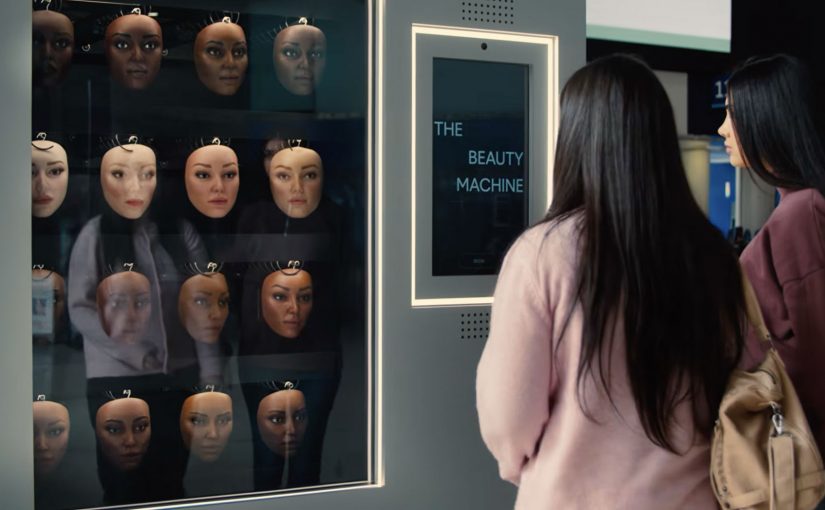
At London’s Waterloo Station, Dove placed rows of different faces inside a vending machine. It invited passers-by to “choose your face” and “pay with your face”, yet every choice produced the same perfect face.
I have featured dozens of unique vending machines over the years. Most use convenience, novelty or personalisation to create a brand experience. Dove uses the format to expose the opposite: the illusion of choice.
That reversal makes The Beauty Machine useful beyond its creative novelty: it shows how to turn invisible system behavior into a physical experience, connect that experience to consumer participation, and quickly feed the response back into the idea.
The mechanism – false choice made physical
At Waterloo station, masks with different skin tones and features appeared to offer a variety of faces. The screen prompted people to select a face and pay with their own, but the machine kept delivering the same ideal face, mimicking a social feed that keeps showing the same beauty ideals now in the form of a vending machine.
This campaign is part of Dove’s long-running “Real Beauty” platform, which began in 2004. The idea started with a simple challenge to traditional beauty advertising: instead of showing only professional models and heavily edited images, Dove began featuring real women of different ages, body types and ethnicities to broaden what “beauty” looks like in media.
Over time, the platform has evolved alongside changes in how beauty is shaped and distributed. In the 2000s, that meant challenging magazine retouching and TV advertising standards. Today, it focuses on newer pressures like social media filters, AI-generated faces and algorithm-driven feeds that repeatedly promote narrow, idealised versions of beauty.
So when this campaign references the Real Beauty platform, it connects the same long-term idea of questioning unrealistic beauty standards to today’s digital systems that now influence what people see and compare themselves against every day.
Because people experience the false choice instead of hearing an explanation about how social media algorithms decide what we see, the campaign turns an invisible loop into something visible and uncomfortable within seconds.
Dove reports that almost one in two women and girls in the UK feels pressured to change their appearance even when they know an image is fake. The machine gives that statistic a behaviour people can see: apparent abundance at the front, narrowing selection behind it.
Why it lands – the format carries the argument
A vending machine is a familiar symbol of convenient choice. You see different options, press a button and receive the one you selected. Dove keeps that familiar interface but removes the expected result: many visible choices lead to one standardised output.
The instruction to “pay with your face” pulls the observer into the contradiction. The issue is no longer happening somewhere inside an inaccessible technology platform. It becomes a personal transaction.
Developed with Ogilvy UK and Emmy-winning documentary filmmaker and photographer Lauren Greenfield, the execution needs very little explanation because the object carries the argument.
The strongest experiential work does not decorate a message; it lets people enact the problem.
Participation at speed – the audience changes the output
The activation then became a participation loop. A participation loop is the process that takes a consumer submission, moves it through approval, and returns it into public distribution.
Through #DoveOpenCall, women were invited to submit unfiltered photographs representing their individual beauty. Dove says participant images began appearing on digital billboards across Waterloo within 48 hours, replacing the machine’s repeated face with real differences.
The strongest part of The Beauty Machine is therefore not the machine itself; it is the response system that allows the audience to change what appears next.
The real question is whether the organisation behind the idea can move consumer participation through consent, usage rights, moderation, brand approval, production and media deployment quickly enough to keep the response culturally live. That only works if there is a connected submission-to-publishing system in place i.e. from consent and usage-rights capture through moderation, DAM intake, legal and brand approval, templated production, digital-out-of-home deployment, social publishing and measurement. Without that end-to-end chain, an open call simply accumulates content instead of becoming a live campaign.
Brand platform – one conviction, a new opponent
The business value comes from keeping the same belief over time. Dove still stands for women defining beauty, but it continually updates what it challenges as beauty is now shaped by algorithms and social feeds.
The installation later appeared in Hamburg and Cannes. That turns one creative object into a repeatable activation format that can travel while retaining the same central argument.
This is a useful model for long-running brand platforms. Instead of inventing a new purpose for each campaign, keep the conviction stable, identify how the surrounding system has changed, and build the next activation around that change.
At enterprise scale, repeatability still needs central narrative control, local activation ownership, media coordination, content governance and a reusable response process. The creative platform and the operating model have to travel together.
The limit – what it does and doesn’t change
The Beauty Machine does not change how social media recommendation algorithms work.
Its impact sits in representation: what Dove chooses to surface publicly and how it invites women to contribute to that output.
It should therefore be measured through participation, published representation, speed of publication, audience response and brand perception, not as evidence of platform-level algorithm change.
From open call to billboard – design the path before launch
For marketing teams, the 48-hour billboard payoff is a design constraint, not a final media flourish. Creative, consumer experience, legal, content operations, data, technology and media teams need to align behind the scenes before a contribution is published.
The takeaway: if a campaign asks people to help change the story, design the complete response path before launch, including consent, moderation, asset handling, approvals, production, distribution and measurement; otherwise participation becomes a promise the operating model cannot keep.
A few fast answers before you act
What is Dove’s Beauty Machine?
Dove’s Beauty Machine is a vending-machine-style installation first shown at London’s Waterloo Station. Although the masks appeared different, they repeatedly produced the same composite face, dramatising how algorithmic repetition can narrow the range of beauty people see online.
Why does the vending-machine format work?
A vending machine normally promises visible choice and a predictable result. Dove reverses that familiar logic by making many apparent options produce the same face, turning the illusion of online variety into an immediately understandable physical experience.
What is #DoveOpenCall?
#DoveOpenCall is Dove’s open casting call inviting women to share unfiltered photographs of their individual beauty. Participant images were distributed through out-of-home and social media, with images beginning to appear on Waterloo billboards within 48 hours.
What makes the campaign operationally interesting?
The Beauty Machine connects a physical activation to consumer submissions and rapid public distribution. A repeatable version of that model requires consent, moderation, asset management, approvals, templated production, media publishing and measurement to operate as one response system.
Does The Beauty Machine change social media algorithms?
No. The Beauty Machine does not alter platform recommendation systems. It broadens representation through Dove’s campaign output, so its impact should be assessed through participation, distribution and brand measures rather than claims of algorithmic reform.
What should marketers learn from Dove’s approach?
Marketers should design the consumer experience and the response infrastructure as one system. If participation is central to the creative promise, ownership, governance, technology and publishing speed must be designed before launch.