The uncomfortable truth about “ranking #1”
My view is simple. A #1 Google ranking can still be useful, but it is no longer the finish line. As AI-driven search experiences answer questions directly, the click is no longer guaranteed. In many queries, the “winner” is the brand that gets mentioned inside the generated answer, not the page that sits at the top of the classic results.
The real question is whether an answer engine will mention and recommend you when the user never clicks.
Traditional SEO has been optimized for blue links. The new battleground is whether an answer engine chooses to reference your brand at all, and whether it trusts your brand enough to recommend you in context.
Why AI can ignore your best ranking
When the interface becomes an answer, rankings become a weaker proxy for visibility. You can rank first and still lose the moment the user’s intent is satisfied before they ever scroll. That changes what “value” means. The value shifts from traffic capture to brand inclusion, brand recall, and being presented as the default option inside the recommendation layer, meaning the part of the interface where the assistant suggests choices.
Extractable takeaway: When the answer is the interface, clarity that can be cited beats rank that still needs a click.
There is a second shift that matters even more. AI systems do not just retrieve pages. They form a view of the world using entities and relationships, which is why clearer entity signals make it easier for them to justify mentioning you. If your brand is not clearly understood as an entity, or not strongly connected to the right categories, problems, and alternatives, you can lose the mention even when you “win” the ranking.
In modern discovery journeys, being cited by answer engines increasingly functions as the new top-of-funnel, even when classic rankings remain strong.
In global marketing teams that rely on organic search, visibility increasingly depends on being mentioned inside the answer, not just ranked in blue links.
For enterprise teams, that shifts the job from chasing rankings in isolation to keeping category definitions, product facts, comparison language, and proof signals consistent across CMS, schema, PR, CRM, and analytics.
GEO is the new layer on top of SEO
Generative Engine Optimization (GEO) is how you improve your probability of being included in AI answers and AI recommendations. The lever is not only keywords and backlinks. The lever is entity clarity and entity corroboration.
Think of GEO as building a machine-readable and human-validated identity for your brand, product, people, and category. Then reinforcing it with consistent signals across the web so an AI system can confidently connect the dots.
In practice, that makes GEO less a content trick and more a cross-functional operating discipline spanning content operations, platform governance, search, earned media, and measurement.
A practical example. When entity strength beats ranking strength
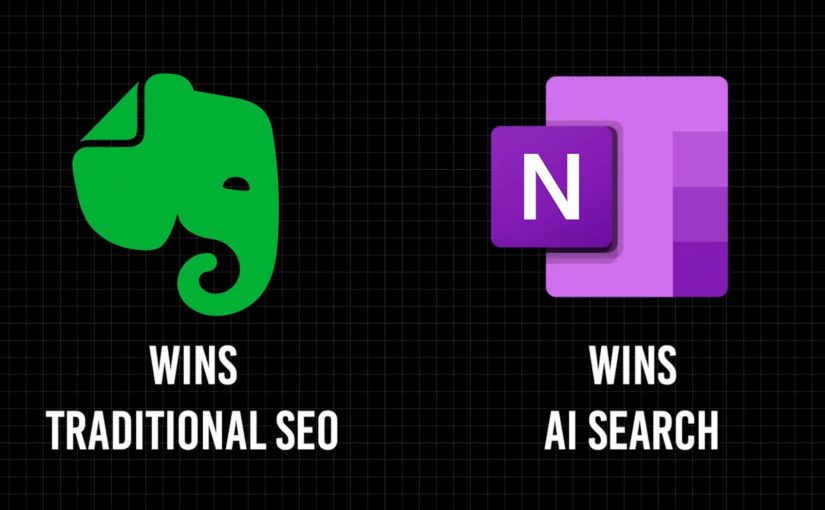
The video illustrates the shift with a simple scenario. An AI-driven recommendation can favor Microsoft OneNote over Evernote, even if Evernote looks stronger in classic Google results for certain queries. The implication is uncomfortable but actionable. The recommendation layer is not a pure reflection of rankings. It reflects how confidently the system can identify entities, connect them to the category, and justify a suggestion.
The video also highlights another reality that reduces classic SEO control. Google can rewrite meta descriptions, which means your carefully crafted SERP message can be replaced by what Google believes best matches the query. That makes “ranking” an even less reliable lever for narrative control.
The new tactics. Build and clarify entities
If GEO is the goal, the playbook changes from “optimize pages” to “optimize understanding”.
- Treat your brand as an entity system, not a website
Define the entities you want AI systems to recognize: your brand, your flagship products, your category terms, your spokespeople, your differentiators, and your comparison set. Then ensure you use consistent naming and consistent descriptions across your owned properties. - Make your content extractable and unambiguous
Write so answers can be lifted cleanly. Use clear headings, crisp definitions, scannable lists, and explicit statements that do not require interpretation. This is where SEO structure and AEO structure become practical GEO enablers. - Corroborate your identity across the web
GEO rewards real-world confirmation. Genuine mentions, real customer conversations, and durable multi-channel presence matter because they create distributed, consistent signals. Those signals strengthen entity credibility and relationships over time. - Align metadata with how people actually ask
If Google rewrites descriptions, you still want your page to provide the best candidate text. Align titles, headings, and on-page summaries with the question patterns your audience uses. That increases the probability that your message survives the rewrite layer and remains coherent in snippets and summaries. - Measure inclusion, not only traffic
In 2026, the more useful KPI set is inclusion in AI answers, share of voice in citations, branded search lift, assisted visits, and downstream conversion quality for priority query themes. Rankings and clicks still matter, but they no longer explain the full picture of visibility.
What to change when the answer is the interface
If your strategy still treats #1 ranking as the ultimate outcome, you are optimizing for a shrinking slice of visibility. The stronger strategy is to earn inclusion. The commercial payoff is not just visibility. It is better qualified discovery, stronger recommendation presence, and cleaner handoff into owned conversion journeys. Make your brand easier to identify, easier to connect, and easier to justify as an answer. That is what keeps you visible when the interface stops being a list of links and starts behaving like a decision engine.
- Design for mentionability. Write and structure key points so an answer engine can quote them cleanly, without relying on interpretation.
- Strengthen entity clarity. Use consistent naming for your brand, products, and comparison set so systems can connect you to the right category and alternatives.
- Measure inclusion. Treat “being cited” in AI answers and recommendations as a KPI alongside rankings, clicks, and downstream conversion quality.
A few fast answers before you act
Can ranking number one on Google still matter?
Yes. It can still drive clicks. But it does not guarantee inclusion in AI answers, summaries, or shopping and assistant experiences that bypass click-through.
Why can an AI answer ignore the top result?
Because answer engines prioritize synthesis, entity credibility, and cross-source consistency. They may select sources that are clearer, more attributable, or better structured for citation.
What is GEO in plain terms?
Generative Engine Optimization is the practice of making your brand and content easy to reference, quote, and cite in AI-generated answers. It builds on SEO but targets “mentionability” and attribution.
What is the most practical GEO move?
Strengthen entities and definitions. Make key claims easy to extract. Use clear naming, consistent terminology, and standalone paragraphs that answer common questions directly.
What should leaders measure if clicks decline?
Track visibility in answer engines, share of voice in citations, branded search lift, and downstream conversion quality. Treat “being cited” as a measurable distribution channel.