
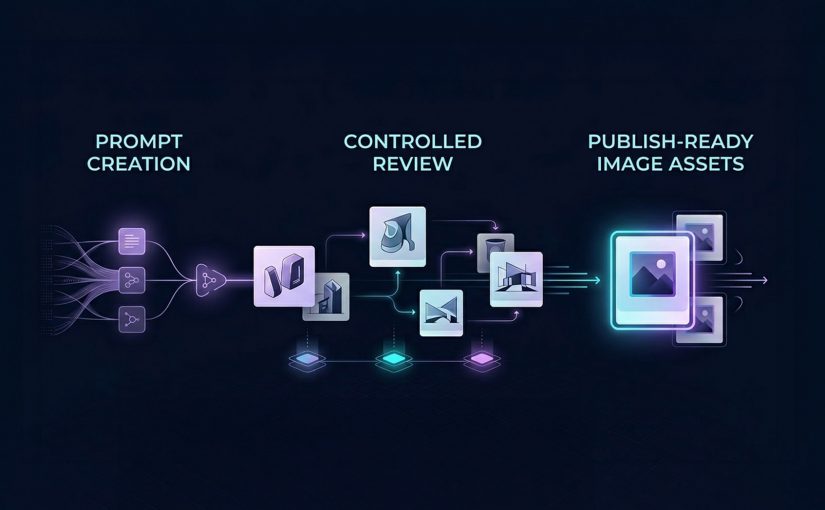
AI Image Tools: From Prompt to Publish

AI Image Tools: From Prompt to Publish

Most coverage of AI image tools still reads like a model beauty contest. One tool wins on realism, another on style, another on speed, and the audience gets the usual low-value conclusion: try them all and see what sticks.

That is not how serious content teams operate. Julia McCoy’s walkthrough is useful because it puts seven popular image tools in one frame, but the more commercially useful lens is different. The job is not to admire outputs. It is to identify which image model helps a team move from prompt to publish with the least waste.

Identifying image models that can actually ship assets

Most teams do not need the most impressive image model in the abstract. They need the right model for the job in front of them, which means matching the tool to the asset type, approval risk, speed requirement, and downstream workflow.

The missing discipline is model-fit. Model-fit is the discipline of choosing an image generator based on what the asset needs to do in production, not just how good the first output looks on screen.

In enterprise content operations, the winning model is usually the one that survives review, resize, and reuse without spawning manual cleanup. At enterprise scale, the issue is not just image quality. It is whether the asset can move cleanly into DAM, CMS, localization, and approval workflows without creating governance exceptions.

The right image model is the one that reduces production friction, preserves brand control, and helps teams ship usable assets. The real question is not which model looks best in a demo, but which one moves a team from prompt to publish with the least waste.

What each image tool is really good at

DALL-E 3 in ChatGPT: Best when teams need fast branded content

DALL-E 3 is best understood as a conversational image generator inside a broader workflow. Its advantage is not just image creation. It is the ability to iterate in natural language, refine outputs quickly, and adapt formats without breaking flow. That makes it especially useful for social graphics, rough branded concepts, and content support assets where speed matters as much as polish.

This is where operator value shows up. If a team can move from idea to usable asset in one conversational environment, production friction drops. The catch is that text rendering can still be unreliable, which means it should support content production, not replace design QA.

Midjourney Alpha: Best when the brief needs visual drama

Midjourney Alpha is a high-detail image model built for stronger visual impact. Its web interface makes the workflow cleaner than the old Discord-first experience, but the reason teams use it is simpler. It produces more dramatic, presentation-friendly imagery when the brief needs mood, depth, or aesthetic intensity.

That makes it a fit for keynote headers, thought-leadership visuals, blog hero art, and concept-led storytelling. The trade-off is practical. High aesthetic quality does not always translate into reliable likeness, identity accuracy, or brand-safe precision.

Meta AI: Best when speed of iteration matters more than finish

Meta AI is most useful as a fast iteration tool. Its strength is responsiveness. It lets users shape and reshape images quickly while prompting, which makes it valuable for early concept exploration and low-friction experimentation.

For content teams, that matters when the task is not final asset creation but directional testing. It is less useful when the workflow depends on reference-image fidelity or more controlled production behavior.

Microsoft Designer: Best for learning prompts and creating simple content fast

Microsoft Designer is less about highest-end image quality and more about accessibility. It helps users understand what prompt ingredients influence outputs, which makes it useful for beginners or teams building prompt literacy.

That makes it a practical choice for low-risk social content, internal creative exploration, or teams still learning how to brief image models effectively. The limitation is consistency. What helps teams learn does not always help them ship premium assets.

Canva Magic Media: Best when generation needs to flow straight into design

Canva Magic Media matters because it sits inside a design workflow marketers already use. That is its real advantage. The value is not only the image. It is the reduced distance between generation, editing, background removal, layout, and final export.

For marketers and in-house content teams, that can matter more than absolute model quality. If the asset is headed straight into campaign design or social production, workflow integration often beats raw creative range.

Adobe Firefly: Best when style control and enterprise workflow matter

Adobe Firefly is the most relevant tool here for teams that care about stylistic control and closer alignment with professional creative workflows. Its strength is not just generation. It is controlled generation inside a broader production ecosystem.

That makes it more commercially useful for teams already operating in Adobe-heavy environments. The value is greater when governance, consistency, and downstream editing matter more than novelty.

My Mood AI: Best when the brief depends on face fidelity

My Mood AI is not really competing for the same role as the broader image generators. It is a likeness-focused workflow built for personal headshots, creator-style visuals, and portrait-led use cases where the face is the asset.

That distinction matters. When the task is human likeness, general-purpose image models still break too often. A specialist approach makes more sense because the commercial requirement is not “make an image.” It is “make this person usable on-brand.”

Why workflow fit matters more than model hype

A lot of teams still talk about AI image tools as if the whole story is creative novelty. That undersells the real business value. The gain is operational.

When the brief is routed to the right model, review cycles shorten, manual cleanup falls, and more assets make it through approval into live use.

That is why workflow fit matters more than model hype. DALL-E 3 compresses ideation inside chat. Canva and Microsoft reduce handoff friction for everyday content creation. Adobe Firefly is stronger when generation needs to stay connected to a broader creative stack. Midjourney is more useful when visual impact is the point of the asset, not just a nice bonus.

The business mistake is trying to standardize on one “best” image model. The better move is to standardize on routing logic. Which briefs need speed. Which need design-system continuity. Which need strong hero visuals. Which need face fidelity. Which need heavy post-generation editing. That is the difference between tool sampling and commercially useful transformation.

A practical image stack teams can actually use

If I were setting this up for a content organization, I would not start by asking which single image tool to buy into. I would map asset demand first, then assign model lanes around asset class, approval risk, editing depth, and likelihood of reuse. Used properly, this is a governed routing layer, not an experimentation sandbox. Teams need approved tools by asset type, defined QA gates, and clear escalation when briefs require design, legal, or brand review.

Start with DALL-E 3, Meta AI, Microsoft Designer, and Canva for fast ideation and everyday content support. Move to Midjourney Alpha and Adobe Firefly when visual finish or downstream creative control matters more. Keep My Mood AI for portrait-led work where recognizability is the requirement rather than a nice-to-have. That routing model is more useful than forcing every brief through one “best” tool, because it cuts waste where content teams usually lose time: revision, cleanup, and rework.


A few fast answers before you act

Which AI image tool is best for fast branded content?

DALL-E 3 is the cleanest fit when the team wants conversational prompting and quick variations inside ChatGPT, while Canva and Microsoft Designer are stronger when the asset needs to move immediately into design or presentation workflows.

Which tool is best for presentation-grade visual impact?

Midjourney Alpha is the strongest fit when the asset needs mood, detail, and visual drama to carry the message. It is the best choice here when aesthetic intensity is part of the business value.

Which image tool fits marketers already working in design platforms?

Canva is the easiest fit for fast marketing production, while Adobe Firefly becomes more relevant when the team already works inside a professional Adobe-centered creative environment.

Can one image model cover every content use case?

No. The smarter operating model is to assign different tools to different jobs instead of pretending one model should own social content, hero art, headshots, and design-integrated production all at once.

What usually breaks before publish?

The failure point is usually not whether the tool can generate an image. It is whether the image survives review, edit depth, channel adaptation, and stakeholder scrutiny without creating more cleanup than value.

How should teams evaluate AI image tools commercially?

Evaluate them by prompt-to-publish fit. Look at production friction, brand control, workflow integration, face fidelity where needed, and how much manual rework the tool creates before an asset can ship.
Viral Content: Clone Winning Ads in Minutes

Viral Content: Clone Winning Ads in Minutes

Viral video creation is shifting from a production task to an operating-model question, and Topview AI is a useful example.

For years, short-form performance video lived in two modes. Manual production that is slow and expensive. Or template-based generators that are faster, but still force you into lots of manual re-work.

Now a third mode is emerging: AI Video Agents, meaning systems that take a short brief plus a few inputs and generate a complete multi-shot draft you can iterate on.

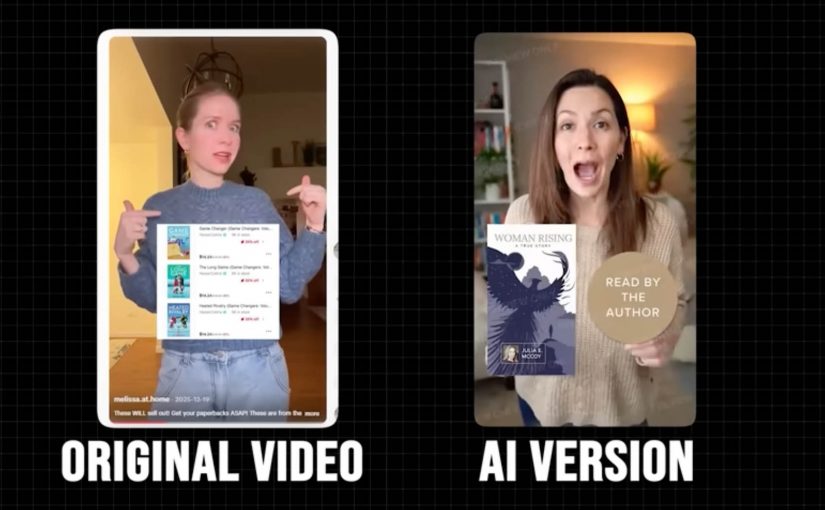
The shift is simple. Instead of editing frame-by-frame, you brief the outcome. Optionally provide a reference viral video. The agent then recreates the concept, pacing, and structure for your product in minutes. Your job becomes direction, constraints, and iteration. Not timelines.

Meet the AI Video Agent “three inputs” workflow

Topview’s core promise is “clone what works” for short-form marketing.

Upload your product image and/or URL so the system extracts what it needs. Share a reference viral video so it learns the shots and pacing. Get a complete multi-shot video that matches the reference style, rebuilt for your product.

That is the operational unlock. You stop asking a team to invent from scratch every time. You start generating variants of formats that already perform, then iterate based on outcomes.

In enterprise teams, that makes this less a content toy and more a new layer in the performance-creative operating model, where briefing quality, asset governance, and measurement discipline matter more than raw production capacity.

That changes what teams need to get right. Faster generation only creates value when the workflow improves how quickly the team learns what to scale.

What “cloning winning ads” really means

This is not about copying someone’s assets. It is about cloning a repeatable pattern.

Extractable takeaway: When a workflow can reliably regenerate a proven creative structure, the bottleneck shifts from making assets to choosing angles, proof, and guardrails that improve one test at a time.

High-performing short-form ads tend to share the same backbone. A strong opening. A clear value moment. Proof. A simple call-to-action. The variable is the angle and execution. Not the structure.

AI video agents are optimized to reproduce that backbone at speed, then let you steer the angle. Because the agent reuses a proven structure, you can spend your time on angles and proof, which increases iteration velocity. That is why they matter for performance teams. The advantage is iteration velocity. The risk is sameness if you do not bring differentiation in offer, proof, and brand voice.

What to evaluate beyond the AI Video Agent headline

I would not judge any platform by a single review video. I would judge it by whether it covers the tasks that constantly slow teams down.

From the “creative tools” surface, Topview positions a broader toolbox around the agent, including: AI Avatar and Product Avatar workflows, plus “Design my Avatar”. LipSync. Text-to-Image and AI Image Edit. Product Photography. Face Swap and character swap workflows. Image-to-Video and Text-to-Video. AI Video Edit.

This matters because real creative operations are never “one tool.” They are a chain. The more of that chain you can keep inside one workflow, the faster your test-and-learn loop becomes.

The practical question is whether that workflow plugs cleanly into your brand-asset flow, approval model, paid-social activation, and testing cadence without creating new review debt.

Topview alternatives. Choose by workflow role, not by hype.

If you are building an enterprise creative stack, choose these tools by workflow role, asset control, and measurement fit, not by demo quality.

HeyGen

HeyGen positions itself around highly realistic avatars, voice cloning, and strong lip-syncing, plus broad language support and AI video translation. It also supports uploading brand elements to keep outputs consistent across projects. Compared to Topview’s short-form ad focus and beginner-friendly “quick publish” style workflow, HeyGen is often the stronger fit when avatar-led and multilingual presenter content is your primary format.

Synthesia

Synthesia is typically strongest for presenter-led videos, especially training, internal communications, and more corporate-grade marketing explainers. Compared to Topview’s short product ad focus, Synthesia is often the cleaner fit when a human-style presenter is the core format.

Fliki

Fliki stands out when your workflow starts from existing assets and needs scale. Blogs, slides, product inputs, and team updates converted into videos with avatars and voiceovers, plus a large set of voice and translation options. Use Fliki when you want breadth and flexibility in avatar and voiceover production. Otherwise, use Topview AI when your priority is easily creating short videos from links, images, or footage with minimal workflow friction.

Operating moves for AI video agents

The real question is whether your team can turn minutes-long production into a disciplined iteration system without losing distinctiveness.

My take is that viral content is no longer mainly a production problem. It is an operating-model problem, because speed only compounds value when briefs, proof, guardrails, and learning loops are already in place.

  • Brief for outcomes, not assets. Define the hook, value moment, proof, and CTA before you generate variants.
  • Constrain sameness early. Put brand voice, offer boundaries, and “do not do” rules into the brief so speed does not turn into remix culture.
  • Run a ruthless learning loop. Test fewer, better variants. Kill quickly. Scale only what proves incremental lift.

Which viral video would you recreate first. And what would you change so it is unmistakably yours, not just a remix.


A few fast answers before you act

What does “clone winning ads” actually mean?

It usually means generating new variants that reuse the structure of high-performing creatives. The goal is to speed up iteration, not to copy a single ad one-to-one.

Is this ethical?

It depends on what is being “cloned.” Reusing your own learnings is normal. Copying another brand’s distinctive IP, characters, or protected assets crosses a line. Governance and review matter.

What will still differentiate brands if everyone can produce fast?

Strategy, customer insight, and taste. If production becomes cheap, the competitive edge moves to positioning clarity, creative direction, and the quality of testing and learning loops.

How should teams use this without flooding channels with slop?

Use strict briefs, clear brand guardrails, and a limited hypothesis set. Test fewer, better variants. Kill quickly. Scale only what proves incremental lift.

What is the biggest risk?

Over-optimizing for short-term clicks at the expense of brand meaning, trust, and distinctiveness. High-volume iteration can become noise if the work stops saying something specific.

AEO for Brands: The New Search Operating Model

AEO for Brands: The New Search Operating Model

SEO is becoming AEO. From clicks to citations

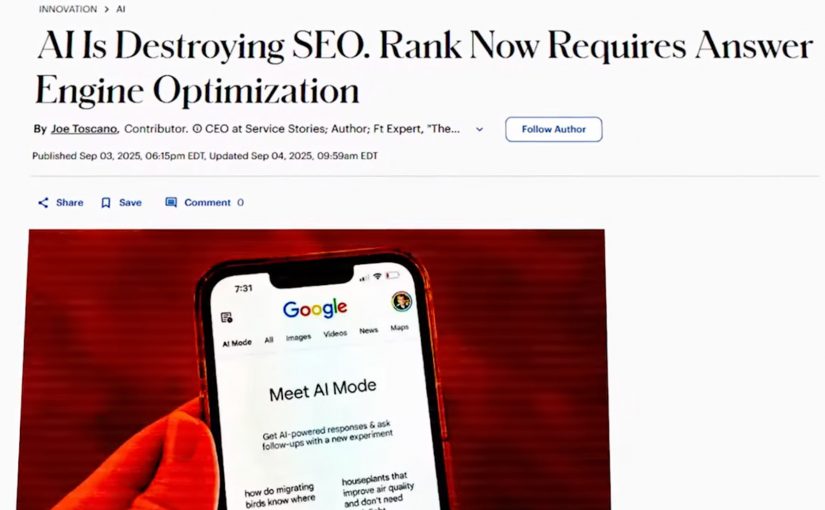
Answer Engine Optimization (AEO) is the practice of structuring content so AI-powered search experiences can extract, summarize, and cite it as the best answer to a user’s question. Traditional SEO optimizes for blue-link rankings and click-through. AEO optimizes for inclusion and citation inside the answer itself.

That is the practical difference. Traditional SEO is built to win rankings and clicks. AEO is built to win inclusion in the answer itself by making your content easy to parse, easy to trust, and worth citing inside Google AI Overviews and AI-driven search experiences.

How AEO earns citations

The real question is whether your page can be extracted, summarized, and cited as the best answer to a user’s question without the system having to guess what you meant.

If you want to “rank #1” in the AI era, stop treating search as a list of links and start treating it as an answer ecosystem. By answer ecosystem, I mean AI-driven search experiences where the interface returns answers instead of links. Publish content that is easy to extract, unambiguous in structure, and defensible with evidence. Evidence means primary sources, concrete numbers, named examples, and claims you can back up with reputable third-party references. Then reinforce it with authority signals beyond your site, because answer engines learn trust from repeated third-party validation.

In enterprise marketing organizations, this shifts content work from chasing marginal ranking gains to engineering pages that can be cited inside the answer layer.

This is not just a copywriting adjustment. It is an operating model issue spanning content templates, source governance, subject-matter expert review, and measurement.

At scale, AEO performance is constrained less by isolated writing tips and more by the platform layer. CMS structure, schema discipline, internal-linking rules, and entity consistency determine whether extractable content can be produced repeatedly across brands and markets.

Why citations beat clicks

As AI summaries appear more frequently across search results, the competitive battleground shifts upward. Visibility concentrates inside the generated answer. The winning strategy becomes “earn the citation,” not just “earn the click.”

Extractable takeaway: In answer-first search, the unit of competition is the claim, not the page. Write claims so they can be lifted and attributed without losing meaning.

The video below breaks down a practical 6-step AEO framework any brand can implement immediately. The objective is simple. Earn the citation, not just the click.

A 6-step AEO framework brands can implement now

  1. Target long-tail conversational questions
  2. Prioritize low-competition AEO opportunities
  3. Match informational intent, then design a conversion path that fits
  4. Optimize for multi-feature SERP visibility, not one placement
  5. Build brand authority through third-party mentions and citations
  6. Run an AEO gap analysis to find where competitors are cited and you are not

The winners will be the brands whose pages are consistently extractable and consistently corroborated. They become the sources AI systems cite when summarizing a category, problem, or decision. The losers will be the ones still optimizing only for yesterday’s SERP.

AEO moves worth copying

  • Declare the dominant question. Make one user question the page answers unmistakable, then align headings and copy to it.
  • Lead with answers, then depth. Put the crisp definition or decision first, then expand.
  • Make claims defensible. Use primary sources, concrete numbers, and named examples you can stand behind.
  • Engineer for citation. Write paragraphs that pass a standalone copy test without missing context.

A few fast answers before you act

What is Answer Engine Optimization (AEO)?

Answer Engine Optimization is the practice of structuring content so it can be directly extracted and used as an answer by AI systems and modern search interfaces. The goal is to be the cited, summarized, or recommended response when the interface returns answers instead of links.

How is AEO different from SEO?

SEO primarily optimizes for ranking in a list of results and earning clicks. AEO optimizes for being included in the generated answer itself. SEO still matters, but AEO focuses more on extractability, clarity, and trusted corroboration.

What is the fastest way to make a page “answerable”?

Use clear headings that match real questions, then answer each question in one concise paragraph before expanding. Define terms explicitly. Use short lists where helpful. Remove ambiguity so an AI can quote or summarize accurately.

How do you improve your chances of being included in AI answers?

Make your entity and topic signals consistent across your site. Use the same names for products, concepts, and frameworks. Support claims with specifics. Ensure the page aligns to one primary intent so the system can confidently select it.

What should you measure if clicks decline but visibility increases?

Track inclusion. Monitor whether your brand or page is referenced in AI answers for your key topics. Combine that with classic metrics like impressions, branded search lift, and downstream conversions, because the click is no longer the only proof of impact.

What is a practical starting playbook for AEO?

Pick 10 to 20 pages that already perform well or match your core topics. Add a clean question-based heading structure. Write crisp answers first, then detail. Ensure internal linking reinforces the same entity and topic cluster. Iterate based on query themes and inclusion signals. Run that as a named pilot with one accountable owner, a citation-inclusion KPI, and a downstream conversion checkpoint before scaling the model.