
Pepsi Like Machine

You walk up to the Pepsi’s “Like Machine”, tap “Like” for Pepsi on Facebook using your smartphone or the machine’s touchscreen, and it dispenses a soda. Simple rule. Instant reward.

The Like Machine mechanic

Coca-Cola has created a whole bunch of innovative vending machines over the last couple of years. Pepsi, on the other hand, created only a couple. Now to add to that collection, Pepsi piloted its latest vending machine. Dubbed the “Like Machine”, it was programmed to dispense soda to fans who “Like” the brand on Facebook via their smartphone or via the touchscreen on the machine.

For brands using event-led FMCG activations, the value of this mechanic is that it turns a familiar digital action into a visible physical conversion point.

The business logic is clear: tie a low-friction social action directly to a branded product moment.

Where did Pepsi pilot it

Pepsi piloted the machine at a Beyonce concert in Antwerp, Belgium and received a good response. So do not be surprised if you see more of them popping up nearby.

Why “Like” works as currency here

The exchange is clear. A lightweight social action becomes the trigger for a real-world payoff. The behaviour is familiar, the barrier is low, and the moment is easy to understand even in a noisy live-event setting. The real question is whether the action feels effortless enough to be worth doing on the spot. This is a smart activation rule because it converts a familiar digital gesture into an immediate physical reward, which reduces hesitation and lifts participation.

Extractable takeaway: When a brand uses a familiar low-friction action as the price of entry, more people complete the interaction because they understand the trade instantly.

What to steal from a like-for-reward mechanic

  • Make the exchange instantly legible. One action. One reward. No interpretation required.
  • Use a behaviour people already do. “Like” is familiar, so the barrier to participation stays low in a live setting.
  • Keep the payoff immediate. The shorter the gap between action and reward, the higher the completion rate.
  • Measure conversion, not just buzz. Track attempts, successful dispenses, and incremental social lift during the activation window.

A few fast answers before you act

What is the Pepsi Like Machine?

It is a vending machine that dispenses a Pepsi to people who like the Pepsi brand on Facebook, either via their phone or on the machine touchscreen.

Why test this at a concert?

Concert crowds are already in a high-energy mindset and open to quick interactions. That makes participation fast and visible, which boosts word of mouth.

Why does this mechanic work so quickly?

Because the rule is easy to grasp and the reward is immediate. People do not need extra explanation to decide whether to participate.

What is the simplest lesson to copy?

Make the rule obvious, the action effortless, and the reward immediate. If any one of those is slow or unclear, participation drops.

What should you measure?

Participation rate per hour, completion rate (start to dispense), and the incremental social lift tied to the activation window.
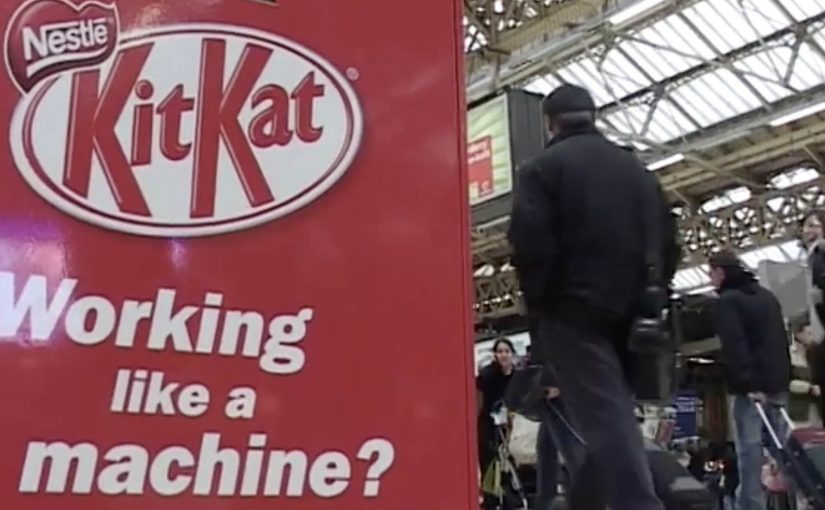
KitKat: Human Vending Machine

We all know how it feels to need a break from the routine of working like a machine. That is why KitKat brought a quirky trend from Japan over to the UK by installing a human vending machine in London’s busy Victoria Station.

Commuters were given a chance to buy a KitKat for 20p, but from a machine with a real difference. A real person operated it from inside, turning a quick purchase into a small moment of surprise and a quick chat. The money was described as going to charity.

A vending machine that replaces automation with a person

The mechanic is straightforward. It looks like a standard vending machine on the concourse. You put money in. You make a selection. Then a real “vendor” inside the unit hands you the bar, human-to-human, at vending-machine speed.

In high-traffic commuter environments, ambient activations (quick, in-the-flow brand interactions placed in public space) work best when the interaction is instant, the reward is obvious, and bystanders can understand the joke in one glance.

Why it lands

This works because it turns the very thing people are tired of, being treated like a machine, into the punchline. The vending format signals efficiency and routine. The human reveal breaks that expectation and delivers the “Have a break” idea as an experience, not a line of copy.

Extractable takeaway: If your brand promise is about relief, do not only describe relief. Stage a short, public interruption of routine where the consumer feels the promise in real time.

What the activation is really doing for the brand

The real question is whether you can make the “Have a break” promise felt without turning the commute into a bottleneck.

This is a strong format when the idea is obvious from a distance and the handoff stays genuinely fast.

At face value, it is a cheap bar and a good deed. Underneath, it is a behavioural prompt in a place where people are stressed, rushed, and receptive to a small uplift. The “human machine” also creates instant social proof. Every interaction becomes a tiny piece of live theatre that recruits the next person in line.

How to borrow the human-vending-machine pattern

  • Make the concept self-explanatory. The best stunts do not need instructions. The crowd teaches the crowd.
  • Build one clean reveal. A single unexpected moment beats multiple clever steps.
  • Design for the queue. Waiting becomes part of the experience and amplifies visibility.
  • Anchor the stunt to the brand line. The “break” is the product, and the bar is the proof.
  • Give people a reason to feel good. A charity tie-in can reduce cynicism and increase participation.

A few fast answers before you act

What is the “human vending machine” idea in one line?

A vending machine that dispenses KitKat bars, but the dispensing is done by a person inside the unit, turning a routine purchase into a surprise interaction.

Why does this work specifically in a commuter station?

Stations concentrate stress, repetition, and time pressure. A fast, playful interruption is more valuable there than a slow, explanatory brand experience.

What makes it feel like a KitKat idea rather than a random stunt?

The experience embodies the brand’s break positioning. It converts “take a break” from a slogan into a short, tangible moment.

What is the main execution risk?

Throughput. If the interaction slows down and the queue becomes frustrating, the stunt flips from “break” to “delay” and the mood collapses.

What should you measure beyond footfall?

Queue conversion rate (people who stop and join vs those who pass by), average interaction time, sentiment in on-site reactions, and whether the activation shifts purchase behaviour during the commute window.