
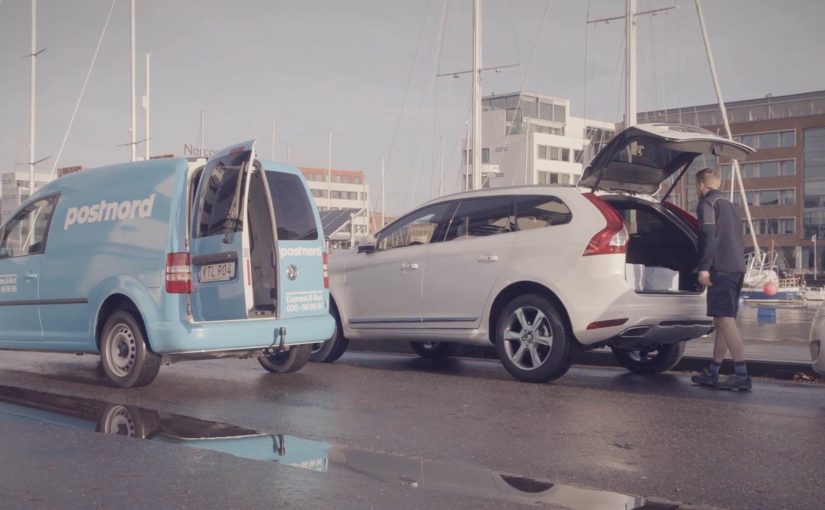
It is late November. You order groceries and Christmas gifts online. You park your Volvo somewhere in Gothenburg. While you are still at work, a courier finds your car, unlocks it once, drops the package into the boot, locks it again, and leaves. You receive a notification. When you drive home, your shopping is already waiting in your car.
That is the core idea behind Volvo’s in-car delivery service. It is available to customers who subscribe to Volvo On Call and live in Gothenburg, Sweden. For the Christmas period, deliveries come from two online retailers. Lekmer.com and Mat.se. PostNord handles the delivery. The courier uses a special one-time access digital key to open the car, place the package in the boot, and re-secure the vehicle.
Why “deliver to the car” is a bigger move than it sounds
At first glance, in-car delivery reads like convenience marketing. Skip missed deliveries. Avoid the “where is my package” loop. Reduce the need to be at home.
But the real shift is structural. The car becomes a secure delivery endpoint. Meaning, the vehicle is treated like a locked, addressable drop-off location with controlled access.
The real question is whether controlled access can make the car a dependable handover point for third parties, not whether the feature feels convenient.
That matters because it turns connected car capability into a service layer that can be monetized and extended. The value does not end when the car leaves the dealership.
The mechanism that makes it work
This service only becomes credible when the access model is precise. The logic is simple:
- The courier does not get your physical key.
- The courier gets a one-time digital key that grants limited access for a single delivery.
- The car becomes the controlled handover point. The boot is the practical drop zone.
Because access is scoped to one delivery and the boot, the courier can complete the drop without you surrendering the car or the physical keys.
When you can grant time-bounded, narrowly scoped access and revoke it immediately, physical assets become secure handover points for partners.
This is not “keyless” as a gadget feature. This is access as a managed entitlement, designed for commerce and logistics.
In European urban settings where people spend the day away from home, reliable delivery depends on secure drop points that do not require the customer to be present.
Why Volvo is telling a marketing story through engineering
Volvo often wins when the innovation is concrete and utility-driven. In-car delivery is exactly that. It is a clean demo of connected technology that saves time, reduces hassle, and fits real family behavior during peak shopping season.
Extractable takeaway: If you want people to believe a new connected service, show it solving a real, repeatable pain point in one clear moment, then let the engineering do the persuasion.
The brand story is also clear:
- Connected car tech is not an abstract dashboard feature.
- It changes how everyday logistics works.
- It makes the car useful even when it is parked.
That is a stronger narrative than “we have an app.” It is a capability that people can visualize immediately.
The strategic signal to other industries
In-car delivery is also a quiet message to adjacent ecosystems:
- Retailers get a new delivery option that reduces failed deliveries.
- Logistics players get a new category of secure handover.
- Carmakers get a template for post-sale services that can scale through partnerships.
In short. Volvo is experimenting with moving beyond simply building and selling cars, by tapping into connected technologies that keep creating value after purchase.
A few fast answers before you act
What is Volvo In-Car Delivery in one sentence?
Volvo In-Car Delivery is a service that lets packages be delivered into your car’s boot using a one-time digital key, instead of delivering to your home.
Who can use it in this pilot?
In this pilot, it is available to Volvo On Call subscribers in Gothenburg, Sweden.
Which retailers and delivery partner are involved?
For the Christmas period described here, the retailers are Lekmer.com and Mat.se, and PostNord handles delivery.
What is the key innovation behind the experience?
The key innovation is controlled access via a one-time digital key that allows the courier to unlock the car once, place the delivery in the boot, and lock it again.
Why is this more than a convenience feature?
It turns the car into a secure delivery endpoint, which creates a service layer that can be monetized and extended through partnerships beyond the initial sale.
