
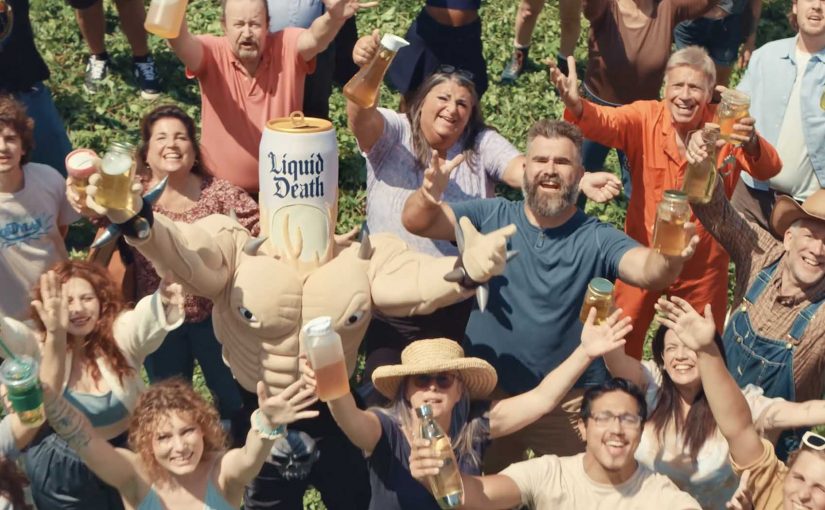
Garage Beer: We Want Your Pee Stunt Becomes A System

Garage Beer co-owner Jason Kelce looks into the camera, holds up a jar of yellow liquid and sings the campaign’s line: “We want your pee.”

What follows is not just a crude song. Garage Beer Classic Light Beer and Liquid Death Sparkling Energy are part of the joke, a limited-edition resealable “Data Center Coolant Collector” makes it physical, and the campaign page gives people somewhere to go next.

The “We Want Your Pee” campaign is best read as a campaign system. A campaign system is a set of connected touchpoints that gives one creative idea a different job at every stage, from attention to action, consented data and commercial follow-through. The useful lesson is not to copy the provocation, but to build the route from attention to measurable action before launch.

The mechanism: Give every partner a job

The campaign starts with a brutally simple chain: drink Garage Beer or Liquid Death Sparkling Energy, create urine, collect it, and supposedly send it to cool an AI data centre. Kelce brings more than a recognisable face: the retired Philadelphia Eagles centre connects the campaign to the NFL, while his brother Travis’s marriage to Taylor Swift places Jason inside a much wider pop-culture context. But the products themselves drive the plot, making the collaboration causal rather than cosmetic.

The wider tension is real: Berkeley Lab estimated that US data centres directly consumed 66 billion litres of water in 2023, although consumption varies materially by cooling system, grid and location.

Because both products are positioned as inputs to the same ridiculous solution, neither brand feels pasted onto the idea. The issue gives the joke relevance, the product logic gives the partnership coherence, and the jingle makes the mechanism easy to retell.

The journey: Give attention somewhere to go

A standalone video could create reach but would leave no owned next step. Here, the collector carries the idea onto the campaign page and into a product interaction. The real question is whether the creative idea survives the handoff from video to owned experience.

The campaign page presents the collector as a limited-edition product. When it is unavailable, the page offers a “Notify Me” registration and an option to join the email list. That turns the punchline into a structured intent signal without forcing every visitor straight into a beverage purchase.

That handoff matters because social attention is rented and short-lived. An owned destination lets the team observe what people do next: watch, browse, register interest, opt into marketing or buy. It creates the possibility to measure them.

The control: Make the joke safe to execute

The same clarity that makes the campaign memorable creates risk. If someone interprets “send your pee” literally, the joke can spill into customer care, fulfillment, reputation and platform moderation.

The official product page explicitly tells people not to actually send their urine. That disclaimer is essential because the clearer the public action, the more precisely the campaign must define where the joke stops.

That handoff matters because the campaign no longer ends with a view. The owned destination creates concrete next actions: browse, register interest, opt into marketing or buy.

The lesson: Make the products carry the idea

The useful part of this campaign is that the drinks, collector and campaign page are not afterthoughts. The drinks create the fictional coolant, the collector makes it tangible, and the page turns the punchline into a product interaction.

Use a simple test before approving the work: if the products can be removed without changing the idea, the brands are sponsoring the entertainment rather than driving it.


A few fast answers before you act

What is the “We Want Your Pee” campaign?

“We Want Your Pee” is an August 2026 campaign from Liquid Death and Garage Beer featuring Jason Kelce. It uses a song and a fake proposal to cool AI data centres with urine to draw attention to water consumption and promote both beverage products.

Why do Garage Beer and Liquid Death fit together?

Garage Beer and Liquid Death fit because both products have a functional role inside the joke: consumers drink them, produce the supposed coolant and use the co-branded collector. The partnership is part of the mechanism, not just a shared logo treatment.

What makes this more than a video stunt?

The campaign connects the film to a physical collector, an owned product page, an availability notification, an email option and an explicit disclaimer. Those touchpoints give attention a route into action, consent and measurement.

Is the campaign really asking people to mail urine?

The creative idea says people should send urine to data centres, but the official product page explicitly tells consumers not to do it. The mailing instruction is satire, not a real fulfilment model.

What should another brand copy from this campaign?

Another brand should copy the connected design, not the crude joke. The useful pattern is a clear product role for every partner, an owned next step, governed risk and a measurement plan that follows the consumer across touchpoints.

How should a connected stunt be measured?

A connected stunt should be measured at each handoff: content engagement, visits to the owned destination, product interaction, purchase or registration, valid marketing consent and later product behaviour. The owners and baselines should be agreed before launch.
Volvo In-Car Delivery

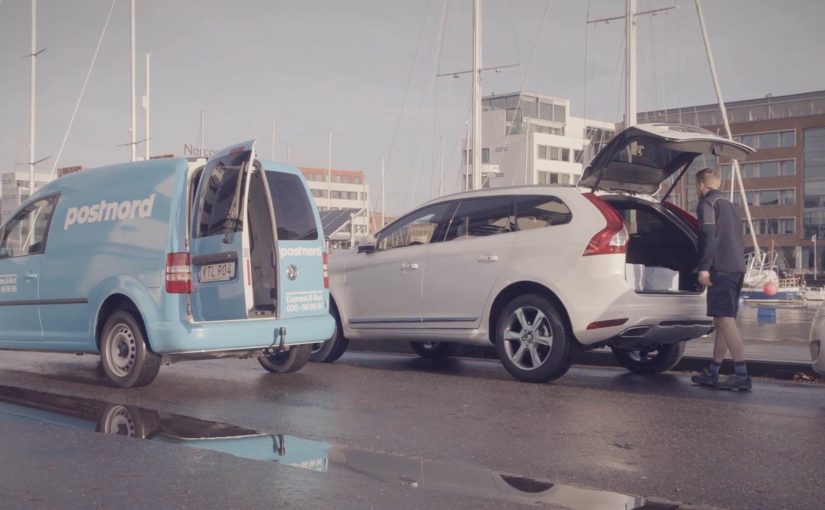
It is late November. You order groceries and Christmas gifts online. You park your Volvo somewhere in Gothenburg. While you are still at work, a courier finds your car, unlocks it once, drops the package into the boot, locks it again, and leaves. You receive a notification. When you drive home, your shopping is already waiting in your car.

That is the core idea behind Volvo’s in-car delivery service. It is available to customers who subscribe to Volvo On Call and live in Gothenburg, Sweden. For the Christmas period, deliveries come from two online retailers. Lekmer.com and Mat.se. PostNord handles the delivery. The courier uses a special one-time access digital key to open the car, place the package in the boot, and re-secure the vehicle.

Why “deliver to the car” is a bigger move than it sounds

At first glance, in-car delivery reads like convenience marketing. Skip missed deliveries. Avoid the “where is my package” loop. Reduce the need to be at home.

But the real shift is structural. The car becomes a secure delivery endpoint. Meaning, the vehicle is treated like a locked, addressable drop-off location with controlled access.

The real question is whether controlled access can make the car a dependable handover point for third parties, not whether the feature feels convenient.

That matters because it turns connected car capability into a service layer that can be monetized and extended. The value does not end when the car leaves the dealership.

The mechanism that makes it work

This service only becomes credible when the access model is precise. The logic is simple:

  • The courier does not get your physical key.
  • The courier gets a one-time digital key that grants limited access for a single delivery.
  • The car becomes the controlled handover point. The boot is the practical drop zone.

Because access is scoped to one delivery and the boot, the courier can complete the drop without you surrendering the car or the physical keys.

When you can grant time-bounded, narrowly scoped access and revoke it immediately, physical assets become secure handover points for partners.

This is not “keyless” as a gadget feature. This is access as a managed entitlement, designed for commerce and logistics.

In European urban settings where people spend the day away from home, reliable delivery depends on secure drop points that do not require the customer to be present.

Why Volvo is telling a marketing story through engineering

Volvo often wins when the innovation is concrete and utility-driven. In-car delivery is exactly that. It is a clean demo of connected technology that saves time, reduces hassle, and fits real family behavior during peak shopping season.

Extractable takeaway: If you want people to believe a new connected service, show it solving a real, repeatable pain point in one clear moment, then let the engineering do the persuasion.

The brand story is also clear:

  • Connected car tech is not an abstract dashboard feature.
  • It changes how everyday logistics works.
  • It makes the car useful even when it is parked.

That is a stronger narrative than “we have an app.” It is a capability that people can visualize immediately.

The strategic signal to other industries

In-car delivery is also a quiet message to adjacent ecosystems:

  • Retailers get a new delivery option that reduces failed deliveries.
  • Logistics players get a new category of secure handover.
  • Carmakers get a template for post-sale services that can scale through partnerships.

In short. Volvo is experimenting with moving beyond simply building and selling cars, by tapping into connected technologies that keep creating value after purchase.


A few fast answers before you act

What is Volvo In-Car Delivery in one sentence?

Volvo In-Car Delivery is a service that lets packages be delivered into your car’s boot using a one-time digital key, instead of delivering to your home.

Who can use it in this pilot?

In this pilot, it is available to Volvo On Call subscribers in Gothenburg, Sweden.

Which retailers and delivery partner are involved?

For the Christmas period described here, the retailers are Lekmer.com and Mat.se, and PostNord handles delivery.

What is the key innovation behind the experience?

The key innovation is controlled access via a one-time digital key that allows the courier to unlock the car once, place the delivery in the boot, and lock it again.

Why is this more than a convenience feature?

It turns the car into a secure delivery endpoint, which creates a service layer that can be monetized and extended through partnerships beyond the initial sale.

Amazon Dash: The Button That Rewrites Loyalty

A one-click purchase is not the point. Default is.

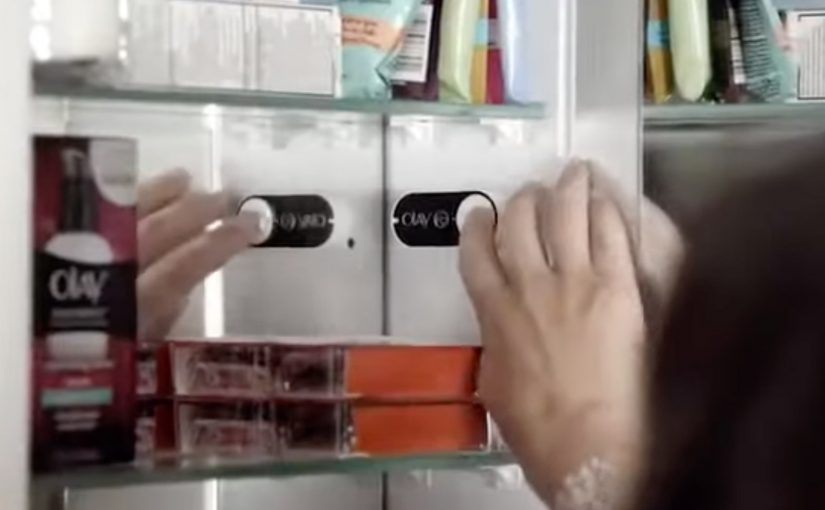
Amazon Dash Button looks simple. A branded button you stick near the place of usage. You press it. The same item arrives again.

But the strategic move is not “one click.” It is making the reorder the default behavior.

Dash Button turns repeat buying into an ambient habit. By “ambient habit,” I mean a repeat action triggered by the environment rather than an active shopping session. It shifts commerce away from discovery and toward automation. It pushes the battle for the customer from the shelf and the screen to the home.

What the Dash Button does

Dash Button is a small connected device tied to one specific product, and often one specific pack size. You link it to your Amazon account. You place it where the need occurs.

Examples are obvious in everyday life:

  • Detergent button near the washing machine
  • Coffee button in the kitchen
  • Pet food button near the feeding area

When the product runs low, you press. Amazon confirms the order, typically via app notifications, and ships.

The experience is intentionally narrow. That narrowness is the innovation.

In consumer convenience products, loyalty is often less about love and more about default.

In high-frequency household categories, the interface at the point of use can matter more than the message at the point of sale.

Why the narrowness matters

Dash Button removes three high-friction moments that brands fight over every day. Because one button equals one SKU, the moment of need no longer reopens the choice.

Extractable takeaway: If you can turn repeat purchase into a single configured action, you shift competition from persuasion in the moment to setup before the moment.

  1. Search. The customer does not type a query.
  2. Comparison. The customer does not see alternatives.
  3. Persuasion. The customer does not view ads, ratings, or promotions in the moment.

In other words, the customer does not shop. They simply replenish.

Once a household adopts replenishment behavior, the role of branding changes. The brand becomes less about persuasion and more about being the chosen default.

The hidden bet. Repeat purchases are the real moat

Dash Button is a physical expression of a platform strategy.

If Amazon captures replenishment categories, it wins the durable, high-frequency part of retail. The items that quietly drive recurring revenue and predictable logistics.

The button also functions as a data instrument. It reveals how often a household needs a product, where it is used, and which categories are truly habitual versus occasional.

That insight feeds subscriptions, predictive delivery, and future interface removal.

What this signals to CPG and retail leaders

Dash Button compresses marketing into an upstream decision.

The real question is how you become the configured default before the point of purchase even exists.

For CPG leaders, this forces uncomfortable clarity on loyalty, pack architecture, trade visibility, and availability. For retailers, it signals a shift in power toward whoever owns the reorder interface.

The consumer tension. Convenience vs control

Dash Button introduces a trust tradeoff.

Consumers value convenience, but they also worry about accidental orders, loss of price checks, oversimplified choice, and dependence on a single platform.

Those tensions do not invalidate the model. They clarify what platforms must solve through better confirmations, clearer reorder states, and smarter replenishment rules.

The bigger story. Interfaces disappear

Dash Button fits a broader direction in commerce. Buying moves away from screens and toward contexts.

The pattern is consistent: less explicit shopping, more embedded intent, more automation, and more default-driven brand outcomes.

Dash Button is not the endpoint. It is an early, tangible step toward commerce that feels invisible.

What to steal from Dash-default loyalty

  • Win the setup, not the moment. Treat the “configured default” as the real battleground, not the last-second persuasion layer.
  • Make narrowness a feature. If the goal is replenishment, deliberately constrain the action so choice does not reopen at the moment of need.
  • Put the trigger where the need occurs. The closer the interface sits to usage, the more it behaves like an always-on shelf for repeat buying.
  • Design for convenience with control. Keep confirmations and reorder states clear so automation feels helpful, not risky.

A few fast answers before you act

What was Amazon Dash?

Dash was a physical reorder button that let customers buy a specific everyday product with one press, removing browsing and checkout steps.

What is the core mechanism?

Turning replenishment into a default action. One button equals one SKU. The interface collapses choice into speed and habit.

Why does this change loyalty dynamics?

Because the reorder interface becomes the brand decision. If the button exists, switching requires extra effort, so the default compounds over time.

What is the business intent?

Increase repeat purchase frequency and reduce churn by owning the replenishment moment and lowering friction to near zero.

What should other brands steal?

Design for the reorder moment. If your category is habitual, the winning move is to remove steps, make the default easy, and earn repeat behavior through convenience.