
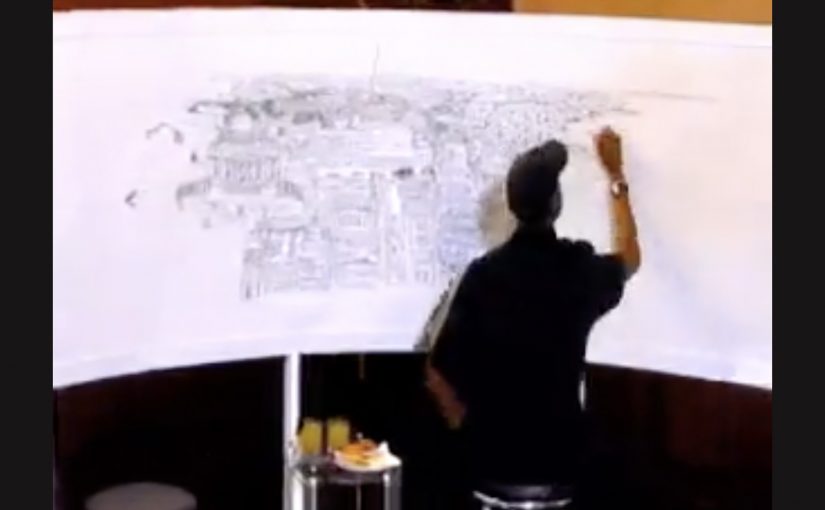
Stephen Wiltshire: Human Camera Over Rome

Stephen Wiltshire from London has been called the “Human Camera”. Here, “Human Camera” means the ability to retain and reconstruct a complex visual scene from memory with unusual precision. In this short excerpt, he takes a helicopter journey over Rome and then draws a panoramic view of what he saw, entirely from memory.

One flight, then a full panorama

The mechanic is simple and almost unbelievable. A brief aerial look at a city. Then a long, quiet reconstruction on paper, with landmarks, streets, and proportions held in his head rather than referenced from photos.

In global media and creativity culture, clips like this work because they show skill as proof, not as a claim.

The real question is why this setup makes the proof feel so undeniable.

Why it lands

It compresses something we usually outsource to cameras into a single human performance. The helicopter ride sets a hard constraint, and the drawing becomes the payoff. This is a stronger proof format than a simple claim of talent, because the audience can watch the capability being earned under pressure.

Extractable takeaway: When you want an audience to believe a capability, show the constraint first and the proof second. The tighter the constraint, the more convincing the proof feels.

What to steal for creative work

  • Lead with the constraint. The “how” is what makes the “wow” credible.
  • Make the process visible. Progress shots and time-lapse style excerpts turn craft into narrative.
  • Let detail do the selling. Specificity beats hype, especially in talent stories.

A few fast answers before you act

What is the core of this excerpt?

A short flight over Rome followed by a panoramic drawing created from memory, framed as a demonstration of exceptional recall and draftsmanship.

Why is the “Human Camera” label so sticky?

Because it gives people a shortcut for the ability they are seeing. It translates an abstract skill, visual memory, into a familiar metaphor.

What makes proof clips like this shareable?

The setup is instantly explainable, and the payoff is visual. Viewers can share it without adding context and the clip still lands.

How would you apply this structure to a brand story?

Show one clear constraint, then demonstrate the capability under that constraint. Keep the proof concrete and easy to verify on-screen.

What should creative teams borrow from this setup?

Borrow the sequence, not the spectacle. Put the limitation up front, make the process visible, and let the final proof resolve the tension.
BrandAlley: Oxford Circus FlashWalk

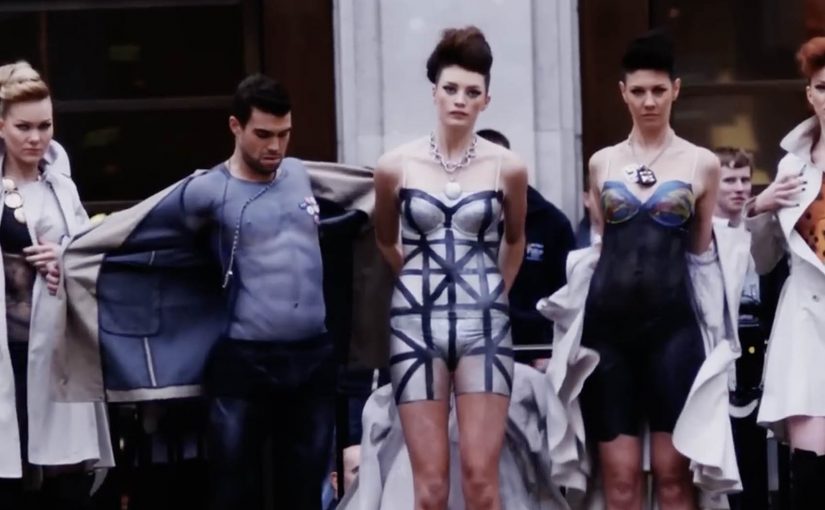
Shoppers hit Oxford Circus and suddenly the crossing becomes a runway. A quick catwalk appears, cameras come out, and the crowd freezes because this is not what people expect in the middle of a busy high street.

BrandAlley’s FlashWalk, a pop-up runway walk staged in public, uses a simple escalation. Models walk a catwalk route in public, styled with body paint rather than clothing, and the spectacle does the rest. It is designed to stop people mid-stride and turn street attention into store intent.

Why this breaks through retail clutter

In high-footfall retail streets, the strongest activations turn a familiar place into a short, unmistakable moment that people feel compelled to witness. Most retail messages compete on price and repetition. This competes on surprise. The catwalk format is instantly readable, so the idea does not need explanation. The audience understands what is happening in seconds, then stays for the contrast between a polished runway and an everyday street.

Extractable takeaway: If you can turn a familiar public space into an instantly recognisable format, you can earn attention before you spend on persuasion.

What BrandAlley is really buying

The real question is whether the moment gives people a story they want to repeat immediately. This is a footfall play built on earned attention. The real “media” is the crowd that gathers, the photos that get taken, and the story people tell immediately afterwards. The brand gets remembered because the moment was unusual, not because the copy was persuasive. If you can stage it safely and legally, a live street moment beats another static poster for first-time attention.

How to turn a street moment into footfall

  • Pick a location that already concentrates your audience. If the street is busy, your stunt scales faster.
  • Use a format people recognise instantly. A catwalk reads at a glance, which reduces friction.
  • Design for documentation. If the crowd films it, distribution becomes automatic.
  • Link the spectacle to a clear next step. The moment should point to the store or the sale without needing a second campaign to explain it.

A few fast answers before you act

What is the BrandAlley Oxford Circus FlashWalk?

It is a street-level catwalk stunt at Oxford Circus designed to stop passers-by and drive attention and footfall to BrandAlley, using a runway-style “flash walk” moment.

Why use a catwalk format for retail marketing?

Because it is instantly legible. People understand “runway” without instructions, so the stunt grabs attention fast and creates a crowd effect.

What makes this different from a typical outdoor ad?

Outdoor ads ask you to notice. This asks you to watch. The experience turns the street into the medium, which tends to generate photos, sharing, and conversation.

What is the biggest risk with shock or surprise stunts?

If the spectacle does not connect back to the store or the offer, you get attention without action. The link to the retail goal must be obvious on the day.

When does a footfall stunt outperform a discount campaign?

When you need cut-through, not only conversion. A stunt can reintroduce the brand to people who have tuned out price noise, then the offer does its job afterwards.