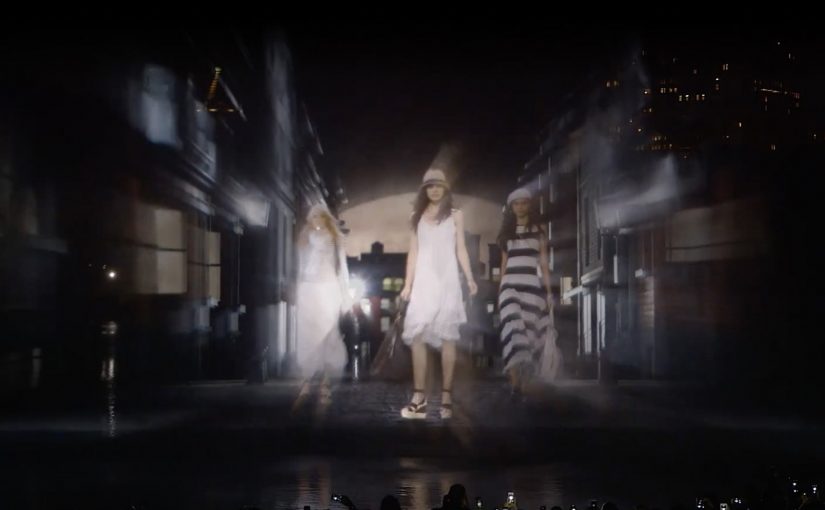
In September 2012, Hugo Boss live streamed its Boss Black Fall Winter 2012 fashion show directly in 3D. Now fast forward to 2014 and Ralph Lauren launches their Polo for Women Spring 2015 collection via a cinematic 4D experience. Here, “4D” means a physical projection experience that uses water, light, film, and live atmosphere to create depth and immersion.
On the evening of September 8th, during New York Fashion Week, Ralph Lauren turns the idea of a runway into a 60-foot-tall water-screen projection that towers above Manhattan’s Central Park, fusing fashion, art, and technology.
A runway made of water, light, and film
The mechanism is a projection-mapped water screen that functions like a living canvas. High-resolution scenes and “models” are projected onto a fan-shaped spray of water, creating the effect of figures moving across a surface that reads as a runway, even though it is literally water.
In global fashion marketing, immersive show formats are used to signal modernity and earn attention beyond the invited audience.
Why it lands
This works because it treats the collection launch as a public cultural moment, not a closed industry ritual. The scale is instantly legible. The format borrows from cinema. The setting adds myth. Central Park at night turns the presentation into something people talk about even if they cannot describe the garments in detail. Because the water-screen illusion reduces the show to one instantly retellable image, the experience travels beyond the guests who were physically there.
Extractable takeaway: When your category is saturated with beautiful imagery, compete on format. If the show itself becomes the story, the brand gets disproportionate reach without relying on louder messaging.
What Ralph Lauren is really doing
The real question is whether the launch format can make Polo for Women feel more culturally current than a conventional runway could. Ralph Lauren is using spectacle less to explain the collection than to position Polo as a modern media brand. The 4D framing functions as a brand statement. It positions Polo for Women as contemporary and city-native, and it uses spectacle to bridge runway tradition with a media behavior that is already screen-first.
What brand launch teams can borrow
- Choose a “native stage”. A location with cultural meaning can do as much work as the production itself.
- Make scale part of the idea. If it reads in one glance, it travels faster in photos, recaps, and retellings.
- Build a film, not a documentation. When the content is cinematic by design, it holds up outside the event moment.
- Let tech serve a single clear illusion. “Models walking on water” is the story. Everything else supports that.
A few fast answers before you act
What is Ralph Lauren Polo 4D?
It is a New York Fashion Week presentation that uses a projection-mapped water screen in Central Park to stage a cinematic runway-style experience for Polo for Women Spring 2015.
Why call it “4D”?
Coverage describes it as “4D” because the visuals are engineered to feel more immersive than a flat projection, with the water spray and depth effects contributing to the illusion.
How big was the water screen?
Reporting describes a water screen around 60 feet tall and 150 feet wide.
What makes this different from a normal runway show?
It blends film, set design, and projection mapping so the “runway” becomes an environment and a story, not just a walk-and-look format.
What is the transferable lesson for brand launches?
If you want a launch to travel, design for one clear, repeatable illusion that audiences can describe in a sentence.