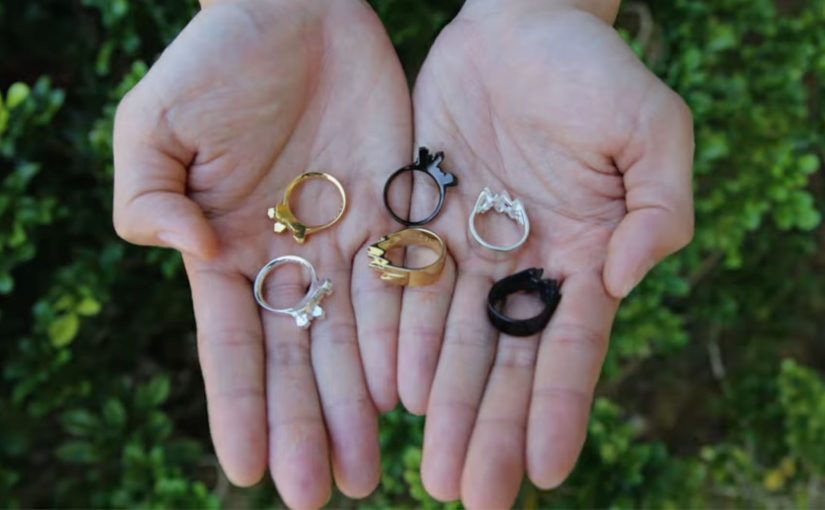
A ring becomes more than a ring when the pattern is literally yours.
“Crafted By My Heart” is an app launched by DDB Group Hong Kong that lets you customize jewelry with your own heartbeat. You place a finger over the smartphone’s camera and flash. The app detects subtle changes in finger coloration, measures your heartbeat, then translates its intensity and rhythm into a unique digital rendering. That rendering becomes the basis for a one-of-a-kind ring.
From pulse to pattern
Turn a biometric signal into a personal design language, then manufacture it as a physical object. By “biometric signal,” I mean a measurable body output, like heart rhythm, captured directly from the user.
How the experience works
The flow is intentionally simple. The mechanism matters because it converts an invisible, emotional idea (“this is us”) into visible proof that feels undeniably personal.
- Capture
You use the phone’s flash and camera to read your heartbeat through small changes in skin coloration. - Translate
The heartbeat becomes a digital rendering that is unique to your rhythm. - Craft
That rendering is used to create a ring. It is not a generic engraving. It is a form generated by your own signal.
In premium gifting categories, the story attached to the object often matters as much as the object itself.
The product choices are clear and bounded
The app offers two base designs, Surge and Sierra, with three finishes: gold, silver, or black silver. Rings cost between HK$1,198 and HK$1,588 (listed as US$155 to US$205), and take around 15 to 20 working days to complete.
Why a heartbeat beats engraving
Most “personalization” is decorative choice. This is structural personalization, where the customer input generates the form, which raises perceived meaning and makes the purchase easier to justify.
Extractable takeaway: If the customer’s input does not change the form of the product, you are offering decoration, not personalization, and it will be competed away by more options and lower price.
Personalization is structural, not cosmetic
A lot of customization is color, text, or surface. Here, the customer input generates the form. That feels materially more personal.
Technology removes the intimidation barrier
Biometrics and jewelry-making sound complex. The interaction is not. One finger. One phone. A result you can explain in one sentence.
The story is built-in
The product carries a narrative you can repeat instantly. It is your heartbeat, turned into a physical object. That makes it inherently giftable.
The deeper point
The real question is: how do you turn personalization from “more choices” into emotional proof people will pay for?
Meaningful personalization rarely comes from expanding menus. It comes from finding a signal that matters emotionally, translating it into a design system, and making the creation process easy enough that people actually do it.
What to steal
- Start with a signal, not a style. Pick an input customers already value emotionally (not just data you happen to have).
- Translate the signal into form. Make the input change geometry or structure, not just surface decoration.
- Keep choices bounded. Offer a small set of base options so the “unique” part stays legible.
- Design for retellability. If the owner cannot explain it in one sentence, it will not travel socially.
A few fast answers before you act
What is the core mechanic behind Crafted By My Heart?
The phone’s camera and flash detect heartbeat via subtle changes in finger coloration, then translate the rhythm into a digital rendering used to craft a ring.
What does the customer actually customize?
They select a base design and finish. The unique part is the heartbeat-generated rendering that drives the final piece.
What are the available designs and finishes?
Two base designs, Surge and Sierra. Three finishes, gold, silver, and black silver.
What are the price and production timelines?
HK$1,198 to HK$1,588 (US$155 to US$205). Around 15 to 20 working days.
What is the transferable lesson for other categories?
If you can capture a personal signal that people care about and make it visibly change the product’s form, you turn “customization” into meaning, not configuration.