
MINI: Photo Box Billboard

A billboard that turns fans into the creative

MINI has launched an innovative electronic billboard on Berlin’s Kurfürstendamm shopping boulevard. The billboard is connected to a Photo Box booth that captures the faces of MINI fans and puts them onto a massive screen along with each participant’s favourite MINI model, for a chance to win their preferred car.

Contestants have four colours and four models to choose from, including the MINI Hatch, Convertible, Clubman and Countryman.

The mechanism: Photo Box in Berlin. Facebook everywhere else

On the street, you step into the Photo Box, clamp on a pair of headphones, pick your colour and model, and the system outputs a ready-to-share moment on a giant public screen.

Fans from around the world can also join through the MINI Facebook app, where you can snap a picture with your webcam wearing a pair of virtual headphones in your favourite MINI colour.

In high-footfall city retail corridors, interactive out-of-home turns passersby into opt-in media, where participants choose to become the message through participation.

The real question is whether you can turn a simple preference into a public moment people want to share.

Why it feels modern: ecommerce choice, but on a building

The experience borrows the best part of online shopping. Configuration, without forcing the rest of it: specs, comparisons, and checkout. Because the billboard outputs a finished result in seconds, the act of choosing feels like content, not a form.

Extractable takeaway: When the environment publishes a participant’s choice at street scale, social proof becomes the distribution, and the moment feels bigger than a personal post.

The business intent: acquisition through identity

This is acquisition marketing that avoids hard selling. MINI lets people declare a preference. model plus colour. and then wraps that declaration in a contest mechanic. The brand gets reach, participation data, and a stream of shareable assets without asking people to create anything from scratch.

What to steal for your next interactive OOH build

  • Make the choice set small and satisfying. Four colours and four models is enough to feel personal, without feeling complex.
  • Design one iconic prop. Here, the headphones act as a visual signature that unifies street and Facebook participation.
  • Let the environment do the distribution. A giant screen creates built-in attention and bystander reach.
  • Mirror the experience online. The Facebook version keeps the same core mechanic so the idea travels beyond the location.

A few fast answers before you act

What is MINI’s Photo Box Billboard?

It is an interactive out-of-home billboard in Berlin where fans take a photo, choose a MINI model and colour, and see themselves displayed on a massive public screen, tied to a chance to win their preferred car.

How does the street mechanic work, step by step?

Step into the Photo Box. Pick your colour and model. The system captures your photo and outputs a finished, public “moment” on the billboard that is easy to share and talk about.

How does the Facebook app extend the same idea?

It mirrors the participation loop online. Fans take a webcam photo, add the campaign’s signature headphones motif in their chosen colour, pick a model, and participate without being in Berlin.

What role do the headphones play in the concept?

They are the visual signature that links the physical Photo Box experience to the Facebook version. One iconic prop makes the campaign instantly recognizable across channels.

Why does this work as acquisition marketing, not just a stunt?

It turns preference into a visible artifact. People declare model and colour, then the street-scale screen adds social proof and bystander reach while the brand collects intent signals.

What should you measure if you build something like this?

Participation rate, completion rate, average time to choose, shares, and downstream lead or test-drive intent. Also track whether the billboard creates bystander attention, not only participant engagement.
MINI: The Art of Omission Posters

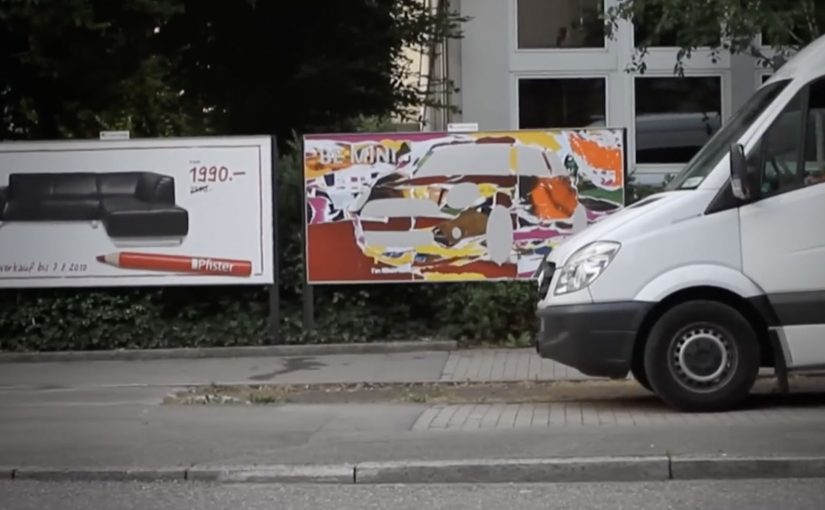
A “MINI” has only the things it really needs. That means getting rid of the superfluous and keeping an eye on the essentials. MINI calls this “Minimalism”.

So Draftfcb/Lowe Group in Zürich creates a poster series across Switzerland that demonstrates the MINI art of omission in an intentionally simple way. Here, “art of omission” means the idea is carried by what you remove, not what you add. Reportedly, more than 20 executions appear in the wild, framed as genuine, unique works of art rather than disposable tactical print.

Minimalism as a communication system, not a slogan

The mechanism is straightforward: take the brand’s “minimum necessary” philosophy and express it through omission, letting what is missing do as much work as what is shown.

In European automotive advertising, stripping a message down to a single visual point is often the fastest way to win attention in cluttered public spaces.

Why omission cuts through

Most posters fight for attention by adding. More copy. More product shots. More badges. Omission flips that logic. The real question is whether your idea is strong enough to survive subtraction. If simplicity is part of the product truth, omission beats piling on claims. The viewer has to resolve the idea themselves, and that small moment of mental completion makes the message stick.

Extractable takeaway: If the audience can reconstruct the meaning from what you remove, the idea is strong. If they need you to explain it, you are not done simplifying.

What the street placement adds

Putting the work across Switzerland turns “Minimalism” into a repeated encounter, not a one-off reveal. Repetition is the multiplier here, because every new variation reinforces the same discipline: remove anything that does not earn its place.

How to apply omission in your next poster

  • Use subtraction as the creative device. If you cannot remove an element without losing the point, it is probably essential.
  • Let the format carry the proof. A minimalist brand idea is more believable when the execution is minimalist too.
  • Design for one-second comprehension. The fastest posters are the ones that do not ask for reading.
  • Build a series, not a single hero. Variations teach the audience the “rule” of the campaign.

A few fast answers before you act

What is this MINI “Minimalism” poster idea in one line?

A Swiss poster series that communicates MINI’s “keep only what you need” philosophy by using omission as the main creative device.

Why does omission work better than adding more message?

Because it interrupts expectations in public space and forces a quick mental “solve”, which increases recall.

What makes this feel clutter-breaking?

The work reduces visual noise instead of competing with it, so the absence becomes the attention trigger.

When should a brand use this pattern?

When the brand truth can be expressed as one visual point, and when simplicity is a credible part of the product story.

How do you decide what to remove without losing meaning?

Strip the execution until the message breaks, then add back only the one element that restores the point. If you need multiple add-backs, the idea is not single-point yet.

MINI: Getaway Stockholm 2010

After their recent Talent Poaching via Facebook Places campaign, Jung von Matt is back with the MINI Getaway Stockholm 2010 campaign.

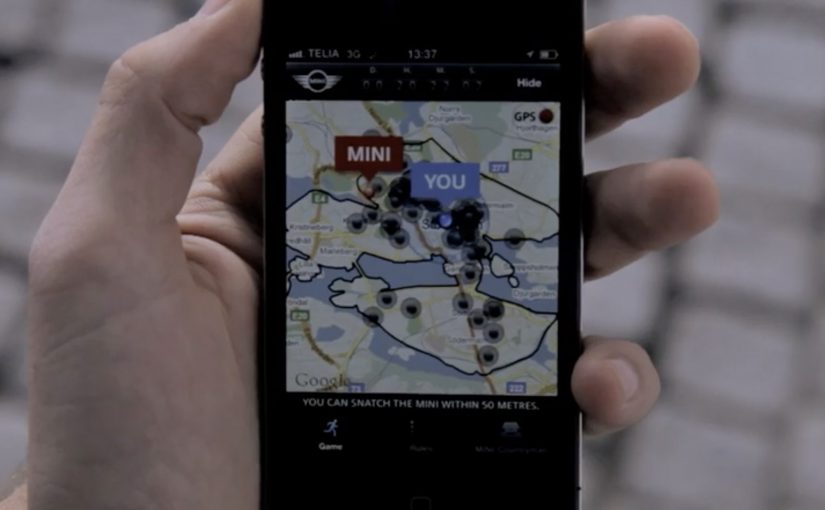
The premise is a reality game that challenges you to do the impossible: stay at least 50 metres away from everybody else in Stockholm city between October 31st and November 7th 2010. If you succeed, you win the new MINI Countryman.

A city-wide game disguised as a launch

This is not a typical “watch and forget” film. It is a product introduction that behaves like a week-long public challenge, using the city as the playing field and social friction as the difficulty setting. Here, “social friction” means the everyday collisions and proximity of city life that make distance hard to maintain.

The mechanic that makes it feel impossible

Mechanically, the campaign turns distance into drama: the rule is simple, but enforcing it in a dense capital city is the whole point. Every street corner becomes a decision, and every near-miss becomes part of the story players tell afterwards.

In European automotive launches, turning a product message into a participatory public challenge is a reliable way to earn attention without leaning on price or specs.

Why this breaks through

Most launches compete on features. This one competes on behavior. It gives people a clear goal, a clear constraint, and a clear reward, then lets the public generate the content through their attempts to win. Because the rule forces constant micro-decisions in public space, it creates tension that keeps spectators watching and participants talking. A constraint-led public game beats a feature-led launch when you need sustained talk value. The real question is whether your launch can earn attention by making the public do the storytelling.

Extractable takeaway: If you can express your launch as one repeatable rule plus one real-world constraint, you turn passive awareness into a week of attempts, near-misses, and shareable stories.

The business intent behind the play

The obvious headline is the prize, but the deeper intent is talk value and repeated engagement over a full week. By “talk value,” I mean the likelihood people will mention it to others and keep the story alive. A launch that unfolds day by day creates more chances for people to hear about it, join late, or simply follow along as a spectator.

Launch moves worth copying

  • Build one rule people can repeat. If the mechanic fits in a single sentence, it spreads faster.
  • Use a constraint, not just a reward. Difficulty creates stories. Stories create sharing.
  • Make the environment part of the experience. When the city is the stage, the campaign feels larger than the media.
  • Stretch the reveal over days. A week-long cadence beats a one-day spike if you want sustained attention.

A few fast answers before you act

What is MINI Getaway Stockholm 2010 in one line?

A week-long reality game in Stockholm with one simple rule and a real prize: stay 50 metres away from everyone else and win a MINI Countryman.

Why does the “50 metres” rule matter?

It turns a basic challenge into something socially and logistically hard in a busy city, which creates tension, stories, and spectator interest.

What makes this feel less like advertising?

The campaign centers on participation and behavior. People engage with the challenge first, and the brand benefits as the enabler of the experience.

What is the transferable lesson for other brands?

If you want attention without shouting, turn your launch into a simple public game with a constraint that generates stories over time.

How do you adapt this pattern without a big prize?

Keep the single repeatable rule, make the constraint genuinely hard in the real world, and use a reward that feels meaningful enough for people to attempt and for others to follow.