
Ralph Lauren: Polo 4D

In September 2012, Hugo Boss live streamed its Boss Black Fall Winter 2012 fashion show directly in 3D. Now fast forward to 2014 and Ralph Lauren launches their Polo for Women Spring 2015 collection via a cinematic 4D experience. Here, “4D” means a physical projection experience that uses water, light, film, and live atmosphere to create depth and immersion.

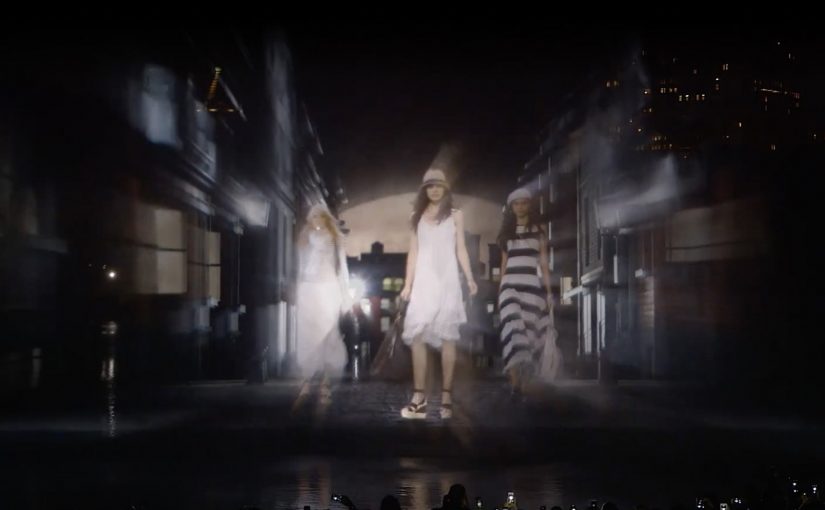
On the evening of September 8th, during New York Fashion Week, Ralph Lauren turns the idea of a runway into a 60-foot-tall water-screen projection that towers above Manhattan’s Central Park, fusing fashion, art, and technology.

A runway made of water, light, and film

The mechanism is a projection-mapped water screen that functions like a living canvas. High-resolution scenes and “models” are projected onto a fan-shaped spray of water, creating the effect of figures moving across a surface that reads as a runway, even though it is literally water.

In global fashion marketing, immersive show formats are used to signal modernity and earn attention beyond the invited audience.

Why it lands

This works because it treats the collection launch as a public cultural moment, not a closed industry ritual. The scale is instantly legible. The format borrows from cinema. The setting adds myth. Central Park at night turns the presentation into something people talk about even if they cannot describe the garments in detail. Because the water-screen illusion reduces the show to one instantly retellable image, the experience travels beyond the guests who were physically there.

Extractable takeaway: When your category is saturated with beautiful imagery, compete on format. If the show itself becomes the story, the brand gets disproportionate reach without relying on louder messaging.

What Ralph Lauren is really doing

The real question is whether the launch format can make Polo for Women feel more culturally current than a conventional runway could. Ralph Lauren is using spectacle less to explain the collection than to position Polo as a modern media brand. The 4D framing functions as a brand statement. It positions Polo for Women as contemporary and city-native, and it uses spectacle to bridge runway tradition with a media behavior that is already screen-first.

What brand launch teams can borrow

  • Choose a “native stage”. A location with cultural meaning can do as much work as the production itself.
  • Make scale part of the idea. If it reads in one glance, it travels faster in photos, recaps, and retellings.
  • Build a film, not a documentation. When the content is cinematic by design, it holds up outside the event moment.
  • Let tech serve a single clear illusion. “Models walking on water” is the story. Everything else supports that.

A few fast answers before you act

What is Ralph Lauren Polo 4D?

It is a New York Fashion Week presentation that uses a projection-mapped water screen in Central Park to stage a cinematic runway-style experience for Polo for Women Spring 2015.

Why call it “4D”?

Coverage describes it as “4D” because the visuals are engineered to feel more immersive than a flat projection, with the water spray and depth effects contributing to the illusion.

How big was the water screen?

Reporting describes a water screen around 60 feet tall and 150 feet wide.

What makes this different from a normal runway show?

It blends film, set design, and projection mapping so the “runway” becomes an environment and a story, not just a walk-and-look format.

What is the transferable lesson for brand launches?

If you want a launch to travel, design for one clear, repeatable illusion that audiences can describe in a sentence.
Castello: Eat the Art

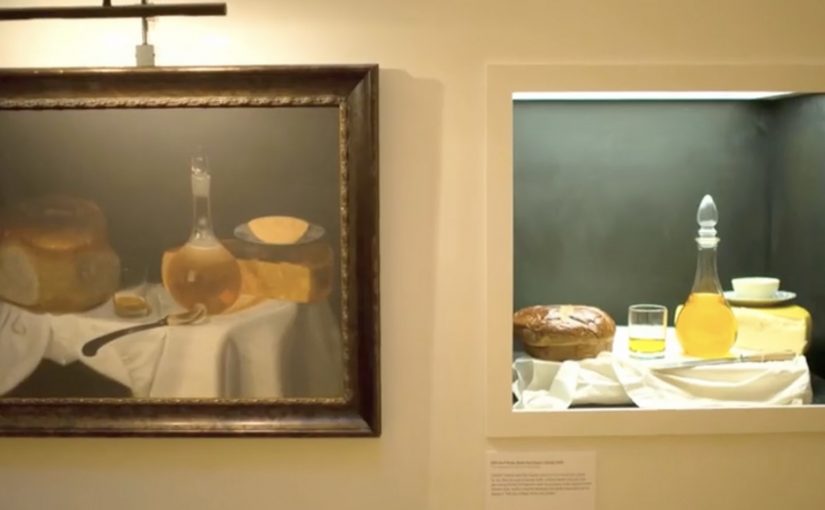
Cheese brand Castello teams up with ad agency Duval Guillaume to give New Yorkers the opportunity to taste their cheese in a very original way. A pop-up museum is set up at Grand Central Terminal, where famous still-life paintings that contain cheese are reproduced with great precision using real Castello cheeses. The difference is simple. You can smell and eat the copied works of art.

Over the course of two days, more than 500,000 visitors reportedly pass through the exhibition, and around 40,000 people actually taste the cheese.

Turning “look” into “taste”

The mechanism is sensory sampling disguised as culture. Borrow the credibility of recognizable art, rebuild it with the product itself, then let the audience complete the experience by tasting the thing they are looking at.

In urban retail environments where people are overloaded with visual messages, multisensory experiences create disproportionate stopping power because they feel like a break from advertising, not another ad unit.

Why it lands

This works because it turns product trial into a story people want to repeat. A free sample is forgettable. “I ate a painting made of cheese at Grand Central” is social currency, which means it is a simple story people want to pass on. It gives the brand an earned reason to be talked about without needing heavy branding on every surface.

Extractable takeaway: If your category wins on taste, do not hide behind claims. Build a public moment where trying the product feels like participating in something bigger than a sample.

What the business intent looks like

The real question is how to turn food sampling into a public moment people actively choose and then talk about. Castello gets scale and relevance in one move. Grand Central delivers footfall. The art framing delivers permission to pause. And the tasting converts attention into the only proof that matters for food. “It is good”. This is a stronger food-marketing move than standard sampling because it makes trial memorable.

What food brands can steal from this

  • Wrap sampling in a reason to stop. People do not queue for “try this”. They queue for a moment.
  • Use a familiar cultural code. Still-life paintings are instantly legible, even at walking speed.
  • Let the product be the medium. When the product is literally the artwork, the message cannot be missed.
  • Design for retellability. If the experience can be summarized in one sentence, it travels further.

A few fast answers before you act

What is Castello “Eat the Art”?

It is a pop-up museum experience where still-life paintings featuring cheese are recreated using real Castello cheeses, and visitors can smell and taste the “art”.

Why stage it in Grand Central Terminal?

Because high footfall increases reach, and a transit setting makes the surprise feel bigger. You find a museum moment in the middle of a commute.

Is this advertising or sampling?

It is sampling, delivered through an ambient, cultural format that makes the trial feel special rather than transactional.

What makes the concept effective for food brands?

It converts attention into taste. Food marketing becomes more persuasive when it gets people to try the product quickly, in a memorable context.

What is the simplest way to adapt the pattern?

Pick a familiar cultural frame your audience already respects, then embed product trial directly into that frame so trying the product feels like participation.

KLM: Live High Five

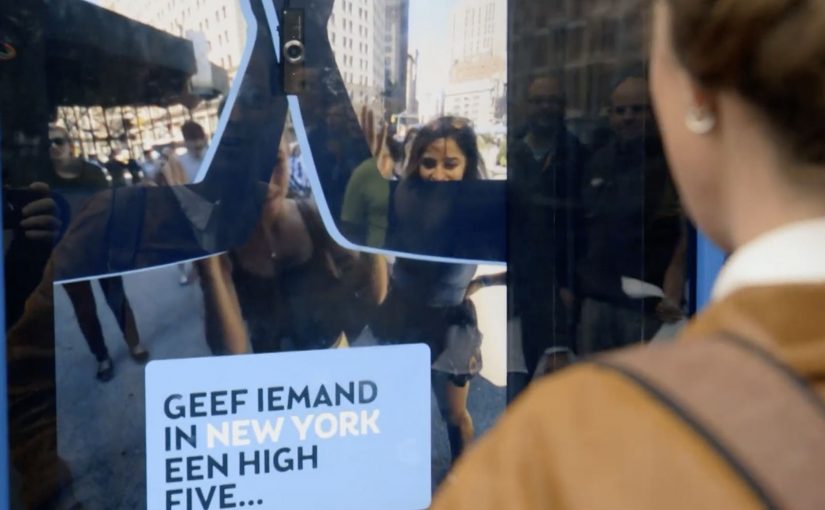
On 28 August, KLM connects hundreds of people in Amsterdam and New York via a live interactive video display, letting strangers on the streets of two cities come face to face.

It echoes the kind of “city to city” street connection seen before, such as the French railway (SNCF) linking Lyon and Brussels.

How the high five contest works

The twist is competitive: the connected pairs are asked to high five each other through the screens. For every successfully timed high five, participants win two tickets to New York or Amsterdam.

In global travel marketing, adding a clear participatory mechanic, meaning a simple action anyone can attempt without instruction, turns a “nice moment” into a repeatable behavior people recruit others into.

Why a high five is the right interaction

A high five is universally understood and visually obvious at distance. It is also time-bound, which creates tension. People lean in. They coordinate. They try again. That retry loop, the quick cycle of attempt, miss, adjust, and try again, is where energy builds and the crowd becomes part of the content.

Extractable takeaway: Pick an interaction that is instantly readable to bystanders, time-bound, and designed to invite visible retries. That is how the crowd becomes the amplification.

What KLM is really buying here

This is a route brand idea, meaning a story that makes a specific connection between two places feel tangible, disguised as play: KLM makes the transatlantic connection feel immediate, human, and winnable. The real question is whether your activation makes distance feel collapsible in under five seconds. This is the right kind of public interactivity when your promise is connection between places. The prize is valuable, but the real asset is the public proof that the brand can engineer connection between two cities in a way passers-by can instantly grasp.

Patterns to borrow for your own city-scale activation

  • Use one gesture everyone knows. The simpler the action, the more strangers will attempt it without instruction.
  • Add a timing challenge. Time-based coordination creates drama and repeat tries.
  • Make the reward match the story. Here, tickets reinforce the “two cities” premise.
  • Design for crowds. The best interactions are legible to bystanders, not just participants.

A few fast answers before you act

What is KLM Live High Five in one line?

A live video street installation connecting Amsterdam and New York where timed high fives between cities unlock travel tickets.

What is the key mechanism?

Two public screens link strangers in real time, then convert the connection into a simple, repeatable contest action.

Why does the high five mechanic work so well?

It is universal, physical, and instantly readable. The timing requirement creates suspense and encourages repeated attempts.

What is the biggest execution risk?

If timing feedback feels laggy or unclear, people stop retrying. The interaction needs instant, visible confirmation so the crowd stays invested.

What is the transferable lesson?

If your idea is “connection”, make people physically coordinate across distance and reward the moment with a prize that matches the narrative.