
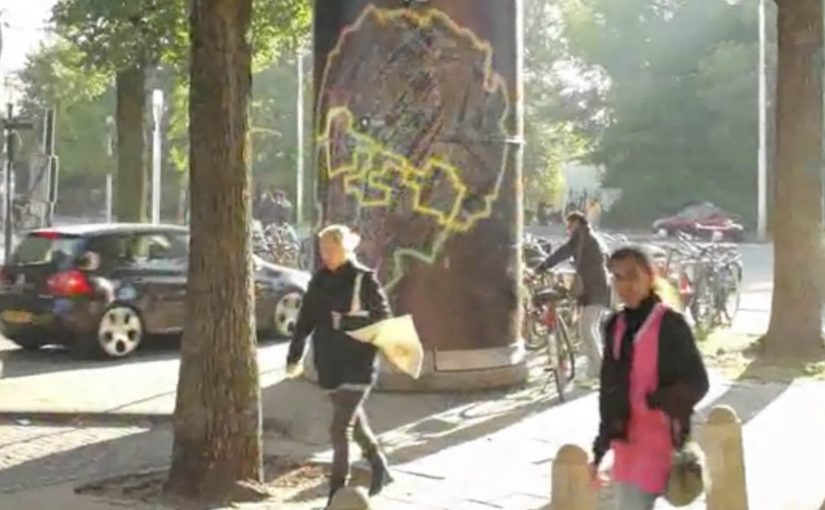
Boondoggle Amsterdam came up with a campaign for Nike that made running less serious. They distracted youngsters from their boring running schedules and challenged them to release their creativity on Amsterdam by using their feet as paint instead.
A Facebook app called “Take Mokum” (Amsterdam’s local nickname) was developed that allowed runners to make digital graffiti on the map of Amsterdam. All they had to do was actually run the route and upload their KMs with Nike+. In this context, Nike+ is simply the upload that validates the kilometres. The app would then paint the graffiti for them. These graffiti pieces could then be shared, and liked fanatically.
Running as a creative tool, not a discipline
The mechanism is beautifully simple: convert effort into expression. The runner designs a “tag” by choosing a route. Here, a “tag” is the graffiti-style signature you draw with your route. The city becomes the canvas. Nike+ becomes the proof that the route was actually run. Then the app visualises the path as graffiti, so the output feels like art rather than exercise data.
That flips the motivation model. Because the route becomes a visible mark, every kilometre contributes to something you can show, not just a number you log. You are not running to hit a number. You are running to create something worth showing. The real question is whether you can turn a fitness discipline into a culture-native act of self-expression.
In youth-facing, city-based campaigns, adoption often follows social signalling, not self-optimisation.
Why it lands with youngsters
This campaign taps into identity and visibility. Graffiti culture is about leaving a mark. Take Mokum lets people do that in a digital layer without vandalising anything. The “like” loop adds social reward. The route becomes content, not just a workout.
Extractable takeaway: If you want people to stick with effort, make the output look like identity and let the community reward it.
It also removes the seriousness that can make running feel like punishment. The challenge is playful. The accomplishment is shareable.
The intent: make Nike’s running promise felt, not claimed
The business intent is aligned with Nike’s broader mission to change running. Instead of telling young people that running is cool, the campaign makes running a means to do something else: create, compete for attention, and express style. The product story is embedded in the behaviour.
Behaviour-change work should treat data as validation and culture as the incentive.
The result, as described: young Amsterdam started running, and Nike’s mission to change running was actually experienced by youngsters.
What to steal from Take Mokum
- Turn effort into an artefact. People stick with habits when the output feels worth keeping or sharing.
- Let users design the challenge. The route is the creative input. That increases ownership.
- Use data as validation, not as the headline. Nike+ proves the run. The graffiti is the reward.
- Build a social loop. Sharing and liking are not add-ons. They are the motivation engine.
- Match the culture. The campaign borrows from street expression rather than “fitness discipline”.
A few fast answers before you act
What is Nike Take Mokum?
It is a Facebook app that lets runners create digital graffiti on an Amsterdam map by running a route and uploading the kilometres through Nike+.
How does the app turn a run into graffiti?
The runner’s route becomes the “drawing”. After the Nike+ upload, the app visualises the path as a graffiti-like mark on the city map.
Why is this motivating compared to a normal running plan?
Because the reward is creative and social. You produce something you can share and get reactions to, not just a time and distance record.
What audience behaviour did this campaign aim to create?
To get young people running by making the activity feel playful, expressive, and socially visible, rather than structured and serious.
What is the key takeaway for behaviour-change campaigns?
Motivation improves when you convert effort into identity. Give people a way to express themselves, then let the community reinforce it.