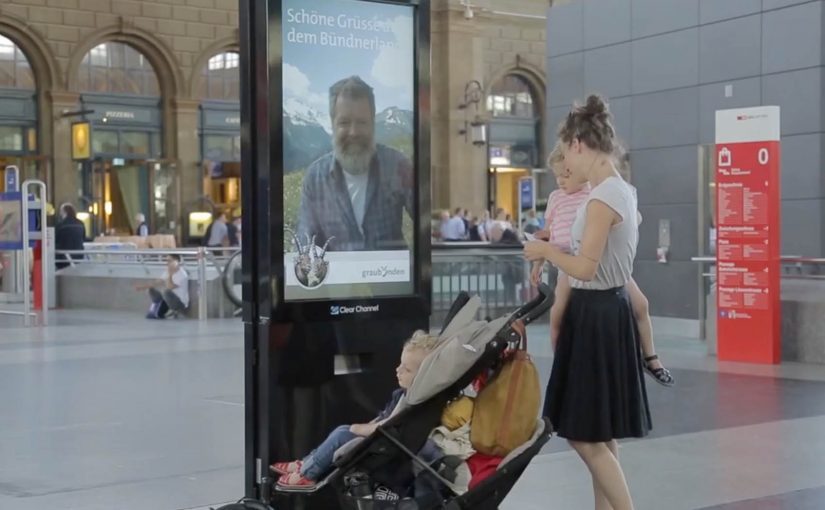
A stressed commuter walks through Zurich’s main train station, eyes forward, pace set to “late again.” Then a large interactive display stops them. On screen is a real Graubünden mountain man. He sees them. He speaks to them. He invites them to step out of the city and into the mountains. The offer is not “someday.” It is now. An all-expense-paid trip to Vrin, a mountain village in the Lumnezia Valley. The only catch is brutal and perfect. They have to drop everything and jump on the train leaving from the next platform.
Escape in one decision
Bring the mountain to the most hectic place in Switzerland, then make escape a one-decision act.
The context you already build on
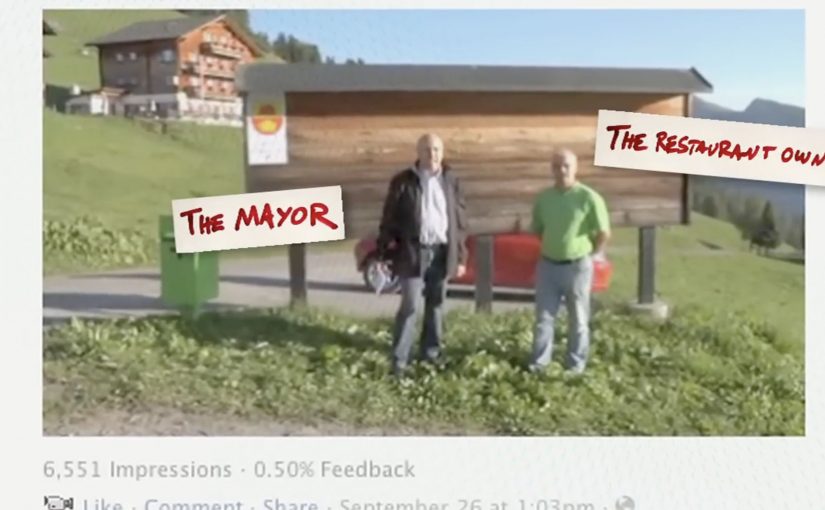
In 2011, Graubünden Tourism and Jung von Matt had created a clever stunt to publicize the remote mountain village of Obermutten on Facebook. There they targeted people closer to home, specifically stressed urban commuters in a Zurich train station.
What happens at Zurich station
Step 1. Replace “beautiful scenery” with a human invitation
Instead of showing landscapes, the campaign puts a real local face in front of commuters. He can see and talk to people as they walk past. It feels personal, not broadcast.
Step 2. Turn interaction into an offer with real stakes
Anyone who engages is offered an all-expense-paid trip to Vrin. The offer is framed as a cure for stress, delivered at the exact moment stress is visible.
Step 3. Make the brand promise non-negotiable with one constraint
The only catch is the mechanism. By mechanism, I mean the single rule that turns the offer into a test. They have to drop everything and take the train that is about to leave from the next platform. That single constraint transforms the idea from a nice story into a real test of desire.
In European destination marketing, the hardest part is turning “someday” escape into a choice people will make on an ordinary weekday.
The real question is: can you turn “escape” from a promise into a decision someone can make in under a minute?
Why this works as live communication
Here, “live communication” means a real person responding in real time, not a pre-recorded loop.
Extractable takeaway: When you sell an experience, shorten the gap between promise and proof. Use live interaction plus one simple constraint so the choice becomes meaningful.
It collapses the distance between promise and proof
Tourism often sells “escape” as a future plan. Here, escape is immediate, and the decision is binary. Stay, or go.
It uses technology to create intimacy, not spectacle
The interactive display is not the point. The point is that someone in the mountains is speaking to you directly in the middle of the city.
The constraint is the creative
The “next train” rule is what makes it unforgettable. It forces commitment. It also creates the story people retell because it is a moment with consequence.
The deeper point
Escape marketing works best when it demands a real choice, not passive appreciation. If you want people to believe in a destination, do not just show it. Put a human being from that place in front of the audience, then convert emotion into action with a simple, immediate next step.
Practical moves for instant escape offers
- Lead with a human: Put a real local face in front of people, not a montage of scenery.
- Make “now” the default: Frame the reward as immediate, not a future plan or a delayed sweepstakes.
- Use one constraint: Add a single rule like “next train” so the offer becomes a test of intent.
- Design for retellability: Build a moment with consequence that people can summarize in one sentence.
A few fast answers before you act
What is The Great Escape in one sentence?
An interactive display in Zurich station lets a real Graubünden mountain man speak to commuters and invite them on an immediate trip to Vrin.
What makes it different from standard digital out of home?
It is not a looped video. It is a live, human interaction that turns attention into a real decision.
What is the key mechanic that creates urgency?
The “next platform, next train” constraint. People have to go now, not later.
How does it connect to the earlier Obermutten work?
It builds on the same strategy. Make a remote mountain place culturally visible through an idea that people actively participate in.
What is the reusable pattern for brands?
If your promise is experiential, create a live proof moment, then add a constraint that forces a meaningful choice.