Audi City London: Future of Auto Retail

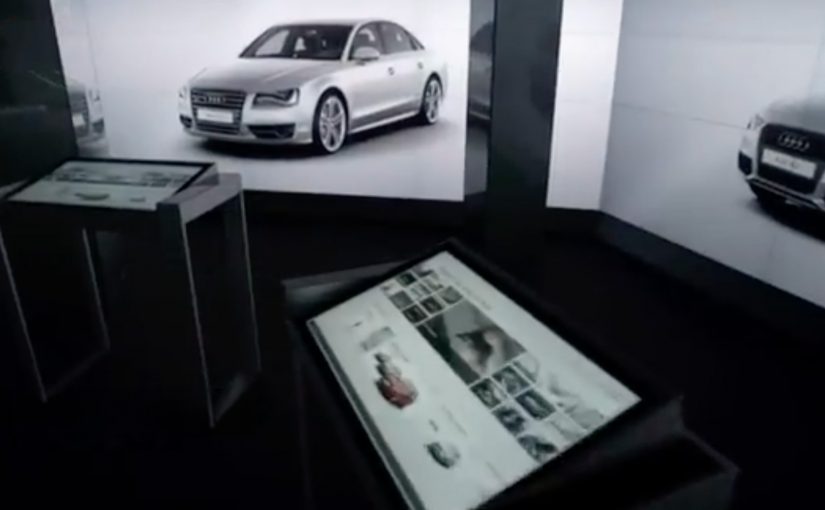
To solve space challenges at its retail outlet in Piccadilly Circus, Audi has used groundbreaking technology to present its growing model line-up.

Visitors can now digitally select their vehicle from several hundred million possible configurations and experience it in realistic 1:1 scale on special powerwalls.

Various details such as drivetrain, bodyshell, LED light technology etc are presented with interactive gestures, touch and physical sample recognition methods. The whole immersive experience helps make the innovations understandable on an intuitive level.

The future of automotive retail is here and Audi is leading the way, with plans to roll out the experience at 20 locations in major international cities by 2015.

Why Audi City matters beyond “wow”

This is not digital for digital’s sake. It is a retail operating model that turns limited floor space into effectively unlimited shelf space, without forcing the customer to imagine the product from a brochure or a small screen.

  • Scale without inventory. Hundreds of millions of combinations without storing hundreds of cars.
  • Confidence through realism. A 1:1 representation reduces the gap between selection and purchase.
  • Innovation made tangible. Drivetrain, bodyshell, and lighting become understandable through interaction.

The showroom becomes an interface

Audi City treats the store like an interface layer between customer intent and product complexity. Gesture, touch, and physical sample recognition are not gimmicks. They are interaction patterns designed to help people explore, compare, and decide.

That is the critical shift. Instead of staff explaining everything verbally, the environment itself becomes the explainer.

In global automotive retail, immersive configuration experiences matter most when they reduce decision friction without expanding showroom footprint.

What this signals about the future of automotive retail

If Audi rolls out this concept across major cities, the implication is clear. Physical retail will not disappear. It will evolve into fewer, smaller, higher-impact locations that are designed for configuration, education, and decision-making, while fulfilment happens elsewhere.

  1. Fewer cars on the floor. More options in the system.
  2. More guided discovery. Less brochure-driven selling.
  3. More consistent global experience. Less dependence on local store size.

What to take from this if you run retail or CX

  1. Use digital to remove physical constraints. The business problem here is space, not “innovation theatre”.
  2. Design interaction for comprehension. Gestures, touch, and samples work when they help people understand complexity quickly.
  3. Make exploration feel premium. 1:1 scale and high fidelity visuals create confidence and desire.
  4. Separate “experience” from “inventory”. Let stores sell decisions, not stock.

A few fast answers before you act

What is Audi City London?

It is an Audi retail concept in Piccadilly Circus that uses large digital powerwalls to let visitors configure vehicles from hundreds of millions of combinations and view them in realistic 1:1 scale.

Why does 1:1 scale matter in a configurator?

It reduces uncertainty. People can judge proportions, design choices, and visual details more confidently than on a small screen.

How does the experience help explain innovation?

By presenting components like drivetrain, bodyshell, and LED lighting through interactive exploration using gestures, touch, and physical sample recognition.

What business problem does Audi City solve?

It addresses limited showroom space while still presenting a broad and growing model line-up and configuration depth.

What is the transferable lesson for other retailers?

Use immersive digital interfaces to expand choice and understanding without expanding physical footprint, and design interactions that make complex decisions feel intuitive.

Shopping & Money: When Payment Disappears

Shopping is 24×7. It happens everywhere, not just in a store or on a website.

The intersection of smartphones, social media, online and offline shopping puts the consumer squarely in control. The shopping journey is no longer linear. Discovery can start in a social feed, comparison can happen on a phone while standing in front of a shelf, and purchase can happen without ever “going to checkout”.

That shift is exactly what PayPal leans into with a hype video depicting what the future of shopping might look like. The story is not only about paying faster. It is about payment disappearing into the experience, powered by PayPal’s next generation payment platforms as they aim to re-imagine money.

Payment is becoming invisible

We already see the building blocks all around us.

  • The phone becomes the remote control for shopping. Discovery, decision, and purchase collapse into one device.
  • Identity and trust become the key. Not the physical wallet.
  • The act of payment moves from a moment to a background process. It becomes an outcome of intent, not a step.

What changes is not only how you pay. It is when you pay. Or more precisely, whether you even notice it.

In commerce ecosystems, the player that owns identity, trust, and the payment layer can influence far more than checkout. It can shape the full shopping journey.

The consumer is in control. Brands and retailers adapt or fade

When consumers can shop anytime and anywhere, the competitive battlefield shifts.

  • Convenience becomes design. You win by removing friction, not by adding features.
  • Context beats channel. The store is not a place. It is a moment, a need, a trigger.
  • Attention becomes the scarce currency. If payment is effortless, the real fight is for preference, trust, and relevance.

In this model, money is not the centerpiece. The experience is.

What the PayPal vision is really selling

Commerce becomes ambient.

PayPal’s narrative previews a broader shift. Commerce becomes ambient.

The hype is the packaging. The strategic message underneath is that payment platforms want to sit one layer deeper in the journey. Not at the end, but throughout.

They aim to become the connective tissue between identity, intent, and transaction.

This is why the video matters. It is not a product demo. It is a stake in the ground. The future of shopping is continuous, and the future of money is embedded.

What to watch next

If payment disappears, a few questions matter more than ever.

  • Who owns the consumer relationship when the transaction becomes frictionless?
  • How do trust, privacy, and permission evolve when identity becomes the wallet?
  • What does loyalty look like when the purchase moment is no longer a moment?

The brands and retailers who win treat checkout as a symptom. Not a destination.


A few fast answers before you act

What does “payment disappears” actually mean?

Payment becomes a background step. The shopper focuses on choosing and receiving, while the transaction happens with minimal explicit action.

Why is the smartphone central to this shift?

It combines identity, context, discovery, and transaction capability in one always-on device, collapsing steps that used to be separate.

What is the strategic risk for retailers?

If the payment layer owns identity and trust, it can also mediate choice. Retailers risk becoming interchangeable unless they add differentiated experience value.

What is the opportunity for brands?

To design end-to-end journeys that reduce friction and increase relevance. When paying fades away, experience quality becomes more visible.

What is the hardest part to get right?

Trust and permission. Invisible payment only scales when consumers feel in control and understand when and why transactions occur.

Homeplus Subway Virtual Store: Mobile Aisle

A retail store that lives on a subway wall

Homeplus turns a familiar commuter moment into a shopping moment.

Instead of asking people to visit a store, Homeplus brings the store to where people already wait. In the subway.

The virtual store appears as a life-size shelf display on station walls. Products are shown like a real aisle, complete with packaging visuals and clear selection cues.

The value is not novelty. It is time leverage. Shopping happens in minutes that normally get wasted.

How it works

The experience is deliberately simple.

A commuter scans product codes with a smartphone, adds items to a basket, and completes the order digitally. Delivery then happens to the home address.

That flow changes the meaning of convenience. The store is no longer a destination. It becomes an interface layer that can be placed anywhere footfall exists.

In high-density urban retail, the strongest convenience plays capture existing dwell time instead of trying to create new store visits.

Why this idea matters more than the technology

It is tempting to frame this as a QR-code story. That misses the point.

The strategic innovation is contextual retail design.

Homeplus places the catalog where time is available, reduces friction to scan, pay, and deliver, and treats the physical environment as media and distribution at once.

The subway becomes a high-intent moment. People have time, they are idle, and they are already in a routine. Retail becomes a habit stitched into commuting.

What this signals for retail experience design

This concept highlights a shift that becomes increasingly important.

Retail experiences are not confined to stores or screens. They can be embedded into everyday environments where attention is naturally available.

For leaders, the question becomes where the best micro-windows of time exist in customers’ lives, and what a purchase flow looks like when it fits perfectly into those windows.

The real lesson. The aisle is a format, not a place

Homeplus shows that an aisle is a navigational model. It does not have to live inside a store.

Once that is accepted, the design space expands. Aisles can be printed. Aisles can be projected. Aisles can appear in transit, at events, or in high-dwell environments.

The pattern is consistent. Retail becomes more modular. Distribution becomes more creative. Convenience becomes a design discipline.


A few fast answers before you act

What is the Homeplus subway virtual store?

It is a life-size “aisle” display in a transit environment where commuters scan products with a phone and order delivery to home.

What is the core mechanic that makes it work?

A fast scan-to-basket flow that turns waiting time into a purchase moment, with fulfillment doing the heavy lifting after the scan.

What is the main prerequisite for repeating this model?

Operational reliability in fulfillment. If delivery fails, the experience collapses because the shopper has no store fallback.

Why is this more than a QR-code story?

The strategic innovation is placing a commerce interface inside a high-dwell routine, using the physical environment as both media and distribution.