
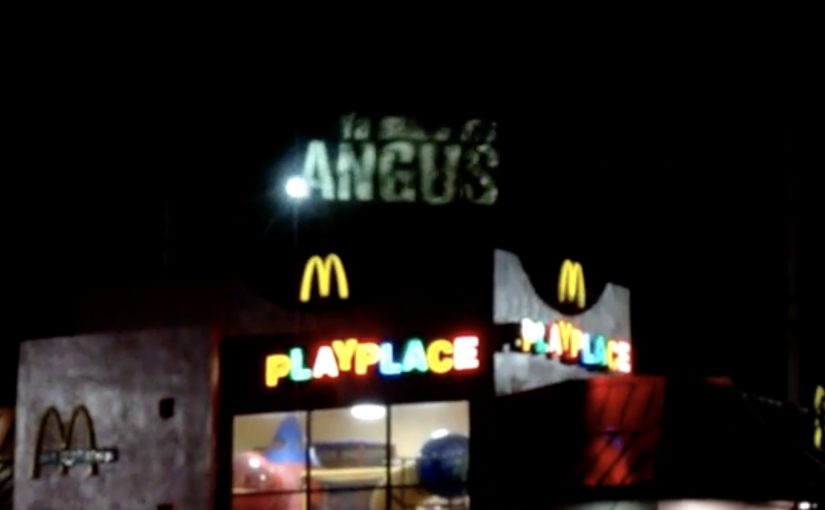
McDonald’s Angus Burger: Grill Smoke

When the medium is literally the product moment

A great ambient strategy by Leo Burnett Puerto Rico to launch the Angus Burger for McDonald’s.

The mechanic: “smokvertising” in one move

Here, “smokvertising” means using real grill smoke as the placement. As smoke rises, imagery and copy are projected onto it, so the message appears to live inside the smell and heat of cooking rather than on a static board.

In high-frequency food and beverage categories, ambient work performs best when it hijacks a real-world byproduct of consumption and turns it into a media surface.

Why it lands

This is attention without shouting. People notice it because it behaves unlike advertising, then the sensory context does the rest. Smoke is already a cue for freshness and grilling, so the brand gets meaning “for free” before a single word is read. It also creates a built-in crowd moment: smoke draws eyes, the projection rewards the look, and the whole thing becomes naturally filmable.

Extractable takeaway: If you want a product to feel immediate, put the message inside an existing sensory cue people already associate with the product, then keep the copy minimal and let the environment do the persuasion.

What the brand is really buying

This is not only awareness. It is salience. The work aims to anchor “Angus Burger” to the visceral trigger of grilling, so the next time someone sees smoke, they are primed to think of the product.

The real question is how to bind appetite cues and brand memory in the same instant.

What food brands can borrow from this

  • Start from a native signal. Find the byproduct or ritual your category already owns (smoke, steam, heat, condensation) and treat it as media.
  • Make the trick readable instantly. Ambient placements succeed when the viewer understands the rule in under a second.
  • Keep the craft on-message. The “wow” should reinforce the appetite cue, not distract from it.
  • Design for phones. If it films cleanly, it travels without needing paid amplification.

A few fast answers before you act

What is McDonald’s “Grill Smoke” activation?

It is an ambient out-of-home concept where grill smoke becomes the “screen” and brand visuals are projected onto it to promote the Angus Burger.

What is the core creative mechanic?

Use a real, moving, sensory element (smoke) as the media surface, then overlay a simple projected message that only exists while the smoke exists.

Why does this beat a normal billboard for a food launch?

Because it collapses message and appetite cue into the same moment. The medium already signals “fresh off the grill,” which makes the product claim feel more believable.

What’s the transferable lesson for other brands?

When you can borrow a natural environmental cue, embed your message into it instead of placing your message next to it.

What is the main risk of copying this approach?

If the effect is hard to see quickly, or if the sensory cue does not match the product promise, the execution becomes a gimmick rather than a brand reinforcement.
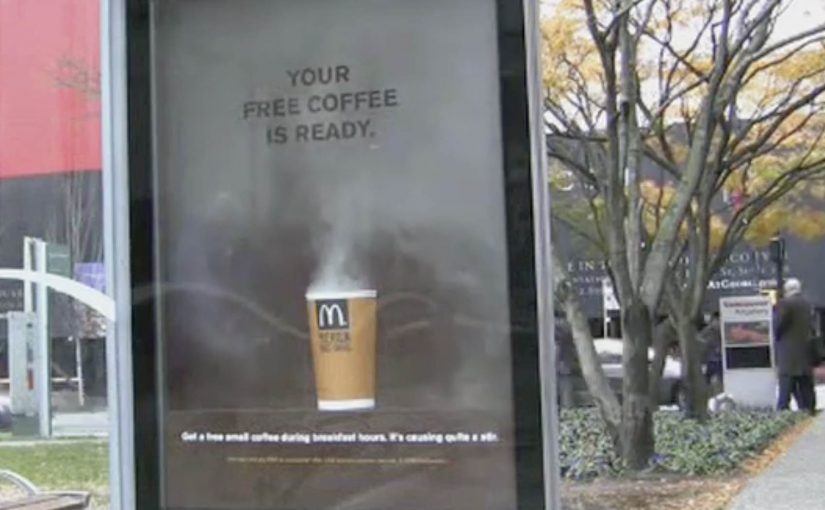
McDonald’s: Steaming Bus Shelter

Over the last couple of months we have seen some innovative bus shelter ideas from Cadbury and Coca-Cola. Now McDonald’s joins in with a cup of coffee that looks like it is still breathing.

Steam that writes the message for you

Instead of printing “hot coffee” on the poster, the execution uses real-looking steam rising from the cup. As the steam drifts across the panel, a simple line appears and disappears, turning a static bus shelter into a time-based reveal.

Interactivity here is low-tech but real. The ad changes over time in front of you, without screens, taps, or instructions. That works because a behavior you can see in real time makes the product benefit feel proved rather than merely claimed.

In out-of-home advertising, the strongest work turns waiting time into a short, sensory experience that people understand in a glance.

Why this lands in the street

Steam is a credibility cue. It signals warmth, freshness, and immediacy. At a bus stop, that matters because you are standing still, watching your breath in the cold, and you have time for one small surprise that feels physical rather than “ad-like”. The reveal also creates a micro-rhythm. By micro-rhythm, the ad creates a simple pattern of pause, reveal, and reset that a passer-by can read in seconds. Nothing happens. Then it happens. That pacing earns a second look.

Extractable takeaway: If you can make the medium behave like the product, you reduce explanation to near zero. The environment becomes your proof point, and the call-to-action feels like the obvious next step.

What McDonald’s is really buying with this shelter

This is a promotion mechanic disguised as a moment of theatre. The shelter does three jobs at once: it dramatizes the heat of the coffee, it frames the offer as “ready now”, and it catches commuters at the exact time window when a breakfast purchase is plausible.

The real question is whether the shelter makes hot coffee feel immediately available in the exact moment a commuter might buy it.

It also borrows the social logic of street magic. When something unexpected happens in public, people point it out. That turns one paid placement into multiple conversations, and it does it without adding complexity for the passer-by.

What to steal for your next transit activation

  • Use a single sensory cue. One clear signal beats layered cleverness in a noisy street.
  • Build a reveal that loops. A repeating moment gives late arrivals a chance to see it.
  • Make the message readable mid-glance. Design for people who look up for two seconds, not twenty.
  • Time the call-to-action to the context. Commuters make different choices at 8am than at 8pm.
  • Let the placement do the targeting. Transit media already filters for routines. Do not overcomplicate the copy.

A few fast answers before you act

What makes this bus shelter execution “interactive”?

The panel changes in real time in front of the viewer. The steam effect creates a repeating reveal, so the message appears and disappears rather than sitting permanently on the poster.

Does this need digital screens to feel modern?

No. The “modern” part is the behavior. A physical effect that updates over time can feel as fresh as a screen when it is tightly connected to the product benefit.

What is the main marketing objective here?

To drive immediate trial during a breakfast window by making “hot coffee” feel tangible, and by framing the offer as available right now.

What is the biggest risk with executions like this?

If the effect is subtle, unreliable, or hard to see from a normal standing distance, the entire idea collapses. The reveal must be legible without effort.

When is a bus shelter the right medium for this kind of idea?

When your message benefits from a short looped demonstration, and when your audience is naturally paused. Transit environments provide both attention and repetition.

Jameson: Are You Talking To Me?

“Are you talking to me?” becomes a real question when a wall talks back. This month, people in high foot-traffic areas across New York and Los Angeles react to Jameson Irish Whiskey as if the city itself has started a conversation.

The idea defies the downturn mood by shifting from broadcast to banter. The wall does not just show a message. It performs a social moment with whoever walks past.

How the talking wall works

The mechanism is described as a projected interactive ad. A large-scale wall projection delivers conversational prompts and responses that feel directed at individuals in the crowd, turning a static surface into something closer to a street-level character than an ad unit. That works because the projection frames the encounter as a social exchange people instinctively want to resolve.

In urban brand marketing, interactive out-of-home can behave like a social channel when it turns passersby into participants rather than impressions.

Why it lands

It flips the usual power dynamic of outdoor media. Instead of you watching an ad, the environment appears to notice you. That creates a tiny moment of surprise and self-conscious humor, which is exactly what people share with friends standing next to them.

Extractable takeaway: If you want out-of-home to travel beyond the street, give it a social script, meaning a prompt people naturally know how to answer or perform. When the medium feels conversational, people perform it, and performance becomes distribution.

What Jameson is really buying

The business intent is to make the brand feel present in the city’s social fabric, not just visible on its surfaces. A “talking” installation creates memory through interaction, which can outperform pure reach when budgets are tight and attention is scarce.

The real question is whether the interaction makes Jameson feel socially present enough to be retold after the moment ends. Jameson is right to use interactivity here as a behavior engine, not a decorative layer.

What to steal from conversational out-of-home

  • Write for interruption. A short line that sounds like it belongs in real life earns the first glance.
  • Design for group reactions. Outdoor works best when it creates a moment that strangers can share in real time.
  • Make the medium feel alive. Interactivity is not a feature. It is the reason people stop.
  • Keep the proof simple. A single video that shows the reaction is often the most scalable artifact.

A few fast answers before you act

What is the core idea here?

Turn a wall into a conversational brand moment, using a projected interactive execution that feels like it is speaking directly to people on the street.

Why does “talking” out-of-home get attention?

Because it breaks expectation. Outdoor is usually passive. When it behaves like a person, people pause to resolve the surprise.

What makes this more than a stunt?

The interaction itself is the brand experience. The wall creates a repeatable feeling, and that feeling is what people remember, record, and retell.

What should a brand copy from this?

Start with a line that sounds native to the street, then make the interaction readable from a distance. If the setup triggers a shared reaction, the format can extend beyond the physical site.

What is the main pitfall to avoid?

If the interaction is unclear from a distance, people will not stop. The hook must read instantly, even before someone understands the tech behind it.