
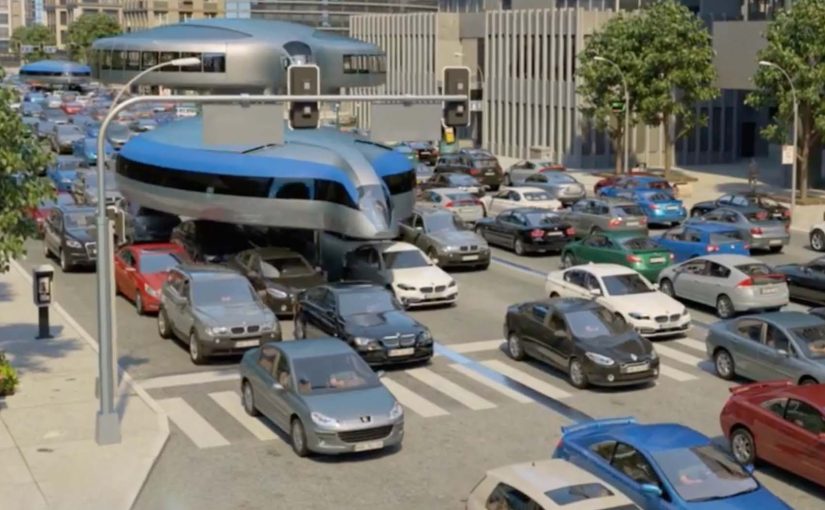
The Gyro Monorail

The Gyro Monorail

It is pretty clear we are not zipping around in flying cars anytime soon. So the pressure shifts back to the ground. How do modern cities expand public transportation as populations grow?

Turkish engineering firm Dahir Insaat believes it has an answer. The company and chief inventor Dahir Semenov argue that gyroscope-equipped vehicles can unlock a new approach to urban transit.

Here, a gyroscope is a spinning mass used to resist tipping, intended to keep the cabin upright on a single rail.

The real question is whether cities can add transit capacity without widening corridors.

What makes the “gyro monorail” idea compelling

A monorail is inherently space-efficient, but stability and ride confidence are always part of the mental model people have of “single rail” transport.

The promise of gyroscope stabilisation in this concept is straightforward. It aims to make a monorail-style vehicle feel stable and controllable even in compact, constrained city environments. If the gyro can keep the cabin level, the ride feels predictable, which is what earns trust for single-rail transport.

In dense, right-of-way-constrained cities, concepts like this live or die on throughput per meter of corridor.

Why this shows up now in future-transport thinking

When a city cannot easily add lanes or widen corridors, transport concepts often converge on two goals.

Extractable takeaway: When space is the constraint, the winning transport idea is the one that increases people moved without asking for more corridor.

  • Use less right-of-way per passenger moved.
  • Increase capacity without building entirely new infrastructure.

A gyro-based mono-track vehicle concept is attractive because it implies a narrower footprint than conventional rail while still signalling “mass transit,” not “one more car.”

Pressure-tests to steal before you buy the hype

The difference between an inspiring transport concept and a deployable system is usually not the visual design. It is the operating model.

This is an intriguing visualization, but without a credible safety case and maintenance model it remains a concept, not a plan.

  • Safety case and redundancy. What happens under failure modes.
  • Maintenance reality. Sensors, moving parts, calibration, and uptime.
  • Network integration. Stations, boarding flow, accessibility, evacuation.
  • Total cost per passenger-km. The number that decides scale.

A few fast answers before you act

What is “The Gyro Monorail” in this post?

A future-transport concept from Turkish engineering firm Dahir Insaat and inventor Dahir Semenov, centred on gyroscope-equipped vehicles.

What problem is it trying to address?

It addresses how modern cities expand public transportation as populations grow, without relying on flying-car fantasies.

What is the core proposal?

Use gyroscope-equipped vehicles as a proposed answer for future public transportation.

What should leaders pressure-test first?

Safety and redundancy. Maintenance and uptime. Integration into stations and operations. Total cost at scale.

Antarctica: The Beer Turnstile

Antarctica: The Beer Turnstile

Carnival in Rio de Janeiro drives alcohol consumption up, and it also drives traffic risk up with it. Traditional safety warnings are easy to ignore in the middle of a street party.

Antarctica, as an official sponsor of Carnival, decides to make the safer choice feel easier than the risky one. With AlmapBBDO, they install a “beer turnstile” at a subway station where carnival groups gather. Scan an empty Antarctica can at the gate and the turnstile opens, giving you a free ride home.

Turning an empty can into a ticket

The mechanism is a direct behavior swap. Instead of telling people not to drink and drive, the brand turns public transport into the reward for doing the right thing. The “payment” is an empty can, scanned like a transit card, then collected at the turnstile.

In big-city event environments, the most effective safety interventions reduce friction at the exact moment decisions get made, and they do it with an incentive people can use immediately.

Why it lands

This works because it replaces moralizing with utility. The act is simple, public, and repeatable, and it reframes the end of the night as a next step you can take without planning. The real question is how to make the safer ride home easier than the risky one when people are already in motion. It also keeps the brand inside the solution rather than just beside the problem, which makes the sponsorship feel like action, not signage.

Extractable takeaway: If you want behavior change at scale, stop asking for restraint. Build a one-step alternative that fits the moment, then reward the safer behavior with access people already want.

What the beer turnstile gets right

  • Reward the right behavior at the decision point. Do not place the incentive after the moment has passed.
  • Use a token people already hold. An empty can is a frictionless “ticket” during Carnival.
  • Make it visible. A physical gate turns participation into social proof.
  • Keep the story one sentence long. “Scan a can. Ride free.” travels fast.

A few fast answers before you act

What is the Beer Turnstile?

A subway gate that accepts an empty Antarctica beer can as the “fare”, unlocking free travel during Carnival to reduce drunk driving.

Why is this more effective than a standard “don’t drink and drive” message?

Because it changes the default action. It makes the safe option simpler, faster, and immediately rewarding in the same moment people need to get home.

How does the can scanning work in practice?

The can’s code is scanned at the turnstile like a transit credential, then the can is collected as part of the exchange.

What results were reported for the activation?

Campaign write-ups reported usage of around 1,000 people per hour at the special gate, cited as 86% higher than conventional turnstiles that day, and a reported drop in drunk drivers caught of 43%.

When should brands use “brand utility” mechanics like this?

When a safety or public-good goal depends on real-time choices, and the brand can provide an immediate alternative action rather than just awareness.