
SNS Bank: I Want Interest on My Current Account

SNS Bank promotes a simple product shift. Paying interest on a normal current account. Instead of leading with rates and fine print, the work frames it as something worth protesting for.

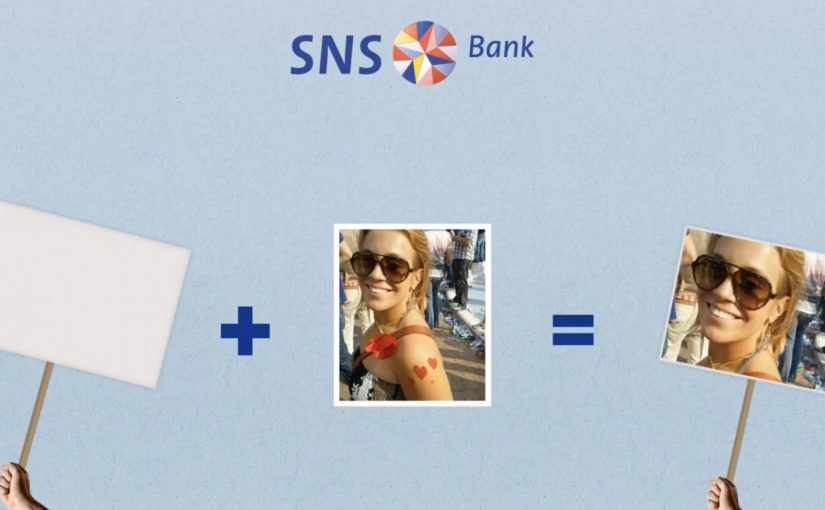
People “join” the protest using their Facebook or Twitter account. Their profile picture then becomes the campaign’s moving unit, connected into live rich media placements running on Dutch publisher inventory such as msn.nl and telegraaf.nl. Here, the moving unit is the participant’s profile picture reused as the visible building block of the protest crowd.

How the protest mechanic is built

The mechanism is straightforward. Sign up with a social account, capture the profile image, then re-render that image as part of a marching crowd inside dynamic banners. The same identity asset travels from social sign-up, to landing experience, to high-impact display formats, including what is described as a homepage takeover on telegraaf.nl.

In European retail banking, feature-led propositions like “interest on current accounts” often need a memorable way for customers to visibly participate to cut through price parity and low attention.

Why it lands

It takes a boring benefit and gives it a human visual. A rate becomes a crowd. That shift matters because it makes the offer feel socially validated and easy to explain. It also turns ordinary display inventory into a live proof point, because the banners visibly update with real people rather than generic stock photography. This is the right strategic move because the campaign makes participation itself the proof of relevance.

Extractable takeaway: When your proposition is a small financial feature, convert it into a visible social object. One reusable profile image can power sign-up, storytelling, and proof across every paid placement.

What SNS Bank is really trying to achieve

The business intent is to make “interest on a current account” feel like a category change, not a marginal tweak. The protest framing gives SNS Bank permission to be louder than the feature itself, and it creates a participation funnel that can be measured from social sign-up to on-site conversion.

The real question is how to make a marginal banking feature feel like a public movement rather than a line item in a comparison table.

What to steal from this protest-led banking launch

  • Turn the benefit into a visual system. If the offer is intangible, give it a repeating picture that accumulates and grows.
  • Use one identity artifact everywhere. A single profile image can unify sign-up, landing experience, and ad formats into one story.
  • Make paid media feel live. Dynamic creative that visibly changes reads as proof, not just persuasion.
  • Respect permission and platform rules. If you are pulling profile images, ensure consent is explicit and the experience stays compliant.

A few fast answers before you act

What is the core mechanic of this campaign?

People join via Facebook or Twitter, and their profile image is then reused as the creative building block inside a marching protest rendered across rich media banners.

Why use display banners for something that starts in social?

Because banners can function as visible proof at scale. The audience sees real faces moving through the ad units, which makes the proposition feel active rather than purely claimed.

What is the main advantage of the “protest” framing?

It makes a dry feature feel like a cause. That reframing increases memorability and gives people a simple story to repeat.

What is the biggest risk in copying this approach?

Using social identity assets without clear consent creates trust and compliance issues. If the sign-up step is not explicit, the same mechanic can backfire fast.

When does this kind of mechanic work best?

It works best when the product feature is real but visually weak. The participation layer gives the feature a public shape without changing the underlying offer.

DoubleClick: Fly over France HTML5 banner

You open a banner and, instead of a product shot, you get a hot-air balloon. You pick up speed, drift across a map, and “tour” famous French locations from above, including the Eiffel Tower, Notre-Dame de la Garde in Marseille, and the Château de Versailles.

This demo came out of the DoubleClick HTML5 Banner Challenge, with Biborg Interactive and Alpha Layer showing what happens when a banner is treated like a mini experience instead of a static placement.

The rich media build, meaning a banner unit that runs real-time code in the browser rather than a fixed image, leans on several HTML5 capabilities at once. Geolocation can drop you near your own location at the start. WebGL handles the 3D-like rendering layer in capable browsers. Audio and video tags add atmosphere. Google Maps-style navigation does the heavy lifting for exploration.

HTML5-rich media lets a banner behave like a lightweight web app, while still living inside a standard media buy.

An HTML5 rich media banner is a display unit that runs real-time code in the browser. It can detect location (with permission), render interactive graphics, and respond to user input without plugins.

What makes this feel different from “banner interactivity”

Most interactive banners ask for clicks. This one offers navigation. If your goal is time-in-unit, navigation is the better default than click-to-reveal. The moment you give people directional control, the experience shifts from “ad” to “toy”, and time-in-unit rises naturally because curiosity takes over.

Extractable takeaway: When you turn a banner into something navigable with one obvious control, you trade “interaction” for exploration, and exploration reliably buys you time.

Why the tech stack choice matters

Geolocation is not a gimmick here. It personalizes the first frame by making “your world” the default starting point, if the user opts in. WebGL is not decoration. It signals modernity and smoothness, making the experience feel closer to a game than a widget.

In programmatic display buys, weight and cross-browser reach still win, so the core interaction has to survive even when advanced features fall back.

The business intent behind the challenge demo

This is less about selling France and more about selling a capability. The real question is whether your banner is built to be explored or merely clicked through. It is a proof point for what DoubleClick Studio and HTML5 workflows can support, and it is a portfolio-grade demonstration for the teams who built it.

Steal these patterns for your next HTML5 banner

  • Give viewers one clear control. Navigation beats click-to-reveal when you want time spent.
  • Use “permissioned” personalization. Geolocation works best when it improves the first 3 seconds, not when it tries to be clever later.
  • Design a graceful fallback. If 3D is not available, the core experience should still be enjoyable.
  • Make the value visible without instructions. If someone can understand the interaction from across the room, they will try it.

A few fast answers before you act

What is the DoubleClick HTML5 Banner Challenge demo here?

It is a rich media banner concept that lets users “fly” a hot-air balloon over a map of France and discover landmarks, built to showcase what HTML5 banners can do beyond animation.

Which HTML5 features does the banner use?

It is described as using geolocation (with permission), WebGL for interactive graphics, and native audio and video support, alongside map-based navigation to create a lightweight exploration experience.

Why is geolocation useful in a banner?

Because it can personalize the first moment. Starting near a user’s own location makes the experience feel immediately relevant, as long as it is optional and clearly explained.

What does WebGL add to rich media ads?

WebGL enables GPU-accelerated 2D and 3D graphics in the browser. In advertising units, that can translate into smoother motion, depth effects, and more game-like interaction.

What is the biggest risk with “mini-app” banners?

Weight and compatibility. If the unit is too heavy or too fragile across browsers, you lose reach. The best builds keep a simple core loop and treat advanced effects as optional upgrades.

GOL Airlines: Mobile Check-in banner you fly

Here is a pretty innovative banner ad from AlmapBBDO in Brazil for GOL Airlines. The banner challenges you to imagine what it would be like to “fly” on your mobile phone.

You submit your mobile number into the banner. Seconds later you get a live call with flight instructions. At the same time the page transforms into a flying game controlled directly from your phone keypad.

You then fly a virtual plane across a major Brazilian travel site while destination deals appear underneath the route you choose. Flying is simple. Touch numbers to change direction and trigger special manoeuvres. The ad finishes by reminding you that flying is easier when you check in via your mobile phone.

In travel categories where products feel interchangeable, interactive creative wins when it turns a service benefit into a felt experience in seconds.

A banner that calls you back

The key move is not the game. It is the phone call. The call instantly makes the experience feel “live” and personal, and it bridges the banner and the handset into one connected moment. Once the call happens, the user is no longer passively viewing an ad. They are inside a two-device interaction.

The real question is whether your creative can make the service benefit happen inside the unit, rather than only claiming it.

This is a classic example of making the handset part of the unit. The mobile phone becomes the interface, which proves the check-in promise instead of describing it.

The mechanic: second-screen control without an app

Most second-screen ideas fail because they ask people to download something or switch contexts. This one uses what every phone already has. The keypad. In other words, the phone becomes a simple remote control for what happens on the page. That choice removes onboarding friction and makes the interaction feel surprisingly accessible for a banner unit.

It also creates a clean narrative arc. Number entered. Call received. Instructions delivered. Game begins. Deals appear. The brand claim lands as the closing line rather than the opening pitch.

In consumer travel marketing, where attention is scarce and booking friction is high, this kind of second-screen viewer control turns “convenience” into something you can feel.

Why the “flying game” format fits the job

The game is not meant to be deep. It is meant to create one sensation. Control. When you steer the plane with your own phone while destination deals appear under your route, the ad links that felt control to the check-in promise.

Extractable takeaway: If your benefit is “ease,” build a small interaction that gives the viewer control and a useful reward in the same moment. In a “message as mechanism” execution, the claim is delivered through the interaction itself, not a line of copy.

Steal this from GOL’s mobile check-in banner

  • Use a real-world channel as the trigger. A live call is stronger than a visual prompt because it changes the user’s state immediately.
  • Make the phone the interface. If you are selling a mobile service, let the mobile device do the work inside the experience.
  • Keep controls primitive and universal. Keypad inputs beat complex gestures when you need instant comprehension.
  • Reward the interaction with utility. Deals, destinations, availability, or next steps should appear as part of play, not after it.
  • End with the service tie-back. Let the experience earn the claim, then state it plainly.

A few fast answers before you act

What is the core idea of the GOL mobile-controlled banner?

You enter your phone number into a banner, receive a live call with “flight” instructions, and then control an on-page flying game using your phone keypad while travel deals appear as you fly.

Why does a phone call change the effectiveness of a banner ad?

It makes the experience feel immediate and real, and it creates a bridge from passive viewing to active participation without asking the user to install anything.

What category situations benefit most from this pattern?

Categories where the product is hard to differentiate visually and the benefit is “convenience” or “ease.” Airlines, ticketing, banking, utilities, and service platforms.

What is the biggest execution risk?

Operational friction. If the call is delayed, fails, or feels spammy, the experience collapses. Timing, consent clarity, and reliability are everything.

How would you modernise the mechanic without changing the concept?

Keep the phone as controller, but use a consent-forward trigger and fast connection method. For example, a one-tap call prompt or a verified in-browser handoff that still preserves the “live instructions” feeling.