Qantas Out Of Office Travelogue

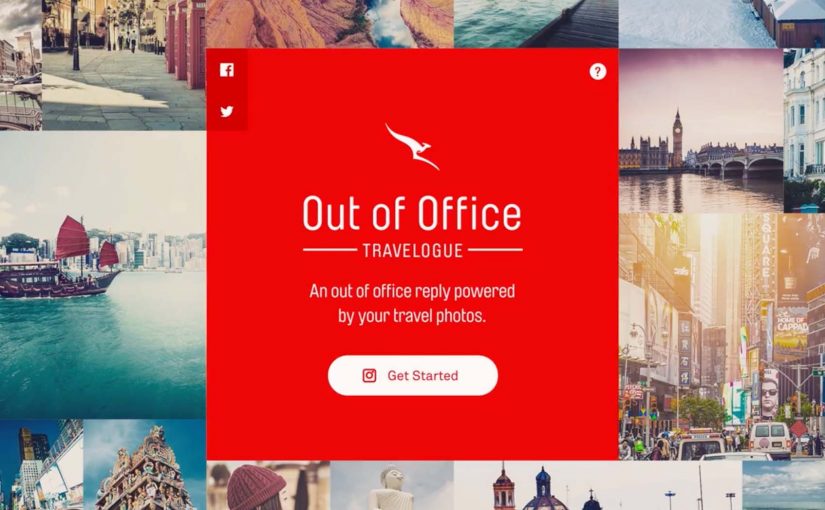
Qantas, Australia’s national airline, wants a new way to inspire travel with an increasingly younger audience. Their answer is a smart twist on a familiar behaviour. The out-of-office email. Instead of the usual “I’m away” message, Qantas turns it into a personalised travelogue powered by the user’s Instagram photos.

The mechanism is simple and effective. Qantas’ research shows that tips from friends and colleagues are a major driver for choosing the next holiday. So the brand uses Instagram’s API to transform a mundane autoresponder into something people actually want to read. A short visual story of where you are, what you are doing, and why it might be worth visiting.

What elevates the idea is the commercial bridge. The email does not just inspire. It incentivises recipients to book flights directly from the out-of-office message. This is social proof plus direct response, built into a format people already accept as normal workplace etiquette. The business intent is clear. Convert social inspiration into attributable flight demand inside the same interaction.

As a result, users created over 10,000 Out of Office Travelogues. The activity generated 100 million media impressions worldwide for Qantas.

Why this works as modern email strategy

Most marketing emails fight for attention in an overcrowded inbox. This one arrives with a built-in reason to be opened and read. It is a message you expect when you email someone who is travelling.

Extractable takeaway: When a brand can place a commercial message inside a communication people already expect, the marketing feels useful before it feels promotional.

It also uses the strongest distribution channel many brands overlook. People’s real networks. When your colleague shares their trip, even passively via an autoresponder, it carries more credibility than a brand-led destination ad.

This is one of the smarter ways to turn routine email behaviour into demand generation because it adds commerce without breaking the social norm that makes the message welcome.

The real innovation is the data-to-story pipeline

At a tactical level, the campaign is “just” an API integration. In practice, it is a reusable pattern. Here, data-to-story pipeline means turning user-owned content and simple signals into a coherent, bookable story unit.

  • Pull customer-owned content from a platform they already use.
  • Convert it into a lightweight narrative unit that fits a communication norm.
  • Add a clear, transactional next step without breaking the tone.

If you can operationalise that pattern, you can treat email not as static creative, but as a dynamic surface where personal context becomes relevant storytelling. Because the story is generated from a person’s real context, it feels more relevant and more trustworthy than static promotional creative.

In travel and hospitality categories where peer recommendation shapes intent, that makes email a distribution surface, not just a notification channel.

The real question is how far a brand can turn trusted everyday communication into measurable distribution without damaging the trust that makes it work.

What to watch if you replicate this pattern

The moment you use personal photos and automated messaging, the trust layer matters.

  • Permissioning and transparency. Make it obvious what is being pulled and why.
  • Control. Users need an easy way to curate what appears.
  • Brand safety. You need guardrails so the travelogue stays on-message without becoming intrusive.

What to steal for email-powered demand generation

  • Hijack a legitimate email type. Out-of-office replies get opened because the recipient expects them.
  • Turn personal content into a controlled story unit. User photos feel authentic, but only work when users can curate the output.
  • Embed the commercial action inside the narrative. Inspiration and booking sit in the same interaction, so intent has no time to cool down.
  • Use networks as distribution, not “audiences”. Colleagues and friends are higher trust than any destination banner.

A few fast answers before you act

What is the Qantas Out of Office Travelogue?

A personalised out-of-office email reply powered by the user’s Instagram photos, designed to inspire travel and drive bookings.

Why is the out-of-office format such a good carrier?

It arrives with intent and legitimacy. People expect it, and it is naturally tied to travel.

What is the core growth loop?

One person travels. Their network sees the travelogue via everyday email behaviour. The recipient gets inspired, and is pushed toward booking directly from the message.

What has to be true for this to scale?

Users need clear permissioning, easy curation, and a direct booking path that feels like a natural next step rather than a hard sell.

What results does Qantas report?

Over 10,000 travelogues created and 100 million media impressions worldwide.
Obermutten: A Little Village Goes Global

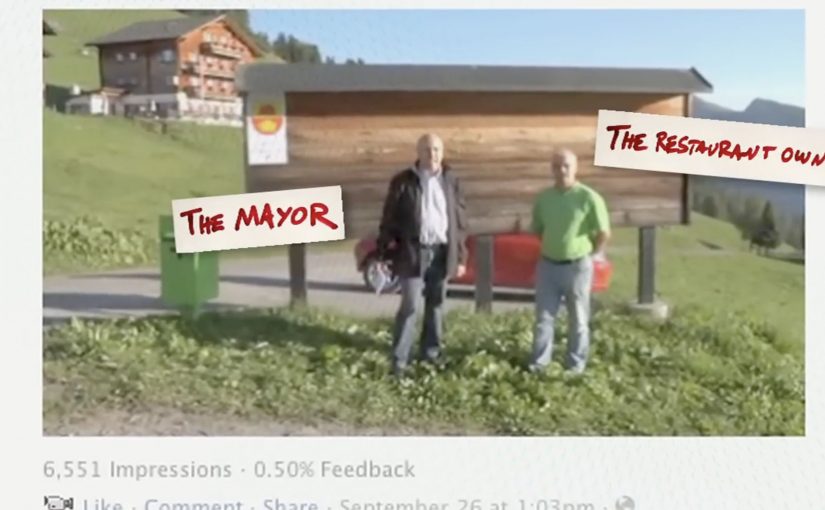
Obermutten is a little mountain village in the Canton of Graubünden, Switzerland. It has around seventy eight residents and is known to virtually no one except a few hikers passing through now and then.

Now, millions of people around the world have reportedly either read about or heard of Obermutten, after Jung von Matt/Limmat created a simple Facebook campaign for Graubünden Tourism that put this small village on the world map. Media reports have reportedly appeared across many countries, including mentions on mainstream TV news in South Korea.

How? It began with a newly created village Facebook page where the local mayor made a remarkable promise via video: click “Like,” and your profile picture will be posted on the commune’s official notice board. In no time, the board was completely covered with fans. To deal with the flood of likes, they reportedly started hanging profile pictures on barn walls in the village. The community has reportedly grown to over 14,000 fans.

A promise that turns a “Like” into a physical souvenir

The mechanism is a simple exchange with a visible payoff. A tiny action online triggers a tangible reward offline. Your profile picture is printed and displayed publicly, which makes the relationship feel real, not symbolic. Each new photo also becomes proof for the next person considering whether to join.

In destination marketing for small places, visible social proof, meaning a growing wall of real faces that proves the promise is being kept, and low-friction participation can outperform paid reach when the reward is concrete and inherently shareable.

The real question is how a tiny place turns a one-click action into public belonging people want to share.

Why it lands

This works because it replaces abstract engagement with a human gesture. You are not “following a page.” You are being welcomed by a real village and given a public spot on a real wall. That emotional upgrade is what converts a novelty into a story, and a story into press and sharing. This is a smarter tourism idea than a bigger media buy because the participation itself becomes the attraction.

Extractable takeaway: When you turn a digital action into a physical, publicly visible reward, participation becomes contagious. People join to see themselves included, and the growing display becomes the marketing.

What destination marketers should steal from Obermutten

  • Make the reward tangible: if the payoff can be photographed, it spreads without asking.
  • Keep the promise binary: one action, one guaranteed outcome, no fine print in the core idea.
  • Design for accumulation: the “wall filling up” is the compounding asset that makes the story stronger over time.
  • Use a human voice: a mayor speaking is more believable than a brand slogan.
  • Let the proof do the persuasion: the growing number of displayed faces sells the idea better than any ad copy.

A few fast answers before you act

What did Obermutten do on Facebook?

They invited people to like the village Facebook page, with the promise that each fan’s profile picture would be printed and posted on the village’s official notice board, and later on barn walls as the number grew.

Why did this become global news?

The idea is easy to explain and easy to visualize. A tiny village publicly “welcoming” thousands of strangers creates an inherently newsworthy contrast, and it produces strong images for media coverage.

What is the core mechanic marketers can reuse?

Convert a low-friction digital action into a tangible, visible reward that accumulates over time. The accumulation becomes both proof and content.

Is this a tourism campaign or a social media campaign?

Both. It uses a social platform to generate participation, then translates that participation into offline visibility that functions like a tourism invitation and a PR engine.

What is the biggest risk with this approach?

If the reward is not genuinely delivered, the story collapses. The format depends on the promise being kept consistently, and on the physical display being maintained with care.

Bonafont: The Tweeting Fridge

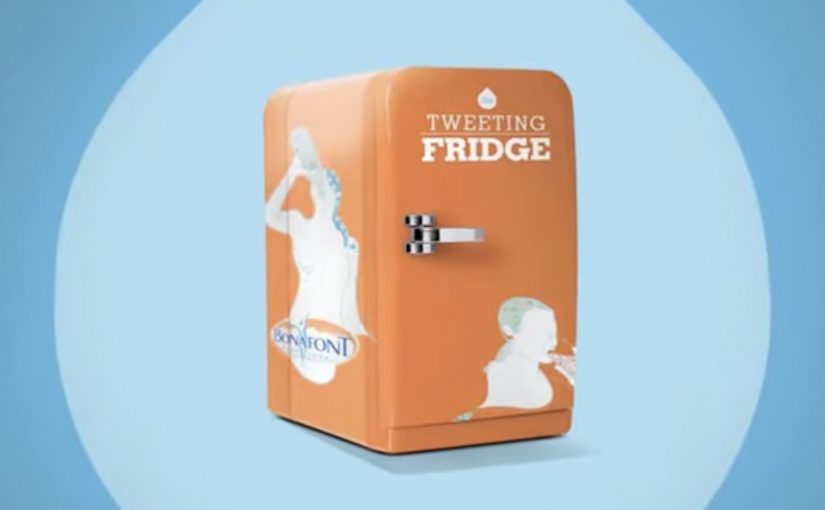
The campaign starts with a simple gift. Bonafont sent a mini fridge stocked with 2 liters of bottled water to an influential Twitter personality in Brazil.

The twist was inside the door. The fridge was wired so every time it was opened, a tweet was automatically posted on the celebrity’s account, signaling to thousands of followers that they were drinking water. With a library of pre-written messages, the feed stayed fresh while the behavior stayed consistent.

In other words, hydration became a public ritual, and the act of opening the fridge became the publishing trigger, meaning the moment that automatically creates the post.

The most effective reminders are the ones that piggyback on social proof from people an audience already pays attention to.

A social reminder disguised as a connected object

The mechanism is straightforward. A door-open event triggers a social post. The creative leap is turning a private habit into a visible cue, so the audience gets a repeated prompt without ever being directly targeted by an ad. It is an Internet-of-things demo used as a behavioral nudge.

In global consumer health and FMCG marketing, habit cues scale best when they ride on routines people already perform and signals people already notice.

Why it lands

People rarely fail to drink water because they disagree with the idea. They fail because they forget, especially during work hours. This execution attacks the memory problem, not the belief problem. It also makes the reminder feel lighter. You are not being lectured by a brand. You are seeing someone you follow take a sip.

Extractable takeaway: When the behavior you want is repetitive and easy to forget, attach the reminder to a reliable physical trigger and let social proof do the distribution, so the message spreads as a habit signal, not a campaign slogan.

The real question is whether your reminder can show up as a lightweight cue at the moment of action, rather than as persuasion delivered in advance.

This is a pattern worth copying when “forgetting” is the main barrier and the trigger can be made automatic.

Stealable moves for your next behavior-change activation

  • Choose a trigger that is automatic. Door opens, post happens. No extra step means no drop-off.
  • Borrow credibility from the right messenger. The influencer is not decoration. They are the proof carrier.
  • Keep content variation ready. Repetition builds habit, but repetition with identical copy feels spammy.
  • Make the action visible, not the persuasion. Showing the behavior is often more powerful than explaining it.
  • Scale through a simple rotation model. Passing the object to new personalities keeps attention without redesigning the system.

A few fast answers before you act

What is “The Tweeting Fridge” in one sentence?

A connected mini fridge that automatically tweets when the door is opened, using social proof to remind followers to drink water.

Why is the fridge better than a normal “drink water” campaign?

Because the reminder is tied to a real-world trigger and delivered through a trusted voice, so it feels like a habit cue rather than an ad.

What problem does it solve for the brand?

It increases consumption by turning “forgetting” into “remembering,” using repeated prompts that keep the brand present at the moment of use.

What is the biggest risk if a brand copies this idea?

Over-automation. If the posting feels spammy or deceptive, audiences can turn against the brand and the influencer at the same time.

How do you keep an automated post from feeling spammy?

Use a small rotation of natural messages and avoid excessive frequency, so the automation reads like a habit signal instead of a bot loop.