ASICS: Run With Me at the Gold Coast Marathon

ASICS has a fine history not just in running sports, but also in the innovative use of technology. So at the Gold Coast Airport Marathon, a grueling 42km run, they created a powerful demonstration of running and technology by connecting runners with their supporters like never before.

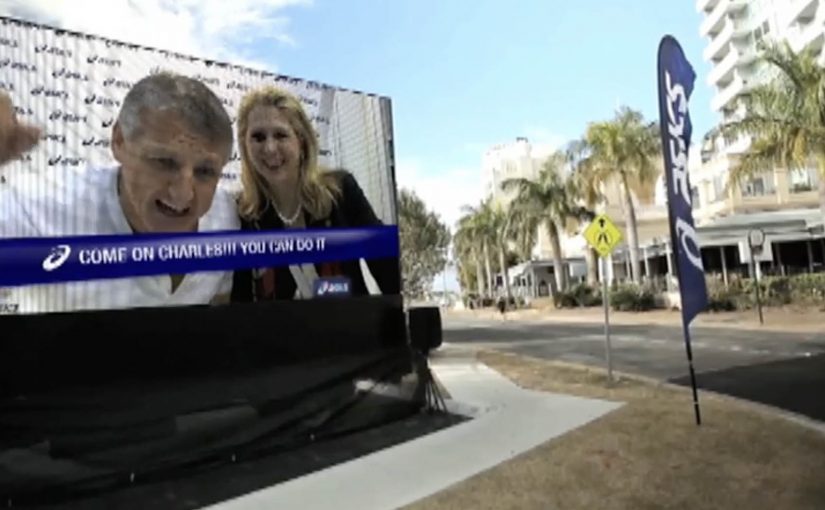
Runners were given RFID timing chips to connect their run with Facebook. RFID, or radio-frequency identification, lets a small chip be detected automatically at checkpoints. This allowed them to automatically post pre-written messages at checkpoints, along with distance run and remaining, live timing, and location data plotted on Google Maps. At the same time, friends and loved ones were able to upload video messages of support, which were triggered and played as runners approached giant screens along the course.

A marathon that posts for you, at the moments that matter

The clever part is not “Facebook integration.” It is the timing. Checkpoints are already emotional beats in a race. Effort spikes. Doubt kicks in. Motivation dips. By tying updates to those exact points, the campaign makes every status feel earned, and every reply from friends feel relevant. The real question is whether you can make that support arrive inside the effort, not after the finish.

Extractable takeaway: Automate sharing only at moments participants already care about, so updates feel like earned progress and support can land at the exact point it matters.

RFID is doing quiet work here. It removes manual posting friction, and it makes the updates feel live rather than staged, because the data is anchored to race progress.

In large-scale sports events, real-time data and social signals can turn spectators into an active support system that changes how the race feels while it is happening.

Support that shows up on the course, not just in the comments

Most event social campaigns keep encouragement on a screen at home. This one brings encouragement into the race environment. The supporter uploads become on-course content, triggered when the runner is near, so the message arrives in the body, not just in the feed.

That shift matters. It turns “cheering” from a passive gesture into an intervention, and it gives runners a reason to care about the system mid-race, not only after finishing. This kind of activation is worth building only when the trigger system is reliable enough to feel invisible to the runner.

Reported outcomes, and what they imply

The campaign reported that 2,000 runners, described as 15%, connected their run with Facebook. It also reported 6,000 messages of support uploaded, 1,000 video messages created at the event, and 35% of runners receiving video support. Additionally, it reported thousands of unique status updates from inside the race, 25,850 unique visitors to the microsite, and tens of thousands of return comments from friends and family.

Even if you strip the numbers back, the strategic takeaway is clear. When you connect performance data to social response, you create a loop. Effort generates updates. Updates generate support. Support reinforces effort.

Steal this support-loop pattern for your next event

  • Attach the experience to natural moments. Checkpoints, milestones, and thresholds beat “post whenever you want.”
  • Automate the boring part. If the participant must manually publish, most will not.
  • Bring support into the physical environment. On-course screens, audio, or wearable prompts outperform distant encouragement.
  • Give supporters a real role. Uploading a message is simple, but it feels meaningful when it is triggered at the right time.

A few fast answers before you act

What is the core mechanic of “Run With Me”?

RFID-triggered race checkpoints publish pre-written social updates, while supporter videos are triggered on giant screens as runners approach.

Why does RFID matter here?

It makes the experience hands-free. The system captures progress automatically, so runners do not have to stop or think about posting.

What makes the supporter videos more powerful than normal social comments?

They appear in the runner’s world during the effort, not after it. Timing plus proximity turns a message into motivation.

What is the biggest risk when building this kind of live experience?

Reliability. If triggers misfire or content appears late, the emotional payoff collapses. The tech has to feel invisible and dependable.

How do you measure success beyond impressions?

Opt-in rate, supporter participation rate, trigger completion rate, and whether the loop changes behavior, for example more mid-race engagement and higher repeat participation intent.
Jameson Irish Whiskey: Blippar Space Invaders

Outdoor ads that turn into a game

Jameson Irish Whiskey recently launched a huge outdoor campaign, teaming up with augmented reality specialist Blippar for image recognition technology. Here, “image recognition” means the app matches what the camera sees to known Jameson creative and then triggers the experience.

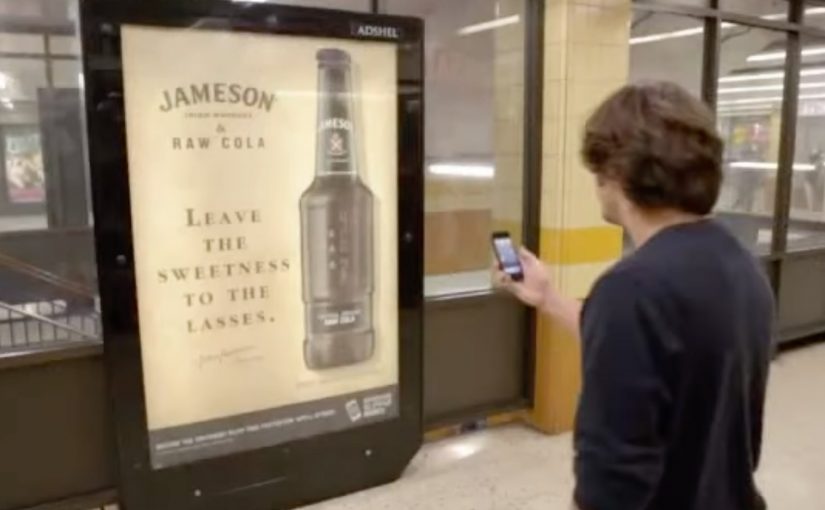
People with the Blippar app could scan any Jameson Irish Whiskey ad or bottle and immediately get immersed in a Jameson Irish Whiskey version of Space Invaders.

How the Blippar scan-to-play mechanic worked

The mechanism was straightforward. A phone camera scan triggered Blippar’s image recognition. That recognition launched an interactive AR experience on the device.

In practice, the physical media became the “portal”. The ad or bottle was the entry point. The phone was the display and controller. The game was the reward.

In spirits and FMCG outdoor campaigns, scan-to-play AR works best when the payoff is immediate and the controls feel natural in a standing, on-the-street context.

Why it landed, and where the interaction could be smoother

The win is immediacy. Scan and you are inside the brand world without a long setup. Because recognition launches the game instantly, it converts a fleeting poster glance into play time.

Extractable takeaway: If you turn physical media into a “scan to reward” portal, deliver the reward within seconds and design controls that match the real-world posture of the moment.

After playing the game myself, I found it would have been a better experience if they had allowed viewer control through tilting the phone around, instead of non-stop tapping at the screen. However, it is still good to see more brands innovating like this.

What the brand was really buying

This was not just about novelty. It was about extending an outdoor campaign into a personal, interactive moment that people could not get from a standard print execution.

The real question is whether your outdoor media can earn voluntary attention, not just reach.

The intent was clear. Increase attention time. Add talk value. Create a reason to engage with the bottle and the ads beyond the first glance.

This pattern is worth copying when you can reward immediately and keep interaction comfortable enough to sustain play.

What to steal for your next AR activation

  • Make the entry point universal. “Scan any ad or bottle” reduces friction and increases participation.
  • Reward immediately. If the scan does not pay off fast, the experience loses the environment it depends on.
  • Design the controls for comfort. Favor natural motion and simple gestures over repetitive tapping when sessions run longer than a few seconds.
  • Use AR to earn time, not impressions. The value is the extra seconds of focused attention, not the novelty headline.

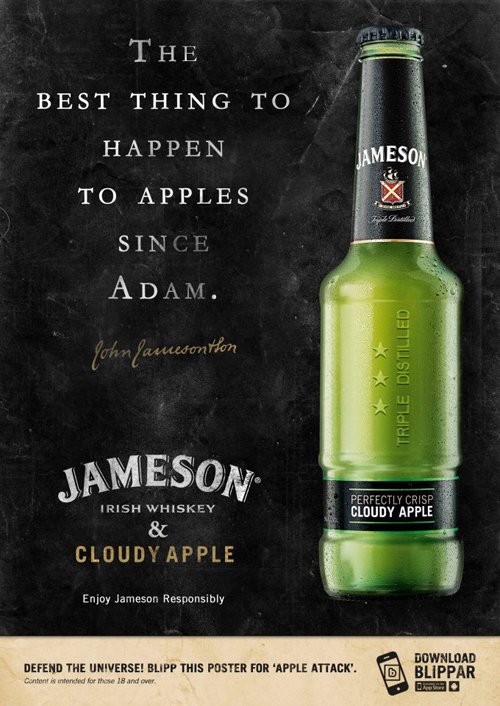
If you would like to give it a try, download the Blippar app on your smartphone and scan the below bottle to start playing.

Jameson Irish Whiskey


A few fast answers before you act

What was Jameson doing with Blippar?

They used Blippar’s image recognition so people could scan Jameson ads or bottles and launch an interactive AR game experience on a smartphone.

What was the core mechanic?

Scan the physical creative with the Blippar app. The scan triggers recognition. The phone immediately launches the game.

Why does scan-to-play work well for outdoor advertising?

It turns a passive glance into an active moment. The ad becomes a portal to content that holds attention longer than print.

What interaction improvement could make this smoother?

More natural viewer control, such as tilting the phone, can reduce fatigue compared to continuous tapping during gameplay.

What is the main takeaway for brands?

Use AR to earn time and engagement by delivering an immediate reward, and make the control scheme comfortable enough to sustain play.

Lynx: Invisible Ad with polarized glasses

Last month, McDonald’s in Canada created a billboard that could only be seen in the night with car headlights.

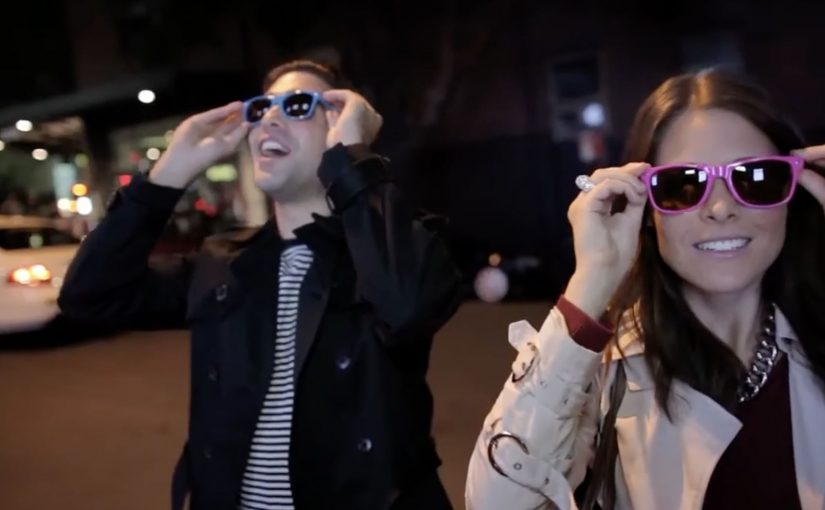
Now Lynx, for its “Unleash the chaos” campaign in Australia, replaces the windows of a house in Sydney with special LCD screens. Sexy hostesses stationed outside hand out polarized sunglasses to passersby, and the glasses suddenly unveil the chaos going on inside the house.

What makes this an “invisible ad”

An invisible ad is a message that is intentionally hidden in plain sight, then revealed only when the audience meets a condition. Here, the condition is wearing polarized lenses, which gate what the screens are able to show.

The result is a street-level experience that looks ordinary to everyone, but becomes explicit and chaotic for the people who opt in by putting on the glasses.

The mechanism: selective visibility creates instant intrigue

The setup is simple and bold. Take an everyday terrace house. Swap its windows for LCD panels. Hand out sunglasses that make the content readable. Suddenly the street becomes a live demo, with viewer control over whether they see it.

Because only people wearing the glasses can see the content, the contrast between “ordinary” and “chaotic” creates instant intrigue and pulls passersby into the demo.

Coverage of the activation describes it as part of the Lynx Anarchy launch, produced as a filmed stunt to capture reactions and extend reach beyond the street.

In consumer marketing, hidden-in-plain-sight stunts work best when the reveal feels like a reward you discovered, not a message delivered at you.

Why it lands: it feels like a secret you earned

Outdoor advertising usually broadcasts. This flips the script. The street stays “clean” until you choose to participate, and that choice makes the reveal feel more personal, more exclusive, and more share-worthy. It also borrows a familiar human impulse. If someone hands you “special glasses”, you want to know what you’re missing without them.

Extractable takeaway: If the audience has to take one small action to unlock the message, the reveal feels earned and sticks longer than a broadcast impression.

The real question is whether your reveal earns attention or merely feels like a trick.

What the brand is buying with this kind of stunt

  • Permissioned attention. People self-select into the experience rather than being interrupted.
  • A built-in talk trigger. The format is easy to explain and retell, even without showing the content.
  • Proof of product personality. The medium embodies the message. Chaos is not only said, it is staged.

Design rules for your next hidden reveal

  • Make the reveal binary. Either you see nothing, or you see everything. Half-reveals feel like malfunctions.
  • Let the audience choose. The opt-in moment (taking the glasses) is what creates commitment.
  • Design for spectators too. Even people who do not opt in should understand that something is happening, and feel curious.
  • Film reactions as a second asset. The live moment is local. The reaction video travels.

A few fast answers before you act

What is a brand “invisible ad”?

It is an ad designed to look blank or ordinary until a specific condition reveals it, such as headlights at night or special glasses in daylight.

What is Lynx doing in the Invisible Ad stunt?

Lynx replaces a house’s windows with screens and hands out polarized sunglasses that reveal hidden content, turning an ordinary street view into a private, chaotic reveal.

Why use polarized sunglasses as the trigger?

Because it creates an opt-in moment. People decide to participate, and that choice makes the reveal feel earned and more memorable.

What is the strategic benefit of hiding the message?

Hiding the message creates curiosity, controls who sees the explicit content, and makes the experience feel like a secret worth sharing.

How do you scale a one-street activation?

By designing it to be filmed, then distributing the reaction footage as the wider campaign asset.