
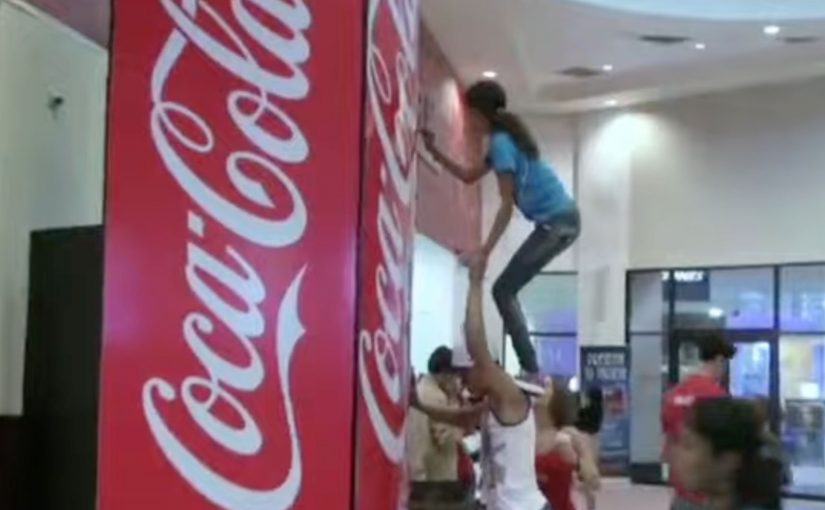
You walk up to a Coke machine that is about 12 feet tall. You cannot reach it alone. You ask a buddy for a boost. When you finally press the button, the machine rewards the teamwork by dispensing two Cokes instead of one.
What Coca-Cola is doing with the “Friendship Machine”
The game of vending machine one-upsmanship between Coca-Cola and PepsiCo continues with Coke’s “Friendship Machine”. To celebrate International Friendship Day, Coca-Cola in Argentina plants machines that appear to be about 12 feet tall and require that you ask a buddy for a boost to use it. As a reward, the Coke machine dispenses two Cokes instead of one.
In consumer brands running physical activations in public spaces, engineered constraints can be the simplest way to force a real-world social moment.
Why the Friendship Machine lands
Because the machine is too tall to use alone, it makes asking for help the trigger, which is why the second Coke feels like earned, shared generosity rather than a giveaway. Here, “friction” means a deliberate extra step that creates a specific behavior before the reward.
Extractable takeaway: If you want sharing to happen, design the mechanic so cooperation is required to unlock the value, not merely suggested after the fact.
The real question is whether your activation can make cooperation the trigger for the reward, instead of bolting “share” onto the end.
This is a stronger pattern than generic “share to win” mechanics because the social interaction is visible, immediate, and hard to skip.
The idea builds on Coke’s “Happiness Machine” viral video, where a machine keeps surprising students with free extras like soda and pizza. Coke also updates that generosity pattern with a “Happiness Truck” video, where a truck gives out Cokes alongside summer gear like surfboards, beach toys, and sunglasses.
PepsiCo responds with its own “Social Vending Machine” that lets you gift free Pepsi’s to friends and strangers via a text message.
How to steal this mechanic without copying it
- Make teamwork the unlock. Ensure the reward only happens after a small, observable act of cooperation.
- Design “fair friction”. The obstacle should feel purposeful, not annoying, and it should clearly connect to the reward.
- Pay out in shared value. Give a two-person reward so the help feels reciprocated, not exploited.
- Anchor to a moment people recognize. A simple calendar hook (like Friendship Day) makes the story easier to retell.
A few fast answers before you act
What is the Coca-Cola Friendship Machine?
It is a Coke machine designed to be too tall to use alone, so you need a friend’s help. When you do it together, it dispenses two Cokes as the reward.
Why make the machine intentionally difficult to use?
Because the friction creates the point. It forces a social interaction first, then makes the reward feel earned and shared, not just handed out.
How do the Happiness Machine and Happiness Truck relate?
They establish the “unexpected generosity” pattern. The Friendship Machine applies the same idea, but makes cooperation the trigger instead of surprise alone.
What makes this different from a typical “share to win” campaign?
The social action happens before the reward and in public. The mechanic makes cooperation unavoidable, instead of asking people to share after they already got the value.
How does this compare to PepsiCo’s Social Vending Machine?
Pepsi’s approach makes gifting the feature via text. Coke’s approach makes in-person collaboration the feature by requiring help at the machine itself.