
#The8N8 Twitter Campaign

#The8N8 Twitter Campaign

A celebrity tweets a question about the new Nokia N8. You spot the clue, follow the celebrity, and race to reply with the correct answer before everyone else. Do it fast enough, and you earn the follow-back. Repeat until you have eight.

The brief. Launching the Nokia N8 on Twitter

Wunderman Buenos Aires is given the task to launch the new Nokia N8 smart phone. They create a Twitter-based activation campaign called #The8N8. Here, “activation” means a participatory game on Twitter, driven by clue tweets and timed replies.

The real question is whether you can turn product features into a race people choose to replay.

This is a strong Twitter launch mechanic because it forces people to learn features under time pressure, while making the reward publicly visible.

How it works. Clues, speed, and follow-backs

  • Nokia enlists top celebrities to tweet questions, clues, and features of the phone.
  • Users find the clues, follow the celebrity, and respond correctly in the fastest time.
  • The reward is the celebrity following the user back.
  • The first eight people to get eight celebrities to follow them back win the new Nokia N8.

In consumer electronics launches on fast-moving social platforms, attention windows are short and social proof is a primary currency.

Why the follow-back works

By making the reward a follow-back from a celebrity, the mechanic converts speed and accuracy into instant social proof, which is why participants keep replaying the hunt.

Extractable takeaway: When you attach a visible status reward to answering product-feature clues fast, you can make launch messaging feel like a game instead of an ad.

Results. Reach and follower growth

The campaign is reported to reach 300,000 Twitter users. It is also reported to increase Nokia’s fan base on Twitter and Facebook by over 100%.

How to reuse the mechanic in a launch

  • Turn features into clues. Write prompts that translate key features into quick, answerable questions.
  • Make speed the differentiator. Keep the rule simple. First correct reply earns the follow-back.
  • Keep the reward visible. A follow-back is public, so the prize doubles as social proof.
  • Use a clear finish line. “Eight follow-backs” makes progress legible and creates urgency.

A few fast answers before you act

What is #The8N8?

A Twitter-based activation by Wunderman Buenos Aires to launch the Nokia N8.

What do participants actually do?

They follow participating celebrities, answer their clue tweets correctly, and do it faster than others to earn follow-backs.

What is the win condition?

Be among the first eight people to get eight celebrities to follow you back.

What are the reported outcomes?

Reported reach of 300,000 Twitter users and reported fan base growth on Twitter and Facebook by over 100%.

What is the transferable mechanic?

Turn product messaging into a speed-based game that rewards social proof. Here, that social proof is the follow-back.
Hire Us: Twitter Follow Stunt Lands a Job

Hire Us: Twitter Follow Stunt Lands a Job

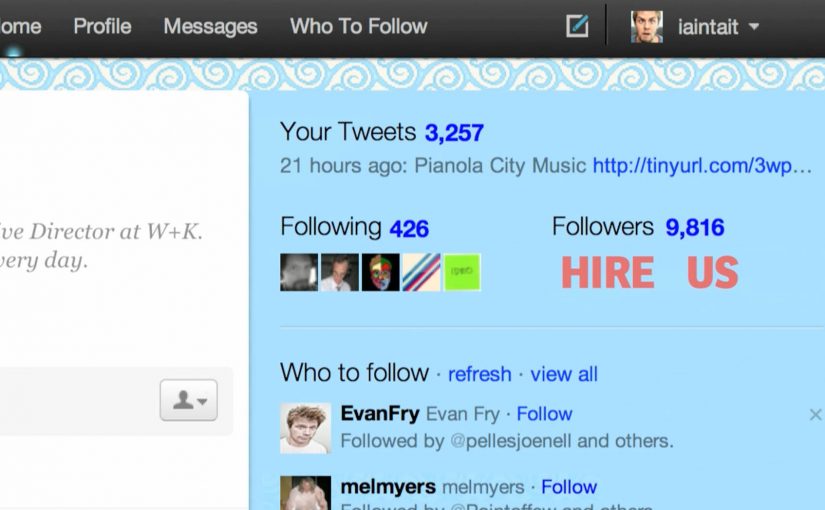
Dutch creative team Bas van de Poel and Daan van Dam set up five separate Twitter accounts and started following various Dutch Creative Directors on Twitter. Their message was simple: HIRE US.

Even though the idea is very similar to the Jeep Twitter Puzzle campaign, the execution is different and innovative. It gets them noticed and finally a job with Boondoggle in Amsterdam.

Why five accounts is the point, not the gimmick

The mechanism is engineered repetition. By “engineered repetition,” I mean deliberately creating multiple small signals that form an obvious pattern in the target’s notifications. One account can be ignored. Five accounts create a pattern. When multiple new followers arrive with the same blunt message, it triggers curiosity and a small sense of social pressure. Someone is doing something intentional, and it is hard not to look.

It is also highly targeted. They do not broadcast “hire us” into the void. They place it directly in the attention stream of the people who can change their outcome.

In creative hiring markets, attention is scarce, so using a platform’s native behaviours to deliver an instantly legible message is often the fastest way to get noticed.

Why it lands: interruption plus clarity

This works because it is instantly legible. No clever puzzle to decode. No long portfolio pitch. The call to action is the entire creative idea. That clarity is what makes it feel confident. And because it happens inside Twitter’s native behaviours, following, notifications, profile clicks, it does not require extra friction. The recipient can react in seconds.

Extractable takeaway: When you need attention from specific decision-makers, create a small pattern using the platform’s native behaviours that communicates the ask in one glance and makes the next step easy.

The intent: turn hiring into a creative brief

The business intent is obvious. Get hired. But the deeper intent is to reframe the hiring process. Instead of asking for a meeting, they create a live demonstration of how they think. Targeted, lightweight, and culturally fluent in the medium.

The real question is how you create an impossible-to-ignore signal for the right people without turning the medium into spam.

Done with tight targeting and restraint, this approach is a legitimate creative proof point. Done broadly or repeatedly, it backfires as noise.

Borrow this for your own career marketing

  • Be specific about who you want. Target decision-makers, not “everyone”.
  • Design an interruption that fits the platform. Use native behaviours, not extra hoops.
  • Make the message instantly legible. One idea. One line. No explanation required.
  • Turn the ask into proof. Show your creativity in the method, not in a PDF pitch.
  • Keep it respectful and reversible. Clever is good. Spammy is not.

A few fast answers before you act

What did Bas van de Poel and Daan van Dam actually do?

They created five Twitter accounts and followed Dutch Creative Directors with a single message: “HIRE US”.

Why did using multiple accounts matter?

It created a noticeable pattern and a stronger interruption than a single follow, prompting curiosity and profile clicks.

How is this different from the Jeep Twitter Puzzle?

It is similar in spirit, but the execution is simpler and more direct. A single clear call to action rather than a puzzle mechanic.

What made it effective as self-promotion?

High targeting, low friction, and a message that communicates confidence in one second.

What is the main takeaway for personal branding?

If you want attention from decision-makers, design a small, platform-native experience that demonstrates how you think and makes the next step easy.

Berghs: Don’t Tell Ashton

Berghs: Don’t Tell Ashton

Berghs School of Communication students want the advertising industry to notice their Interactive Communication class, and they decide to prove it instead of claiming it. They build a Twitter-driven artwork where participation is “paid” with a tweet.

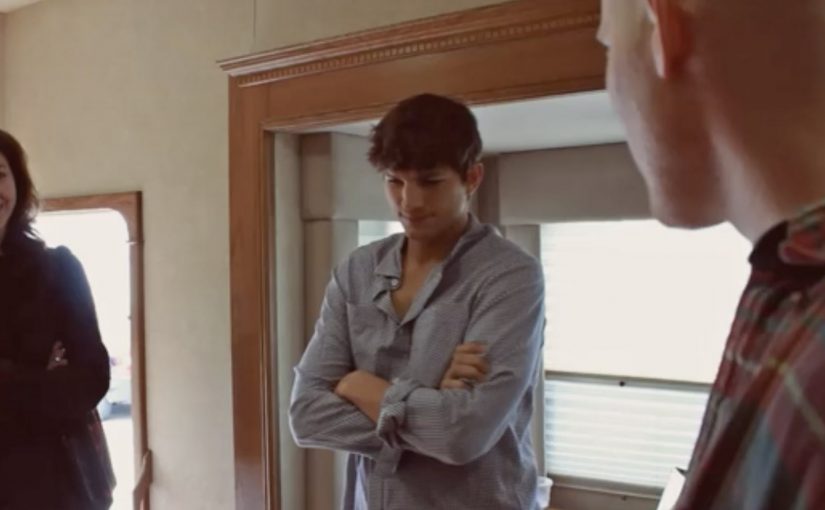
The rule is easy to understand and easy to repeat. Tweet to join the frame. The more followers you have, the bigger your photo appears in the final piece. One person has enough followers to dominate the entire artwork by himself, Ashton Kutcher, so the campaign dares the internet with a simple prompt: Don’t tell Ashton.

How the social currency mechanic earns attention

The mechanism turns a social signal into a visible design system. Followers become “value”. Value becomes size. Size becomes status inside the artwork. Because the output is a single shared object, every participant has a reason to bring in more participants, and every new tweet is both payment and distribution.

In global creative education and talent recruiting, showing capability in a format that naturally spreads can outperform any brochure-style message about what you teach.

Why it lands

It uses a clean, game-like inequality that people instinctively understand. Bigger accounts get bigger presence. Smaller accounts still get in. The Ashton constraint makes the whole thing feel fragile and urgent, because one “wrong” tweet could ruin the artifact. Because the rule turns status into a visible outcome, people instantly understand why participation matters and why the object keeps spreading. That tension becomes the hook that keeps the story moving.

Extractable takeaway: If you want participation to scale, turn one simple social metric into a visible stake inside a shared outcome. Then add a single constraint that makes the outcome feel at risk.

What this is really doing for the program

This is a recruitment campaign disguised as an internet object. The artwork is the portfolio piece, and the spread is the proof that the makers understand how digital behavior works in the wild. The more people talk about the object, the more the school’s program name travels with it.

The real question is whether the program can turn its digital thinking into an object the industry wants to notice, share, and remember.

What to steal from the participation mechanic

  • Build one object people want to join. Collages, maps, frames, and leaderboards make participation legible.
  • Convert a metric into meaning. Followers, contributions, referrals, and time can become “materials” in the output.
  • Make the story retellable. If the rule cannot fit in one sentence, distribution collapses.
  • Add one constraint that creates urgency. A single “if X happens, we lose” condition can be enough.

A few fast answers before you act

What is the core idea of Don’t Tell Ashton?

A Twitter-built artwork where a tweet buys you a spot, and your follower count determines how large your portrait appears in the final piece.

Why tie portrait size to follower count?

It turns a social metric into a visible stake. That makes participation competitive, shareable, and instantly understandable without explanation.

What role does Ashton Kutcher play in the story?

He is the “edge case”. As the most-followed account in the story, one tweet from him could overwhelm the entire artwork, which gives the campaign its tension.

What makes this more than a clever stunt?

It demonstrates a transferable skill. Designing a mechanic where participation and distribution are the same action.

Why does this work better than a normal student showcase?

It makes the audience prove interest through participation. That produces evidence of relevance, not just a claim that the class understands interactive communication.