
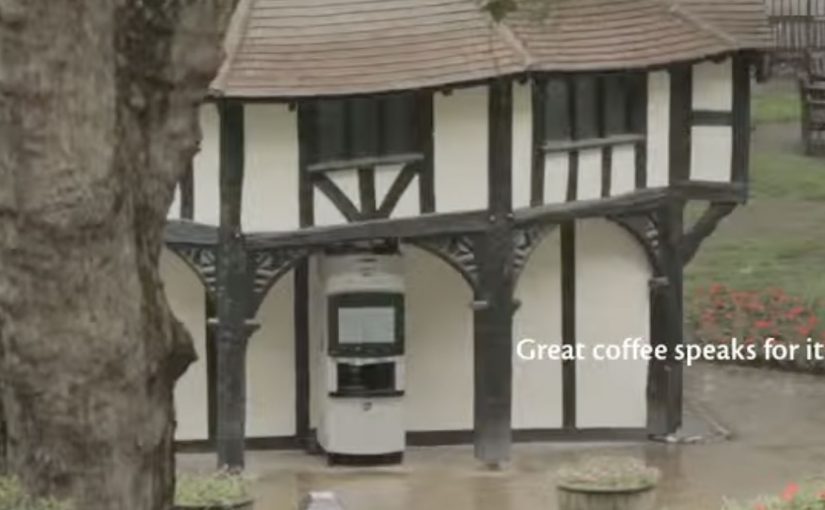
Kenco: Kenneth the Talking Vending Machine

Kenco: Kenneth the Talking Vending Machine

Kenco Millicano’s whole bean instant coffee is positioned as the closest thing to a proper coffee from a vending machine. However, people often have negative perceptions about drinking instant coffee from a machine. So, to engage and excite people enough to consider swapping their coffee shop routine for a vending option, Kenco Millicano worked with its agency team on a talking vending machine. The voice for the machine was provided by comedian and voice actor Mark Oxtoby, who spent a whole day in Soho Square interacting with passers-by.

Similarly in Hong Kong, Levi’s worked with TBWA on a talking phone booth dubbed the “Levi’s Summer Hotline”. Inside the booth, two popular local radio hosts connected via video and challenged visitors to answer questions or do stunts. The crazier the stunt, the bigger the prize. The prize printed out in the booth like a receipt, and could be redeemed at nearby Levi’s stores. The activation was reported to have drawn more than half a million interactions over three days and to have driven a 30% sales uplift.

Two executions. One shared trick

Both ideas take a familiar street object. A vending machine. A phone booth. Then they add something people do not expect from an object like that. A voice, a challenge, a human response, and a reward that arrives immediately.

How the “talking interface” mechanic works

A “talking interface” is a familiar street object that responds with voice, turning a simple transaction into a short ask, response, reward loop.

  • Interrupt the script. People approach expecting a predictable transaction, then the unit talks back.
  • Create a small social contract. You do something simple or slightly brave, and the unit rewards you.
  • Turn participation into theatre. Bystanders can understand what is happening fast, and the crowd recruits the crowd.

In busy public places where attention is scarce, interactive installations win when the first five seconds are obvious and the payoff is immediate.

The real question is whether you can make a vending moment feel like a social interaction, not a compromise.

Why it lands

The “talking” element is not a gimmick. It flips an inanimate object into a social moment, which makes the interaction feel personal even when it is happening in public. That shift changes the emotional framing from “machine coffee” to “a quick story I was part of”. For brands, that is how you replace a negative perception without arguing about it.

Extractable takeaway: If you want people to try something they think they dislike, do not debate the product. Change the moment around the product so the first experience feels human, surprising, and worth retelling.

What these activations are really doing for the brands

Kenco’s machine makes “vending” feel warmer, and it makes the product choice feel less like compromise. Levi’s booth turns brand interaction into a game with a tangible receipt-style reward that pushes people towards a nearby store. Both installations are a conversion point and a content engine at the same time.

Steal this loop for street activations

  • Use a familiar object. Familiarity reduces explanation time and increases participation.
  • Make the first step low-risk. A small action opens the door to a bigger payoff.
  • Keep the loop short. Ask. Respond. Reward. Long flows die in public space.
  • Design for onlookers. The audience around the participant is the multiplier.
  • Make redemption effortless. If the reward requires extra effort later, participation drops.

Vending machines are one of my favourite formats for street-level innovation. I have featured plenty of them on Ramble. If you want to go deeper, browse the vending-machine archive.


A few fast answers before you act

What is a “talking vending machine” in marketing terms?

It is an interactive out-of-home installation where a vending unit uses live or scripted voice interaction to trigger participation, then delivers an immediate reward to reframe the product experience.

Why does “talking back” increase participation?

Because it breaks the expected script of a transaction. That surprise creates curiosity, and curiosity pulls people closer long enough for the reward loop to start.

What makes these ideas work in high-footfall locations?

They are instantly legible, fast to complete, and entertaining for bystanders. The environment supplies the amplification through crowd behaviour.

What is the biggest execution risk?

Throughput and reliability. If interactions slow down, misfire, or confuse people, the installation becomes friction, not fun.

How do you measure success beyond views?

Participation rate per hour, completion rate, average dwell time, sentiment, and whether the activation produces measurable trial or store redemption lift.
Fantastic Delites: Delite-O-Matic

Fantastic Delites: Delite-O-Matic

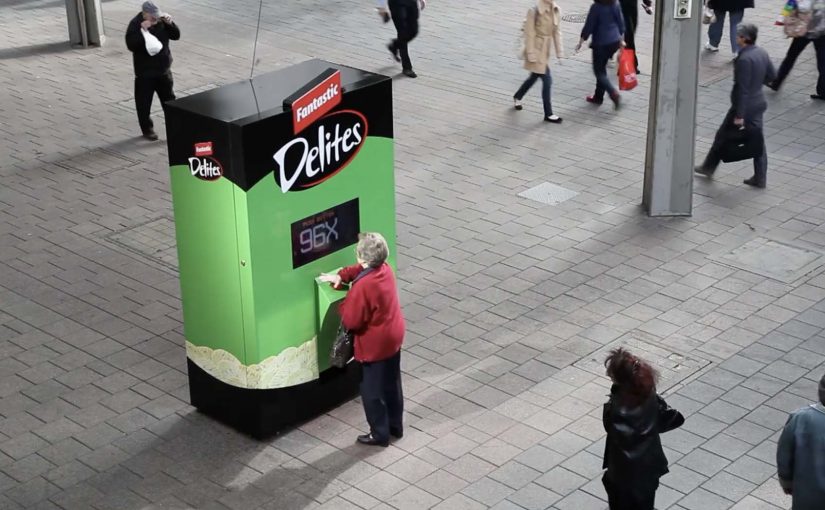
In this latest example, ad agency Clemenger BBDO Adelaide set out to see how far people will go for a free pack of Fantastic Delites.

So a machine dubbed the “Delite-O-Matic” was created that gave people a free pack of Fantastic Delites by means of pushing a button hundreds of times or performing challenges. It was then put out on the streets to prove that because Fantastic Delites taste so good, people would go to incredible lengths to get them.

Sampling that people choose to earn

Interactive vending machines are a great way to get consumer participation and engagement on the ground. There are tons of examples out there, of which some have been covered here.

The mechanic that makes it watchable

The mechanism is effort-based reward. The machine sets an instruction, the participant complies, and the prize is dispensed only after the effort is visible. The escalating “work” becomes the entertainment, and the entertainment becomes the message.

In FMCG sampling and retail activations, interactive vending machines are a repeatable way to exchange effort for product trial.

That structure works because visible effort gives the crowd a simple story to follow before the product appears.

Why it lands

This works because it turns sampling into a story people can instantly judge. The point is not only “free snack”. The real question is what kind of visible effort makes a simple product feel worth watching and worth wanting. Each extra button press or challenge makes the product feel more desirable, and the crowd becomes a built-in audience.

Extractable takeaway: When you make the cost of entry visible, you turn a giveaway into a social moment. That moment carries the brand further than a silent handout ever could.

What to steal from Delite-O-Matic

  • Make the exchange legible: people should understand the rule in one glance, and the effort should be obvious on camera.
  • Escalate, then release: tension comes from “will they do it”. Satisfaction comes from the dispense moment.
  • Keep the prize simple: the product is the hero. The machine is the stage.
  • Design for bystanders: the best sampling stunts recruit a crowd even before the first pack comes out.
  • Let participation become proof: the more people comply, the stronger the implicit claim becomes.

A few fast answers before you act

What is the Delite-O-Matic?

It is an interactive vending machine activation that dispenses a free pack of Fantastic Delites after people complete button-mashing or challenge-style tasks.

Why use effort instead of a simple giveaway?

Effort creates a story. It increases attention, pulls in bystanders, and makes the reward moment feel earned, which boosts recall and sharing.

What’s the key behavioral trick?

Visible commitment. When people publicly invest effort, the product feels more “worth it”, and the scene becomes entertainment for everyone around.

Where does this work outside snacks?

Anywhere trial is the goal and the product is easy to dispense or unlock. Beauty samples, quick-service food, entertainment promos, and event activations.

What’s the main risk?

If the tasks feel humiliating or unfair, the tone can flip. The sweet spot is playful challenge with a clear, quick payoff.

Salta Beer: The Rugbeer Machine

Salta Beer: The Rugbeer Machine

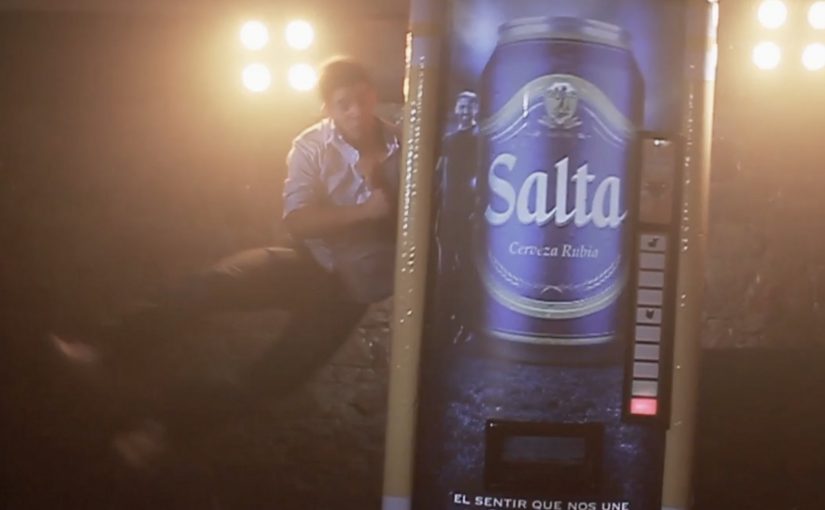
A vending machine that rewards you for tackling

Argentina is often described as football-obsessed. But up in the northern Salta province, described by some as the “New Zealand of Argentina”, rugby culture runs deep. Salta Beer set out to give those rugby fans a live experience built for what they do best.

Working with Ogilvy Argentina, the brand created the Rugbeer Machine, a tackle-activated vending machine concept described as first of its kind. It dispenses exactly what rugby players want most after doing what they do best. One cold Salta Beer per tackle.

The mechanic that makes the idea instantly legible

The machine turns a familiar ritual into a simple rule. You do a proper tackle. The machine validates the hit. You get a can. That is it. No explanation needed, no copy deck required, no “brand purpose” lecture.

Because the rule is binary and the reward is immediate, people understand the exchange instantly and decide on the spot whether to join. In global beer marketing, the fastest way to earn attention in a bar is to convert consumption into a participatory challenge that proves the product in the moment.

Why it lands

It respects the audience’s identity. Rugby is physical, social, and performance-driven, so the “payment method” matches the culture. It also creates a crowd dynamic. One person tackles, everyone watches, the machine responds, and the moment becomes a repeatable mini-event that people want to try and film.

Extractable takeaway: If your brand can credibly borrow an audience ritual, turn that ritual into the input, then make the brand reward the output immediately and publicly.

What the brand is really buying

This is a product trial engine disguised as entertainment. The real question is whether the brand can turn rugby identity into a public participation loop that sells the beer without feeling like an ad. The reward is immediate. The proof is physical. And the format creates social permission to engage because it feels like play, not promotion.

What experiential teams should steal

  • Match the mechanic to the tribe. The interaction should feel native to the audience, not imported from a marketing playbook.
  • Make the rule binary. Do the thing. Get the reward. Complexity kills participation in public spaces.
  • Design for a crowd. The best activations create spectators and participants at the same time.
  • Reward immediately. Instant payoff turns curiosity into action, and action into repeat attempts.

A few fast answers before you act

What is the Rugbeer Machine?

It is a rugby-themed vending machine activation for Salta Beer that dispenses a cold beer after a participant completes a tackle on the machine.

Why does “one beer per tackle” work as a mechanic?

Because it is culturally aligned, instantly understandable, and produces a public moment that is fun to watch and easy to repeat.

What makes this more effective than a typical sampling campaign?

Sampling is usually passive. This turns sampling into earned reward, which increases attention, memorability, and social sharing.

What is the transferable principle for other brands?

Turn a core audience behavior into the input. Then deliver an immediate, visible reward that proves the product in context.

What is the most common failure mode if you copy this format?

Forcing an interaction that does not fit the audience culture, or adding friction that makes people hesitate in public.