
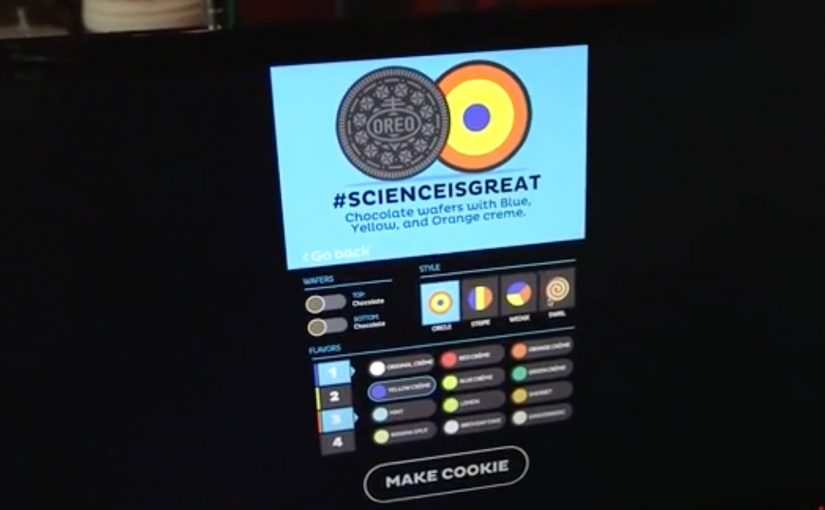
SXSW 2014 has just wrapped up, and Oreo was running a Twitter-powered vending machine that turned what is trending on Twitter into custom Oreo flavours and colours. Here, “Twitter-powered” means live Twitter activity drives the customisation rules the machine applies before dispensing.
How the Twitter-powered machine behaves in the moment
The installation listens to what people are talking about right now, translates that live signal into a tangible product variation, and delivers immediate gratification. It feels less like a branded demo and more like a real-time “trend to treat” pipeline.
In consumer-brand event marketing, the hard part is making a live social signal feel physical fast enough to matter.
Why this works as a live brand experience
The strength is the conversion loop. Social conversation becomes the input. A physical machine becomes the output. The novelty is not just that it is connected. It is that it makes the connection visible and edible in front of a crowd. Because the cause and effect is visible in the cookie itself, people can understand what changed immediately.
Extractable takeaway: Social-to-physical ideas travel when the mapping from input to outcome is obvious and fast. If people cannot explain the cause and effect in one sentence, the activation will not scale beyond the moment.
The real question is whether your activation turns a live signal into a payoff that is legible to bystanders and rewarding to participants.
If the mapping is not instantly clear and the output is not immediate, skip the “social-to-physical” build and invest in a simpler loop.
Steal the ‘trend to treat’ loop
- Pick one live signal. Use a single, public input people already understand in the moment.
- Make the mapping obvious. Show exactly what changed and tie it directly to what the person receives.
- Design for throughput. Keep steps minimal so the line moves and the crowd can watch cause and effect.
- Instrument the loop. Track usage and wait time so you can compare impact against other event spend.
A few fast answers before you act
What is a Twitter-powered vending machine?
It is a connected vending machine that uses Twitter activity as an input signal. In this case, trending topics influence the Oreo customisation, then the machine dispenses the result.
Why do brands build installations like this at events?
They compress awareness, participation, and sharing into a single experience. People see it, try it, and talk about it in the same moment, which amplifies the reach beyond the venue.
What makes “social-to-physical” activations effective?
The mapping has to be obvious and fast. People should immediately understand what they did, what changed, and what they received. The tighter the loop, the more it feels like magic instead of tech.
How do you keep this from feeling gimmicky?
Anchor the change in something people can see instantly, and make the output desirable enough that bystanders want to try it next. If the “why” is not visible in the product, it reads as a demo.
What should you measure if you run a similar idea?
Measure throughput and dwell time at the installation, social lift during the activation window, content volume and quality created by attendees, and the cost per meaningful interaction compared with other live formats.
