
Volvo Keyless Cars

You land at Gothenburg airport, walk up to your car. There is no key handover. No kiosk. No awkward “where did I put it?”. You unlock the door with your phone, start the engine, and drive off. That is the behavioral shift Volvo is putting on the table as it pilots a Bluetooth-enabled digital key. The physical key stops being the default. The car starts behaving like a shareable service.

Volvo’s plan is straightforward and bold. Replace the physical car key with a mobile app that acts as a digital key. It locks and unlocks doors and trunk. It also allows the engine to be started. Volvo intends to roll this out to a limited number of commercially available cars in 2017, with real-world testing beginning in spring 2016 via Sunfleet at Gothenburg airport in Sweden. Physical keys remain available for people who want them.

What “keyless” really changes

Most coverage of keyless cars focuses on convenience. That is real, but it is not the headline. The headline is that the key becomes software, and software is shareable, revocable, time-bound, and measurable.

Once the key is an app, a car can be:

  • Shared without meeting up. You can grant access remotely, without physically transferring anything.
  • Granted for a window of time. A key can expire after a set period, or be limited to a specific day.
  • Revoked instantly. Access can be removed without changing locks or reissuing hardware.
  • Audited. Digital access can create a clean trail of who had access, when, and potentially under what conditions.

Those are not just UX improvements. They are the primitives of “car as a platform,” meaning a vehicle where access and entitlement are programmable.

The real question is whether turning the key into software makes sharing trustworthy and reversible, without adding friction in everyday edge cases.

In mobility services and car-sharing operations, making access software is the quiet foundation for scalable sharing, service models, and trust.

The strategic unlock for car sharing and new mobility behavior

Volvo is not positioning this as a novelty feature. The real-world test through Sunfleet is the tell. Keyless is a missing piece for car sharing because physical keys create friction at exactly the moment you need trust and speed.

Extractable takeaway: When an entitlement becomes software, the hard problem shifts from logistics to permissions, which is why sharing can scale without constant handoffs.

When access is digital:

  • You can share your own car more safely, because you do not need to hide a key or coordinate handoffs.
  • You can operate fleets with lower operational drag, because key logistics shrink.
  • You can start designing new use cases that are impractical when keys are physical.

This is where brand storytelling gets interesting. Volvo is not “marketing an app.” It is marketing an engineered shift in how the product behaves. The brand moves from sheet metal and safety features to a designed system of access, trust, and mobility.

What the digital key needs to get right

Moving the key to a phone is a promise. It must hold up in the messy reality of travel days, dead batteries, and edge cases.

A credible keyless experience typically needs clear answers to:

  • What happens if the phone battery dies? (Fallback options matter, including a physical key for those who want it.)
  • How does identity and authorization work? (Who can issue a key. Who can revoke it. What is the recovery path.)
  • How secure is the handoff? (Bluetooth is convenient. It also raises expectations around encryption, pairing, and spoofing resistance.)
  • How does it work for families and multi-driver households? (Multiple keys, multiple devices, and different permissions.)
  • How does it behave when connectivity is weak? (Airports and parking structures are not always friendly environments.)

None of these are reasons to avoid keyless. Keyless is worth doing, but only when fallbacks and recovery are designed as first-class features.

The marketing lesson hiding inside the engineering

This is a strong pattern in modern innovation storytelling. A brand earns attention when the innovation is tangible and legible. Not “we are digital.” Instead, “a thing you used to do physically becomes software, and your behavior changes.”

For Volvo, the narrative is easy to grasp:

  • The key becomes an app.
  • Access becomes shareable.
  • Mobility becomes more flexible.

That is the kind of product story that travels well. It is engineering that people can feel.

Steal the pattern: access becomes software

  • Reframe the benefit. Lead with “the key becomes software,” then show sharing, revocation, and time-bounding as the real unlock.
  • Design trust into the edge cases. Dead batteries, weak connectivity, and recovery paths decide whether the behavior shift sticks.
  • Make sharing operationally cheap. When keys stop being objects, handoffs and key logistics stop being the bottleneck.
  • Use auditability to increase confidence. If access is trackable, it can support clearer accountability and faster issue resolution.

A few fast answers before you act

What is a digital car key?

A digital car key is a phone-based key that can replace the physical key for core actions like locking, unlocking, and starting the car.

Why does keyless matter beyond convenience?

Because access becomes programmable. You can share it, time-limit it, revoke it, and potentially audit it. That changes how ownership and sharing can work.

What is Volvo actually proposing here?

A Bluetooth-enabled app that replaces the physical key, with a real-world test through Sunfleet at Gothenburg airport, and a limited rollout planned for 2017. Physical keys remain available.

What is the immediate business implication for mobility services?

Lower friction. Less operational overhead around key handling. More flexible sharing models for fleets and individuals.

What must be true for this to feel trustworthy?

Clear fallbacks and recovery paths, secure authorization and revocation, and a user experience that holds up in real-life edge cases like dead batteries and poor connectivity.
Volvo In-Car Delivery

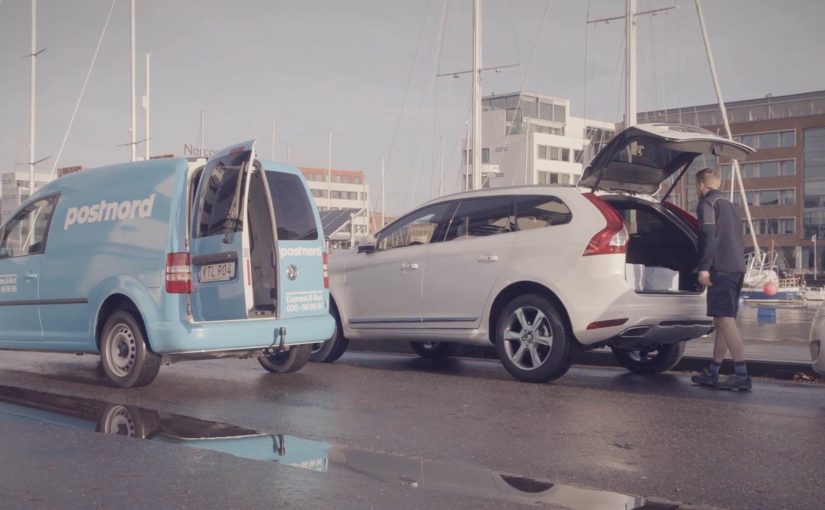
It is late November. You order groceries and Christmas gifts online. You park your Volvo somewhere in Gothenburg. While you are still at work, a courier finds your car, unlocks it once, drops the package into the boot, locks it again, and leaves. You receive a notification. When you drive home, your shopping is already waiting in your car.

That is the core idea behind Volvo’s in-car delivery service. It is available to customers who subscribe to Volvo On Call and live in Gothenburg, Sweden. For the Christmas period, deliveries come from two online retailers. Lekmer.com and Mat.se. PostNord handles the delivery. The courier uses a special one-time access digital key to open the car, place the package in the boot, and re-secure the vehicle.

Why “deliver to the car” is a bigger move than it sounds

At first glance, in-car delivery reads like convenience marketing. Skip missed deliveries. Avoid the “where is my package” loop. Reduce the need to be at home.

But the real shift is structural. The car becomes a secure delivery endpoint. Meaning, the vehicle is treated like a locked, addressable drop-off location with controlled access.

The real question is whether controlled access can make the car a dependable handover point for third parties, not whether the feature feels convenient.

That matters because it turns connected car capability into a service layer that can be monetized and extended. The value does not end when the car leaves the dealership.

The mechanism that makes it work

This service only becomes credible when the access model is precise. The logic is simple:

  • The courier does not get your physical key.
  • The courier gets a one-time digital key that grants limited access for a single delivery.
  • The car becomes the controlled handover point. The boot is the practical drop zone.

Because access is scoped to one delivery and the boot, the courier can complete the drop without you surrendering the car or the physical keys.

When you can grant time-bounded, narrowly scoped access and revoke it immediately, physical assets become secure handover points for partners.

This is not “keyless” as a gadget feature. This is access as a managed entitlement, designed for commerce and logistics.

In European urban settings where people spend the day away from home, reliable delivery depends on secure drop points that do not require the customer to be present.

Why Volvo is telling a marketing story through engineering

Volvo often wins when the innovation is concrete and utility-driven. In-car delivery is exactly that. It is a clean demo of connected technology that saves time, reduces hassle, and fits real family behavior during peak shopping season.

Extractable takeaway: If you want people to believe a new connected service, show it solving a real, repeatable pain point in one clear moment, then let the engineering do the persuasion.

The brand story is also clear:

  • Connected car tech is not an abstract dashboard feature.
  • It changes how everyday logistics works.
  • It makes the car useful even when it is parked.

That is a stronger narrative than “we have an app.” It is a capability that people can visualize immediately.

The strategic signal to other industries

In-car delivery is also a quiet message to adjacent ecosystems:

  • Retailers get a new delivery option that reduces failed deliveries.
  • Logistics players get a new category of secure handover.
  • Carmakers get a template for post-sale services that can scale through partnerships.

In short. Volvo is experimenting with moving beyond simply building and selling cars, by tapping into connected technologies that keep creating value after purchase.


A few fast answers before you act

What is Volvo In-Car Delivery in one sentence?

Volvo In-Car Delivery is a service that lets packages be delivered into your car’s boot using a one-time digital key, instead of delivering to your home.

Who can use it in this pilot?

In this pilot, it is available to Volvo On Call subscribers in Gothenburg, Sweden.

Which retailers and delivery partner are involved?

For the Christmas period described here, the retailers are Lekmer.com and Mat.se, and PostNord handles delivery.

What is the key innovation behind the experience?

The key innovation is controlled access via a one-time digital key that allows the courier to unlock the car once, place the delivery in the boot, and lock it again.

Why is this more than a convenience feature?

It turns the car into a secure delivery endpoint, which creates a service layer that can be monetized and extended through partnerships beyond the initial sale.

Volvo HoloLens Showroom: Virtual Dealership

The showroom no longer needs cars

Car dealerships traditionally depend on physical inventory.

Space, logistics, and availability limit what customers can see, touch, and configure. That constraint disappears when Volvo introduces a showroom experience powered by Microsoft HoloLens.

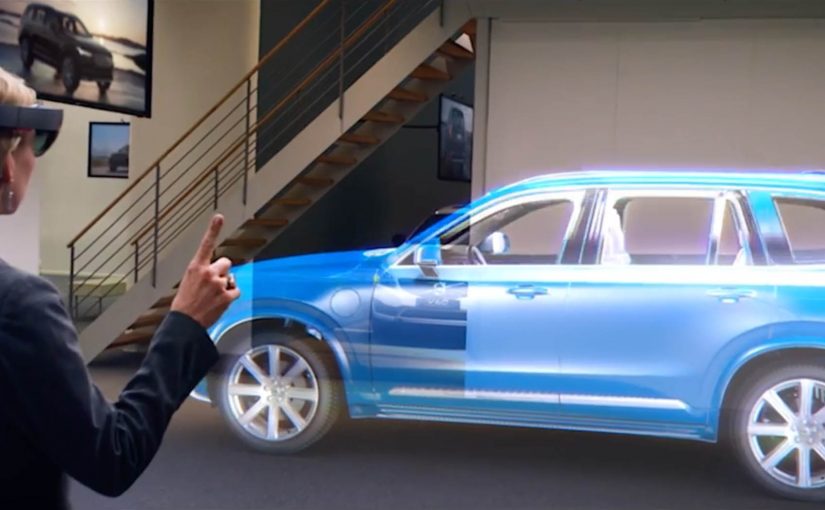
Instead of walking around parked cars, customers step into a virtual environment where full-size vehicles appear as holograms.

How the HoloLens showroom works

Using HoloLens, customers explore Volvo cars at real scale. This is mixed reality, digital objects anchored to the physical space around you.

They walk around the vehicle. Look inside. Inspect details. Colors, trims, and configurations change instantly. The experience feels physical, even though no car is present.

The showroom becomes software-driven. Inventory becomes optional.

In high-consideration retail, the job is helping people visualize options confidently before commitment, even when the product is not physically present.

Why this matters for automotive retail

This is not a gimmick. Virtual showrooms reduce the need for large floor space and allow dealerships to showcase the full portfolio, including models and options that are rarely stocked physically. Because customers can see the car at full scale and switch configurations instantly, they can compare options without relying on imagination, which makes commitment feel safer.

Extractable takeaway: If you can make options visible at real scale and changeable in seconds, you can sell preference, not availability, even when the product is not physically present.

For customers, the experience becomes calmer and more focused. There is less pressure. More exploration. Better understanding before committing.

Experience beats inventory

The deeper shift is about viewer control.

The real question is whether your showroom is designed for preference discovery or for stocking convenience.

Dealerships should treat mixed reality as a configuration layer that complements physical touchpoints, not as a tech demo.

Customers explore at their own pace. Sales staff guide rather than push. The conversation moves from availability to preference.

The dealership turns into a configuration studio, not a warehouse.

  • Make configuration the starting point. Let customers explore options first, then map the shortlist to what they can test and buy.
  • Keep staff in guide mode. Use people to frame trade-offs and confirm choices, not to gate access to information.
  • Design the experience like software. Treat the showroom as a repeatable configuration studio, not a one-off installation.

A few fast answers before you act

Is this replacing test drives?

No. A mixed reality showroom helps customers narrow configurations before a physical test drive.

What do customers actually do in the HoloLens showroom?

They walk around a life-size hologram, look inside, inspect details, and switch colors, trims, and configurations in real time.

What is the real business benefit?

Reduced reliance on physical inventory, clearer configuration conversations, and better use of showroom space.

Why does mixed reality fit automotive retail?

Cars are high-consideration purchases, so visualization can carry as much weight as specification.

What has to be true for this to feel real?

The hologram must stay aligned to the physical space, and configuration changes must respond instantly so customers trust what they are seeing.