
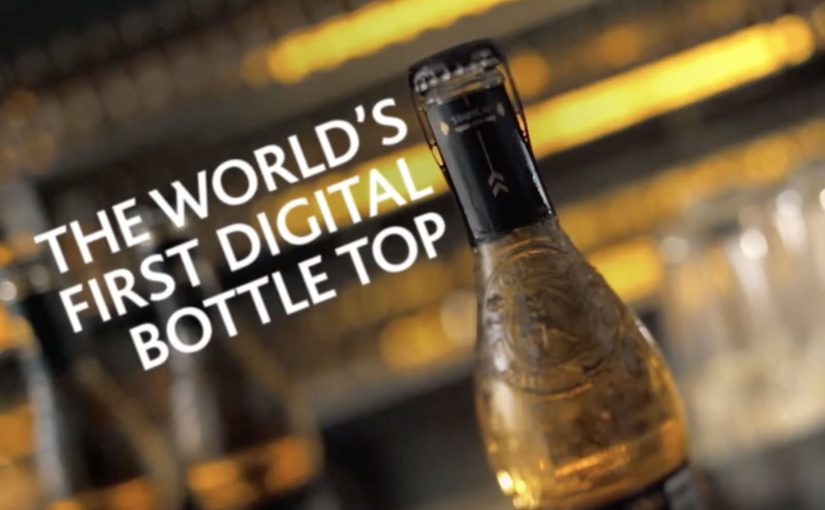
Strongbow Gold: StartCap Bottle Top

Strongbow Gold is testing what is being billed as the world’s first digitally enabled bottle top. Trigger it, and the bottle top activates a surprise designed to make the night feel more refreshing, more unexpected and more exciting.

For its first public appearance, the Strongbow Gold team rigged an entire bar in central Budapest with RFID readers, antennas and wires. Then during the night, StartCap triggered a string of memorable activations.

A bottle that behaves like a remote control

The core mechanism is packaging as a trigger. An RFID element in the cap signals nearby readers when the bottle is opened, and that signal kicks off a pre-set sequence in the environment, lights, music, props, anything the system is wired to control.

In European FMCG brand launches, connected packaging is a direct way to turn a product claim into a lived experience because the consumer action, opening the bottle, becomes the start button for the story.

Why this lands in a bar context

Bars already run on anticipation. People are there for the next moment. StartCap simply makes that “next moment” programmable, and ties it to the brand in a way that feels earned rather than announced. Because the trigger is the same action guests already perform, the surprise reads as part of the night, not a branded interruption.

Extractable takeaway: In any shared venue, tie a visible “room moment” to a natural product action and the crowd will supply the reaction and conversation without extra prompts.

What the brand is really proving

This is less about a new cap and more about a new role for the brand. Strongbow Gold positions itself as the catalyst for a better night out, not just a drink choice. Connected packaging is only worth doing when the payoff is unmistakable in the room. The technology is the proof device that makes that positioning tangible.

The real question is whether you can choreograph a repeatable “room moment” without making the tech the headline.

Connected-packaging stealables for your next idea

Connected packaging here means the package contains an identifier or sensor that can trigger a response in a nearby system, turning a normal use action into an experience cue.

  • Make the trigger unavoidable. Opening, pouring, unwrapping. The action must be natural.
  • Design for surprise, not complexity. One clean signal, one clear payoff, then scale the choreography.
  • Use the environment as media. If the space reacts, you earn attention without buying more screens.
  • Keep it safe and reliable. In live venues, failure is public. Redundancy matters.

A few fast answers before you act

What is StartCap in one sentence?

A digitally connected bottle top that uses RFID to trigger events in the surrounding environment when the bottle is opened.

Why is packaging-triggered tech so effective?

Because it links the brand to a physical action the consumer already performs. The experience starts at the product, not at an ad.

What is the biggest risk with “connected bar” activations?

Operational fragility. If sensors misread, activations lag, or the venue is too noisy to notice outcomes, the magic disappears.

Does this need a smartphone app to work?

Not necessarily. This model can be environment-driven. The venue infrastructure can detect the trigger and run the experience without asking the guest to install anything.

What should be measured to judge success?

Participation rate, repeat triggers per guest, dwell and sentiment in the venue, plus any post-event lift in brand consideration and trial.
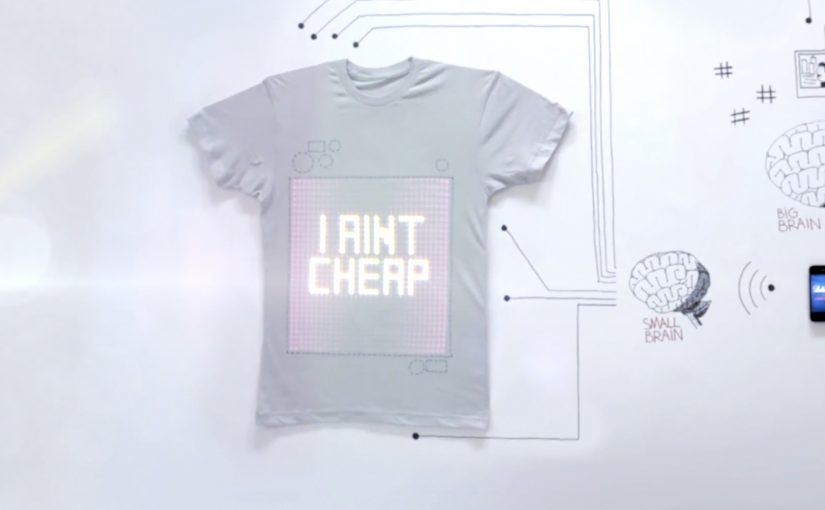
CuteCircuit x Ballantine’s: tshirtOS

A grey T-shirt looks ordinary until it lights up and starts broadcasting whatever you choose. Text. Images. A status. A moving graphic. Your chest becomes a screen.

London fashion house CuteCircuit, in collaboration with whisky brand Ballantine’s, introduces tshirtOS, described as a wearable, shareable, programmable T-shirt built for digital creativity.

Here is a short making-of film, described as having received over 500,000 views.

What tshirtOS actually is

At the center is a 32 by 32 grid of 1,024 LEDs on the front of the shirt, controlled via an app on your phone. The concept is expanded with built-in components including a micro-camera, a microphone, an accelerometer, and speakers. The result is a garment that can display and capture content, then push it outward as a wearable broadcast. Here, that means the shirt itself becomes the display surface and the phone becomes the control layer.

In global consumer culture, where mobile is the primary tool for self-expression, programmable wearables turn identity signals into a personal channel that travels with the wearer.

Why it lands

Most “future of fashion” ideas die because they look like tech demos instead of culture. tshirtOS works as a story because it keeps a familiar object, the plain tee, then adds one new superpower that everyone understands immediately. You can show something. Right now. In public. Because the output appears on a familiar object people already understand, the technology reads as communication before it reads as hardware. That instant legibility makes the idea feel less like a gadget and more like a new medium.

Extractable takeaway: If you are launching a new interface, anchor it in a familiar form factor, then make the first benefit obvious in one glance so the audience explains it for you.

What the brands are really betting on

The ambition is bigger than a one-off prototype. It is a new creative canvas that sits between fashion, social content, and live communication. Ballantine’s gets cultural adjacency to creativity and experimentation, while CuteCircuit extends its interactive fashion narrative into something that looks commercially repeatable.

The real question is whether a programmable garment can move from prototype theater into a repeatable medium people instantly understand and want to use.

The second film, “T-shirt of the future,” puts tshirtOS into a night-out storyline. It is described as having already generated over 1.3 million views.

What to steal from tshirtOS

  • Prototype the medium, not the message. When the platform is new, the product itself is the headline.
  • Design for instant comprehension. If it cannot be understood in a second, it will not spread.
  • Show it in culture, not a lab. A night out beats a spec sheet for explaining why it matters.
  • Make it programmable. Viewer control creates infinite variations without infinite production.

A few fast answers before you act

What is tshirtOS in one line?

A programmable T-shirt concept that uses a 32 by 32 LED grid and a mobile app to display and share digital content in real time.

What hardware is described as being inside the shirt?

A 1,024 LED grid plus components including a micro-camera, microphone, accelerometer, and speakers.

Why does a programmable shirt matter for brands?

It turns the wearer into a moving, controllable surface for expression, which can connect live moments to digital content without relying on external screens.

What is the main adoption barrier?

Practicality and cost. Washability, comfort, battery life, and price all determine whether it becomes a product or stays a prototype.

What is the strongest creative use case?

Live, personal expression in social settings, where instant visual output is part of the experience and the wearer wants to change what is displayed on the fly.