
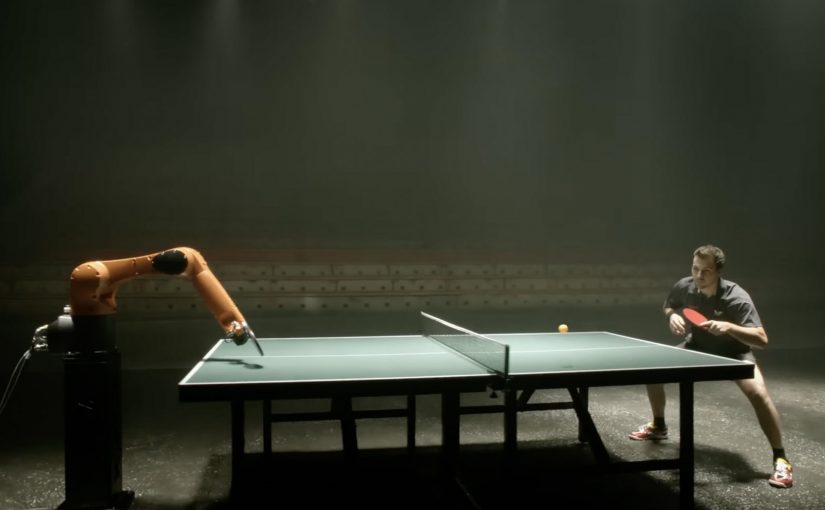
KUKA: The Duel – Timo Boll vs Robot Arm

KUKA: The Duel – Timo Boll vs Robot Arm

KUKA is a market leader in industrial robotics. To provide a realistic vision of what robots can be capable of in the future and at the same time celebrate the opening of their new robotics factory in Shanghai, they got German table tennis champion and former world number one Timo Boll to take on a KUKA robot in what was billed as the first ever man versus robot (arm) table tennis match.

The match took place on March 11th in Sofia, Bulgaria. Since then the results of the match have been sliced and diced into the below final cut video that celebrates the inherent speed, precision, and flexibility of KUKA’s industrial robots in tandem with Boll’s electrifying and tactical prowess in competition.

A sports duel as an industrial demo

The mechanism is straightforward. Put a world-class human performer in a constrained arena. Put a robot arm in the same arena. Then shoot it like a movie. Tight angles, slow motion, dramatic beats, and a clear scoreboard narrative. The engineering message rides inside the entertainment. That works because the duel format makes speed, precision, and control visible before the viewer needs any technical explanation.

In B2B industrial categories, cinematic demonstration is often the fastest way to translate engineering attributes into mainstream attention.

The real question is how to make robotic precision feel obvious to people who will never read a spec sheet.

Why it lands

Table tennis is a smart choice because it compresses the value proposition into a single frame. Reaction time, repeatable precision, and control are all visible without a technical explanation. You do not need to understand robotics to understand a rally that never misses its mark.

Extractable takeaway: If your product advantage is “invisible” to most people, stage a head-to-head scenario where the advantage becomes legible in seconds, then edit the story so the viewer can feel the difference.

The intent behind the “first ever” framing

The “man vs. machine” line is a distribution strategy as much as a claim. It gives journalists, employees, and customers a simple hook. It also lets a factory opening travel beyond trade press, because the asset is watchable even if you have no interest in industrial automation.

What industrial marketers should copy

  • Turn specs into a duel: pick one human benchmark and make your performance measurable against it.
  • Choose a sport that explains you: the activity should naturally map to your differentiators.
  • Make the first 10 seconds self-explanatory: the premise should land without narration.
  • Edit for story, not documentation: the cut should create tension and release, not just show footage.
  • Provide a “making-of” layer: give engineers and buyers a deeper track once the headline video has earned attention.

A few fast answers before you act

What is “The Duel”?

It is a KUKA campaign video built around a staged table tennis match. Timo Boll plays against a KUKA robot arm, with the story edited like a cinematic showdown.

What is the campaign trying to prove?

Not that a robot “plays sport” like a human. The point is to make speed, repeatability, and precision feel real, fast, and memorable.

Why table tennis specifically?

Because the action is compact and readable. You can see reaction time and accuracy in a rally without needing technical context.

Is “man vs robot” the important part?

It is the packaging. The more transferable lesson is how the format turns complex capability into a simple, shareable demonstration.

What should B2B marketers copy from this?

Engineer a single, high-contrast scenario where your advantage is visible immediately, then ship both a headline cut for attention and a deeper “behind the scenes” layer for credibility.
Duracell Moments of Warmth: Heated bus shelter

Duracell Moments of Warmth: Heated bus shelter

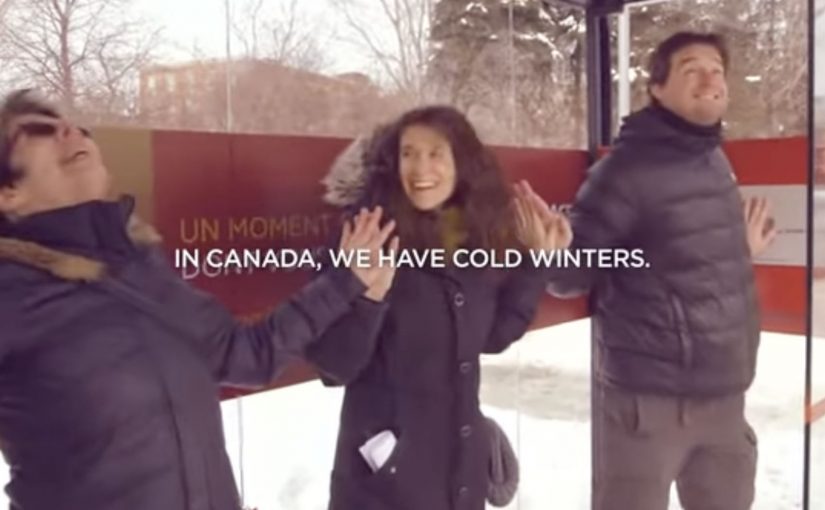
In a winter of ice storms and a polar vortex, moments of warmth are few and far between. So to change that, Duracell Quantum batteries in Canada retrofit a bus shelter with heaters, but the only way to get the heat to work is through a human connection, people joining their hands.

The shelter is set up so warmth only kicks in when two or more commuters complete a simple circuit by touching the contact points and holding hands in the middle.

Why “warmth you earn together” is the right mechanism

This idea works because the product promise is experienced, not explained. Because the heaters only turn on when strangers complete the circuit together, “power” turns into instant relief you can literally feel while you wait. This is the right pattern when you can prove your claim with a sensory payoff in under a minute.

Extractable takeaway: An ambient activation, meaning a brand experience built into the environment, lands fastest when the reward is physical and only unlocks through simple cooperation.

In cold-weather urban transit, small prompts that reward cooperation can turn waiting time into a shared moment, and into a brand story.

The real question is whether your interaction rule makes strangers coordinate in seconds without a staffer, a screen tutorial, or a social script.

What makes the interaction memorable

  • Clear rule in seconds. No app, no signup, no instructions beyond the physical cues.
  • Instant feedback. The reward is heat, right now, right where you are standing.
  • Social proof built in. Every new person who walks up sees the behavior and understands what to do.

Steal the cooperation trigger

  • Make the benefit tangible. If your claim is about performance, choose an output people can sense.
  • Use a cooperative trigger. Shared actions create a story people retell without prompting.
  • Keep the loop short. If it takes more than one minute to understand, street attention disappears.
  • Let the environment do the explaining. Physical design beats copy when you only have a few seconds.

A few fast answers before you act

What is “Duracell Moments of Warmth”?

It is an ambient bus shelter activation where heaters only activate when commuters connect physically, turning “power” into a felt experience.

How does the bus shelter get activated?

Two or more people complete a simple circuit by touching the shelter’s contact points while joining hands, which triggers the heating system.

Why does the hand-holding mechanic matter?

Because it forces cooperation. The brand benefit is delivered through a human moment, which makes the warmth feel earned and memorable.

What is the brand message in one sentence?

In cold winters you need power, and sometimes the best power comes from connecting with other people.

What is the main lesson for experiential marketing?

If you want people to remember a claim, make them participate in a mechanism that behaves like the claim.

Apotek Hjärtat: Blowing in the Wind

Apotek Hjärtat: Blowing in the Wind

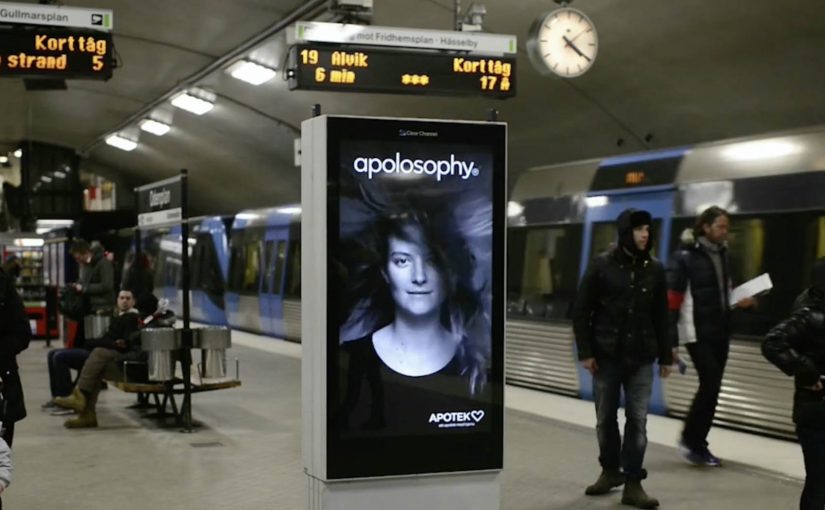
A subway platform in Stockholm. A digital screen. A model with a lush mane. Then the train arrives and her hair starts to whip around, perfectly timed to the rush of air you can feel on the platform.

To introduce a new line of hair products, Swedish pharmacy Apotek Hjärtat worked with Åkestam Holst to fit the platform screens with ultrasonic sensors. When those sensors detect an incoming train, the film switches into a “blowing in the wind” sequence, creating the illusion that the turbulence from the train is affecting the model on the screen.

The trick behind the timing

This is reactive outdoor done with restraint. Here, reactive outdoor means the screen responds to a real environmental trigger instead of running the same sequence on a fixed loop. There is no complex interface and no extra instruction for commuters. The environment provides the trigger, the sensor provides the cue, and the creative provides the payoff. The moment is over in seconds, which is exactly how long you get on a platform before attention snaps back to schedules and crowds.

In high-traffic transit environments where attention is scarce, reactive outdoor works best when it synchronizes with a real-world moment everyone already notices.

Why commuters stop

The effect feels “impossible” because it is contextual and precise. People experience the wind and see the wind at the same time. That sensory alignment is what makes it memorable, and it makes the product claim feel physical instead of cosmetic.

Extractable takeaway: If you want outdoor to earn attention, link the creative to a shared environmental trigger, and make the response immediate enough that viewers can connect cause and effect without being told.

What the brand is signaling

The story is not really about sensors. It is about vitality. The real question is whether the public moment makes the product promise feel physically true before the commuter moves on. The ad implies the product brings hair to life, then proves that idea through a living, timed reaction in a public space. You remember the feeling first, then the brand name attached to it.

What to steal for reactive outdoor

  • Pick a trigger that already exists. Trains arriving, doors opening, crowds gathering.
  • Make the payoff instantly legible. One glance should be enough to get it.
  • Use craft to hide the tech. The illusion matters more than the explanation.
  • Design for repeat viewing. Platforms are perfect for loops, because people wait.

A few fast answers before you act

What is “Blowing in the Wind”?

A reactive DOOH installation for Apotek Hjärtat where ultrasonic sensors detect an approaching subway train and trigger a film effect that makes the model’s hair appear to blow in the train’s turbulence.

What is the core mechanism?

Sensor detects train arrival. Creative switches at the same moment the real airflow hits the platform. The viewer experiences both together, which sells the illusion.

Why does it feel more persuasive than a normal screen ad?

Because it is synchronized with the physical environment. That alignment makes the message feel like something happening, not something being played at you.

What is the most common mistake when copying this pattern?

Overbuilding the interaction. If viewers need instructions, or if the trigger is unreliable, the magic disappears and the screen becomes just another screen.

Why does the product claim feel more real than in a standard beauty ad?

Because the demonstration is tied to a real physical cue on the platform. That makes the benefit feel observed in the moment, not merely claimed in the creative.