

Plan: The Erasable Billboard for Girls’ Education

Plan: The Erasable Billboard for Girls’ Education

A large illustrated billboard appears in a busy city square. People donate, receive a simple eraser, and start rubbing away the artwork. As the top layer disappears, a second illustration is revealed underneath, shifting the story from girls working to girls going to school.

Plan has reported that tens of millions of girls worldwide are pushed into work instead of education, while in many less privileged countries boys are more likely to get access to schooling. To spark action, Plan and CLM BBDO created an erasable billboard with an illustration designed to be removed to reveal another illustration underneath. The billboard ran in central locations in Paris and Berlin. Passers-by were invited to donate in exchange for an eraser, then use it to change what the billboard showed.

Why the “erasable” mechanic is so strong

The mechanism does two jobs at once. It raises money, and it makes the issue understandable without explanation. The before-and-after is literal. Work disappears. School appears. The donor is not only informed. The donor performs the change. Cause-led campaigns should treat participation as the message, not a bonus layer.

Extractable takeaway: When the donor completes the transformation with their hands, the message becomes a memory and the donation feels consequential.

Definition-tightening: the eraser is not a gimmick. It is the interface, meaning the simple physical tool that gives the donor viewer control over the story. Because the act of erasing creates ownership, it makes someone more likely to donate, talk about it, and remember it.

In social-impact fundraising, participatory outdoor media can turn a small donation into a visible act of change that people feel in their hands.

The real question is whether your donation ask feels like participation or just passive sympathy.

What Plan is really buying

This is a public proof of participation. Instead of asking people to “care” in private, it makes caring visible, social, and shared. Every person who erases becomes a live endorsement that the issue matters enough to stop and act.

Steal this pattern: make giving tactile

  • Make the transformation physical. A tangible before-and-after beats a poster full of statistics.
  • Use the donation as the trigger. The action should only unlock after contribution, not before it.
  • Let participation create the content. The billboard changes because people change it.
  • Design for bystanders. Watching others erase is part of the persuasion.

A few fast answers before you act

What is the “Erasable Billboard” idea?

An illustrated billboard designed to be physically erased. Donors receive an eraser and reveal a second image underneath, shifting the story from girls working to girls going to school.

Why exchange a donation for an eraser?

Because it turns giving into an action. The eraser is a simple reward, but more importantly it is the tool that lets the donor create the transformation themselves.

What makes this more effective than a standard charity billboard?

It is participatory and observable. The public sees the billboard changing in real time, which builds social proof and makes the issue easier to grasp.

What is the main emotional lever?

Viewer control. The donor does not only learn about the problem. The donor performs a symbolic solution in front of others.

What is the biggest execution risk?

If the transformation is not instantly readable, people will not engage. The before-and-after needs to be obvious from a distance and satisfying up close.
British Airways: #lookup points to planes

British Airways: #lookup points to planes

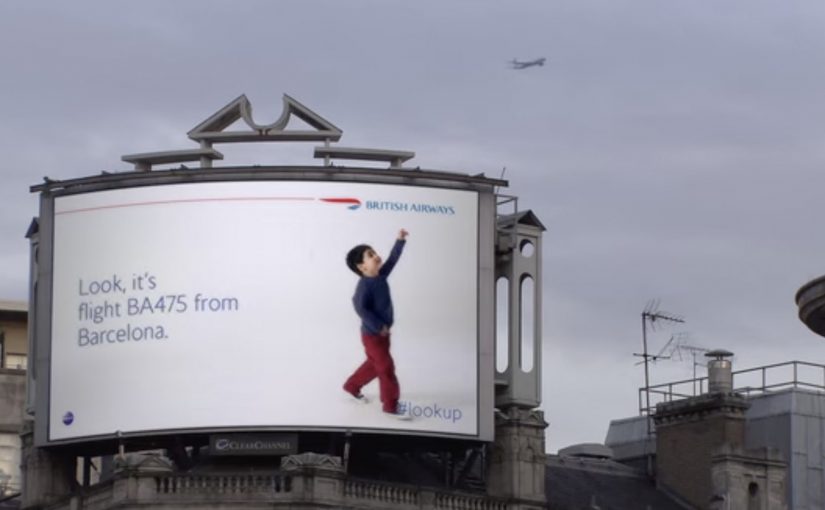
Last month, British Airways set up an interactive digital billboard in London’s Piccadilly Circus. It uses custom-built “surveillance technology” to track British Airways flights passing overhead. Here, that means identifying aircraft and matching them to British Airways flights in real time, not tracking individuals on the street.

On detecting a BA flight, the boy in the ad gets up and points to the plane. An accompanying message displays the flight number and the place it is arriving from.

In high-traffic city centres, digital out-of-home works best when it reacts to the environment rather than shouting at it.

Interactive advertisements are getting more popular with brands. In May, a Spanish organization called ANAR used lenticular printing to show different messages to kids and adults in their campaign for anti-child abuse.

How #lookup works (and what “surveillance” means here)

The magic is simple. The screen stays “normal” until the exact moment a British Airways aircraft is in view. Then the creative switches to a scene that makes you do what the boy does. You look up, spot the plane, and connect the brand to the real object above you.

“Surveillance technology” sounds heavier than what’s happening in practice. In this execution, it is reported as hardware and software used to identify aircraft and match them to British Airways flights in real time. The storytelling trigger is the aircraft, not the crowd.

Definition you can reuse: Context-aware DOOH is outdoor creative that changes based on live signals from the environment (location, time, weather, movement, or public data feeds). It works when the signal is instantly understandable and the change earns attention rather than interrupts it.

In European city-centre media buys, context-aware DOOH is one of the few formats that can earn attention without relying on volume.

Why it lands: a micro-surprise that answers a real question

Most outdoor advertising asks for attention first, and only then offers meaning. #lookup flips that order. It gives you meaning first. A child pointing at something real. Then it rewards your curiosity with an answer you cannot get from a static poster. What flight is that, and where has it come from? Because the trigger is a plane you can actually see, the data reveal feels like an answer to curiosity, not an interruption.

Extractable takeaway: If the environment makes people ask a question, your creative should answer it instantly with one human-readable data point that completes the scene.

The real question is how you turn ambient curiosity into a brand-credit moment people choose to share.

This is the rare “brand moment” where the interface and the emotion line up. A real plane prompts real curiosity. The billboard supplies the missing information. The brand gets credited for the experience.

What British Airways is really buying with this idea

At one level, it’s a smart stunt. At a deeper level, it’s a reframing of air travel. Instead of selling price, routes, or amenities, it sells the feeling of possibility and the breadth of the network.

It also turns a passive medium into an earned-media engine. When a billboard reacts to reality, people record it, talk about it, and share it because it feels like “proof,” not persuasion.

How to borrow the #lookup pattern

  • Pick a signal people already notice. Planes, trains, weather shifts, match scores, queue length, local landmarks. The trigger should be obvious without explanation.
  • Make the reaction immediate and legible. If the audience needs to read a paragraph to understand the mechanic, the moment is lost.
  • Answer a question the environment creates. “Where is that going?” is stronger than “buy now.” Build the creative around curiosity.
  • Use data as a storytelling ingredient, not a dashboard. Flight numbers and origins feel human when they complete the scene, not when they look like telemetry.
  • Keep privacy optics clean. If you must use loaded terms like “surveillance,” clarify what is being detected and what is not.

A few fast answers before you act

What makes the British Airways #lookup billboard “interactive”?

It changes its creative in real time based on a live external trigger. A British Airways aircraft passing overhead. That trigger causes the billboard to play a scene and display flight details tied to the specific plane.

Is this the same as QR codes or touchscreens in outdoor ads?

No. QR codes and touchscreens require deliberate user input. #lookup is environment-triggered interaction. The “input” is a real-world event, not a tap.

Why does real-time data improve out-of-home advertising?

Because it turns a static message into a situated experience. When the content matches what is happening around you right now, attention feels earned and the brand feels more relevant.

What’s the simplest way to replicate this pattern without complex engineering?

Use a clean, reliable signal you can access easily (time of day, weather, local transit status) and design one dramatic creative switch that is instantly visible from a distance.

What’s the biggest risk with “reactive” outdoor ads?

Overcomplication. If the trigger is rare, hard to understand, or the creative change is subtle, the concept will not land. Optimise for clarity and frequency of payoff.

Honda CR-V: An Impossible Made Possible

Honda CR-V: An Impossible Made Possible

When “no CGI” becomes the flex

Optical illusions and jaw-clenching stunts (Volvo Trucks) instead of computer animation are becoming the norm.

Honda’s latest European commercial for the CR-V 1.6 i-DTEC Diesel keeps that trend going. It uses well-placed props and carefully drawn imagery to trick you into seeing the impossible. Describing it in detail gives too much away, so it is better to watch the optical illusions directly.

The mechanic: perspective tricks that stay readable on camera

The spot plays with perspective, scale, and line-of-sight to make everyday spaces behave in ways they should not. The car seems to float, shrink, or move through geometry that your brain struggles to reconcile, precisely because the scene is constructed to be “correct” from the camera’s viewpoint. That matters because a camera-perfect illusion feels physically plausible, so viewers give the stunt more credit than they would give obvious digital trickery.

In European automotive marketing, practical illusion work is a fast way to signal engineering credibility while still delivering spectacle. By practical illusion work here, I mean physical sets, props, and camera-controlled perspective rather than digital effects.

Why it lands

It rewards attention. You cannot half-watch it, because your brain keeps trying to solve the image. That creates replay value, and replay value is a quiet superpower for car advertising, where most spots blur into the same driving shots and the same claims.

Extractable takeaway: If your message is “this performs beyond what you expect,” use a visual system that makes viewers test their own assumptions, then let the craft do the convincing.

The real question is whether the illusion makes the car feel more impressive, not just the ad more clever.

Honda gets that balance right here because the illusion sharpens the product story instead of distracting from it.

What to borrow from illusion-led car storytelling

  • Make one camera angle the truth. Illusions work when the viewing position is controlled and the payoff is immediate.
  • Use mystery as a feature. A little confusion buys you replays, and replays buy you recall.
  • Keep the brand role simple. The product should move through the illusion, not compete with it.
  • Protect the reveal. If explanation kills the effect, build your copy to point, not to decode.

A few fast answers before you act

What is “An Impossible Made Possible” for Honda CR-V?

It is a European TV spot for the CR-V 1.6 i-DTEC Diesel that uses practical optical illusions, props, and perspective tricks to make the car appear to do impossible things.

What is the core creative mechanic?

Forced perspective and camera-aligned set construction. The scene is built so the illusion reads as “real” from the viewer’s point of view.

Why avoid heavy CGI in this kind of execution?

Practical illusions feel earned. Viewers sense there is a real setup behind the shot, which increases credibility and replay value.

What makes illusion-led ads more memorable?

They trigger a “solve it” response. People replay to understand what they saw, and that repetition drives recall.

What is the most transferable lesson for brands?

Use craft to create viewer doubt, then resolve it with a clean product moment. Confusion first. Clarity second.