
McDonald’s Reflective Billboard

McDonald’s Reflective Billboard

You drive past a billboard during the day and see nothing. Then you pass it again at night, your headlights hit the surface, and a message appears. “Open all night.”

The idea. An ad you can only see at night

McDonald’s wanted to target people looking for a late night snack, so Cossette Vancouver created an ad that only showed itself when the audience was most likely to want it.

How reflective tape turns headlights into a reveal

Reflective tape was used to write “Open all night” on the billboard. The message was not visible during the day, but at night, with car headlights, it was revealed.

For late-night retail and roadside food brands, timed visibility like this turns the placement itself into the filter.

Why this works for late-night intent

This is behavioural targeting without data. The medium uses context instead of audience data to decide when the message becomes visible. Because the message only appears when headlights activate it, the reveal feels timely rather than intrusive.

Extractable takeaway: When the environment can decide who sees the message, the creative can stay simple and still feel precise.

What this does for late-night traffic

The real question is whether the medium can do the filtering before the copy has to. In this case, the billboard spends visibility only on people who are out at night, which makes a simple store-hours message feel more useful and more memorable.

This is a stronger OOH move than a generic night-time billboard because the medium itself makes the message feel useful.

What to steal for context-driven OOH

  • Turn an environmental condition into the trigger. Here, light does the targeting without any data.
  • Align message visibility with intent. If the audience can see it, they are already in the right moment to act.
  • Keep the proposition short and literal. The reveal is the effect, so the copy should be instantly readable at speed.
  • Design for repeat exposure. The “I saw nothing. Then I saw it” contrast is what makes it stick.

A few fast answers before you act

What is the McDonald’s Reflective Billboard concept?

It is a billboard that stays visually “blank” in daylight, but reveals the line “Open all night” when car headlights hit reflective tape after dark.

Why is night-only visibility a smart creative constraint?

Because it aligns the message with the moment of need. People out late are more likely to want a snack, so the ad appears when intent is highest.

What is the key production technique here?

Using reflective tape to create a hidden message that only becomes legible under direct light sources like headlights.

Why does this feel less intrusive than normal targeting?

Because the environment does the filtering. The ad only becomes visible in the right condition, so the timing feels useful instead of forced.

What is the broader lesson for outdoor advertising?

Let context do the targeting. When the medium responds to time, light, or location, the message can feel personalised without collecting data.
Samsung Galaxy Y Duos: Human Face Mapping

Samsung Galaxy Y Duos: Human Face Mapping

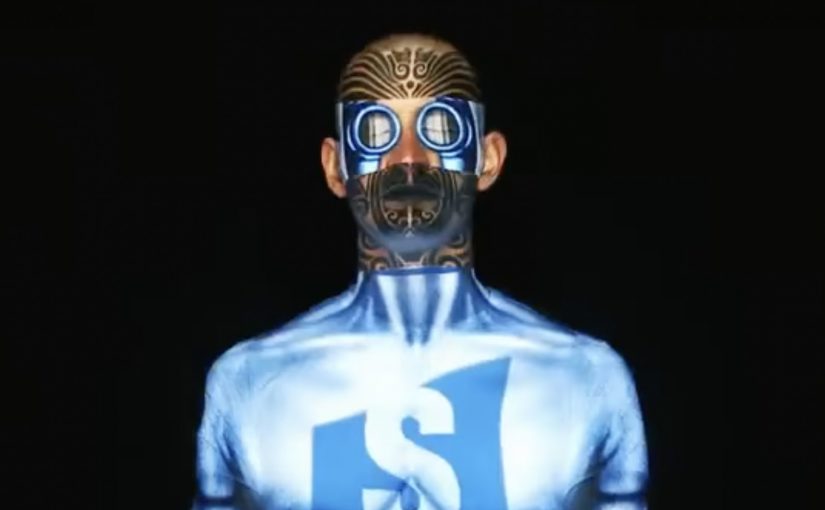
A man sits still in a chair, and his face becomes the screen. Light wraps perfectly around skin, eyes, and contours, switching identities and moods as if the head is a living billboard.

Over the years there have been numerous noteworthy projection mapping events and installations. In this latest example, Samsung, for the launch of its Galaxy Y Duos, a dual SIM smartphone, creates a very unusual projection mapping piece on a human face.

When mapping leaves the building

The mechanism is the point. Projection mapping normally favors surfaces that do not move. Here, the “surface” is a face, which means every tiny change in angle threatens the alignment. The craft is in keeping the projected geometry locked to human features so the illusion stays believable.

In global consumer electronics launches, spectacle earns attention fastest when the medium demonstrates the product idea, not just a product visual.

Why this fits a dual SIM story

The creative metaphor is identity switching. Multiple personas, contexts, and “modes” land on one face, which mirrors the promise of a phone designed to manage two worlds without forcing a hard choice between them. Because the mapping stays locked to facial features, the switching reads instantly, which is why the metaphor can carry the dual SIM idea without copy.

Extractable takeaway: If your product promise is “two worlds, one device”, pick a medium that naturally visualizes switching. Then strip everything else away until the switch is the only thing people can retell.

What Samsung is really buying

This is not a spec explanation. It is an attribution grab, meaning a creative move designed to bind one message to the brand in memory. The goal is to make “Galaxy Y Duos equals dual identity” stick in memory through a visual that feels new, technically ambitious, and hard to ignore. The real question is whether the stunt makes “dual identity” feel obvious in one glance, without needing specs.

Projection mapping takeaways you can reuse

  • Make the mapping carry the meaning. The effect should express the product truth, not decorate it.
  • Choose a single metaphor and commit. Here it is identity switching. Everything supports that.
  • Design for instant comprehension. If it does not read in two seconds, the stunt becomes “cool tech” with no brand imprint.
  • Keep the hero shot simple. One clean sequence that people can retell beats five clever sequences no one can describe.

A few fast answers before you act

What is “human face mapping” in this context?

Projection mapping where the projected visuals are calibrated to a real face, so light and motion appear to sit on the skin and follow facial geometry.

Why is mapping onto a face harder than mapping onto a wall?

A face is complex and can move. Small shifts break alignment, so the illusion depends on precise calibration and controlled motion.

How does this connect to the Galaxy Y Duos product idea?

The piece uses shifting identities on one face as a visual metaphor for managing two SIM identities on one device.

What is the main advantage of a mapping stunt for a phone launch?

It earns attention through novelty, then links that attention to a single, memorable product idea people can repeat.

What is the biggest creative risk with this approach?

If the metaphor is weak, the audience remembers the technique but not the brand or the product message.

Norte Beer: Photoblocker

Norte Beer: Photoblocker

After their successful campaigns for Andes Beer in Argentina, Del Campo Nazca Saatchi & Saatchi is back with another beer campaign. This time it is a TV ad that highlights another Argentine beer-related invention.

A beer cooler that fights the camera flash

The invention is described as the Norte “Photoblocker”. A functional beer cooler fitted with sensors that detect camera flashes. When a flash goes off nearby, it fires back its own burst of light to overexpose the photo and make faces hard to recognize.

In nightlife culture and bar marketing, protecting privacy in public spaces is a relatable tension that spreads fast through word-of-mouth.

Why it lands

The idea works because it turns an everyday annoyance into a “brand-powered solution”. Being tagged in a messy night-out photo is a modern fear, and the Photoblocker is a simple, visual punchline that makes the benefit obvious without explanation. It also sets up a clean contrast. With Photoblocker versus without Photoblocker. That before-and-after logic is perfect for TV, but it also hints at a real-world stunt, which is where the campaign earns extra talk value.

Extractable takeaway: If you can productize a social pain point into a physical prop that demonstrates itself in one second, you get both a clear story and a repeatable proof moment people will retell.

What the brand is really doing

This is less about claiming a taste difference and more about claiming a role in the night. The real question is how a beer brand can become useful in the exact social moment where embarrassment starts. Norte positions itself as “on your side” in the club. The brand becomes the enabler of freedom, mischief, and plausible deniability, with a device that dramatizes that promise.

What to borrow from this nightlife privacy stunt

  • Start from a real behavioral pain. Here it is social photo-tagging anxiety.
  • Build a prop that shows the benefit instantly. One flash. One ruined photo. No explanation needed.
  • Use an obvious contrast format. “With / without” is easy to remember and easy to share.
  • Make the stunt feel usable. Even if it is promotional, it should look like something you would want in real life.
  • Keep the brand role credible. The solution must feel like it belongs in the product’s world.

A few fast answers before you act

What is the Photoblocker, in one sentence?

A beer cooler that detects camera flashes and fires back light to spoil photos taken nearby.

Why is this a “beer campaign” and not just a gadget gag?

Because it connects directly to a drinking occasion and positions the brand as a protector of nightlife freedom, not just a beverage.

What makes the mechanic so shareable?

It is visual, instantaneous, and easy to explain. People understand the benefit the moment they see a flash ruin a photo.

What is the biggest credibility risk?

If the audience thinks it is impossible or staged, the “solution” stops being funny and becomes just an ad trick. The execution has to look functional.

How can other brands apply this pattern without copying it?

Identify a socially painful moment in your category, then build a simple, physical demonstration that resolves it in a way anyone can understand at a glance.