
Formula E: Leap of Faith

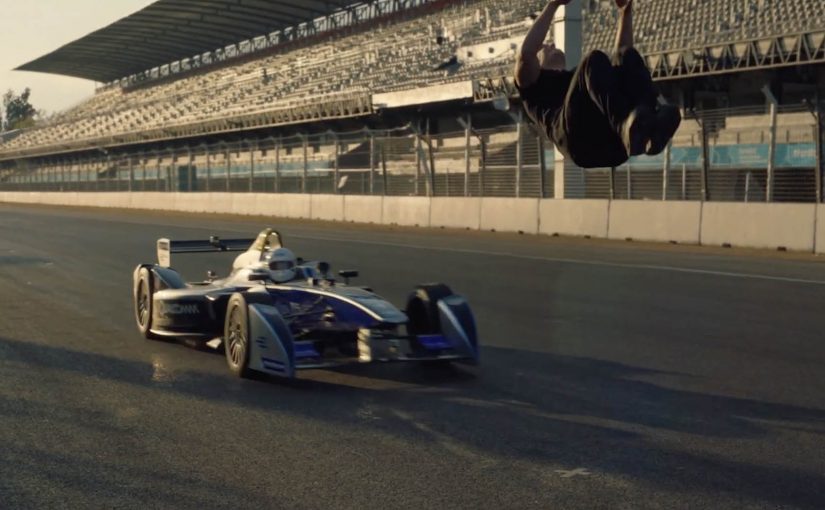
A race car comes up fast from behind. Damien Walters cannot see it. He commits anyway, throwing a backflip that clears the car at speed, landing as if it is routine.

Watch the perfectly synchronised leap below.

One trick, built on timing discipline

The mechanic is simple to describe and hard to execute. A blind backflip over a moving Formula E car. What makes it work is timing control. The driver holds a consistent approach speed, and the stunt is triggered off a repeatable timing reference so the flip happens at the exact moment the car reaches the take-off zone.

In sports branded content, the cleanest way to earn attention is to stage a single, unmissable proof where human skill and the sport’s technology meet in the same frame.

Why it lands

This is a spectacle with a clear question and a clear answer. Can he do it. Then, there it is. The real question is whether the stunt can make precision feel visible rather than merely claimed. The “blind” constraint adds tension because it removes the most obvious safety cue, and the viewer instinctively runs the risk calculation while watching. The payoff is the feeling of precision, not chaos. It reads less like danger for danger’s sake and more like controlled performance.

Extractable takeaway: If your story is “this is high-performance and precise,” build a moment where the viewer can see precision as a binary outcome, and keep the framing uncluttered enough that nobody misses the proof.

What Formula E gets out of it

The stunt borrows the language of elite motorsport. Speed, control, engineering, nerve. It also gives Formula E an easily shareable “you have to see this” asset that travels beyond core racing fans, while still feeling native to the category.

What to steal from the stunt

  • Make the promise visible. Translate “precision” into a single, legible pass or fail moment.
  • Add one constraint that increases tension. Blind, one-take, fixed distance, single attempt. Keep it understandable.
  • Keep the shot honest. The simpler the framing, the more the audience trusts what they are seeing.
  • Design for replay. If the moment is short and clean, people will rewatch and repost without needing context.

A few fast answers before you act

What is “Leap of Faith” in one sentence?

A branded stunt film where Damien Walters performs a blind backflip over a speeding Formula E car with tight timing synchronisation.

What makes the stunt feel different from a normal trick shot?

The car approaches from behind, so the timing has to be pre-controlled rather than visually adjusted, which raises tension and makes precision the headline.

Why does this format work for a sports brand?

It communicates the sport’s core attributes, speed and control, in a compact proof that is understandable even to non-fans.

What is the main creative risk?

If the production feels over-edited or overly cinematic, audiences question authenticity and the share impulse drops.

When should you use a “single proof moment” idea like this?

When your brand story is performance-based and you can express it as one unmistakable action that holds attention in the first three seconds.

Volkswagen Trailer Assist

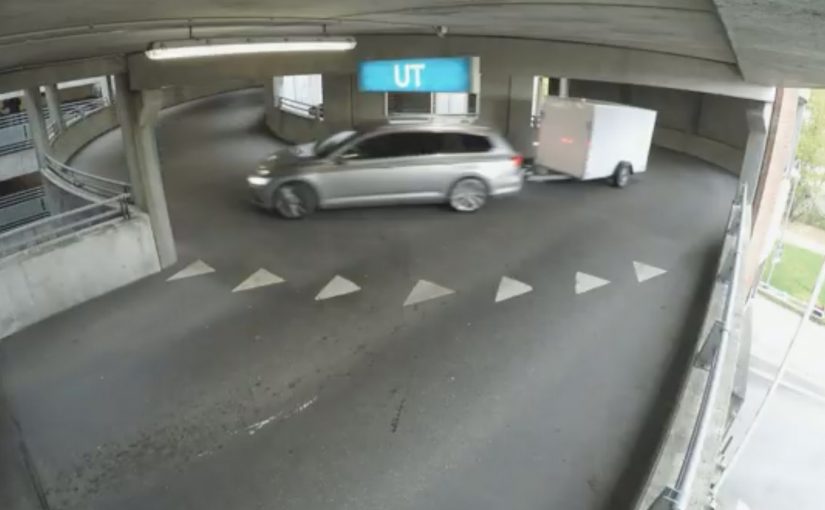
The Trailer Assist feature allows Volkswagen cars to park semi-autonomously using the rear backup camera. To promote this feature in Norway, Volkswagen created a stunt where a driver appeared to back up his car and trailer at high speed through parking lots, roundabouts and intersections.

The film looks impossible on purpose. The “trailer” was built as a disguised driving rig, with a stunt driver inside. One-way transparent plexi glass (and film) kept visibility possible for the driver in the rig, while still selling the illusion from the outside.

What Trailer Assist is actually solving

Reversing with a trailer is where confidence collapses for many drivers. The steering feels counter-intuitive, small corrections compound fast, and stress makes it worse. Trailer Assist flips that experience by turning the job into a simpler “direction setting” task, while the system handles the tricky part of guiding the trailer’s path using the rear camera. By “direction setting,” the driver chooses where the trailer should go rather than constantly counter-steering every correction.

Why the stunt works as marketing

In automotive marketing, driver-assist features are easier to remember when the audience feels the pain before it hears the specification. Because the stunt externalizes the panic of trailer reversing at an exaggerated scale, viewers immediately understand why assistance matters before the feature is explained. This is smart feature marketing because it dramatizes the user problem first and the technology second.

Extractable takeaway: When a feature reduces a known stress point, dramatize the stress first so the assistance feels necessary rather than technical.

What Volkswagen is really demonstrating here

The real question is whether Volkswagen can turn a hidden driver-assist feature into a capability buyers instantly understand and remember. Volkswagen is not selling autonomous driving here. It is selling confidence at the exact moment many drivers feel least competent.

What to steal for tech-feature storytelling

  • Start with a strong visual proof. If the benefit is hard to explain, make it easy to see.
  • Use exaggeration to earn attention, then anchor in reality. The stunt pulls people in. The feature explanation keeps it credible.
  • Pick a scenario your audience already fears. Trailer reversing is a universal stress test.

A few fast answers before you act

What is Volkswagen Trailer Assist?

A driver-assist feature that helps manoeuvre a trailer while reversing using the rear camera, reducing the counter-intuitive steering challenge.

What did Volkswagen do in Norway to promote it?

They staged a stunt that made it look like a Volkswagen reversed a trailer at very high speed through real-world driving situations.

How did they create the illusion?

A disguised trailer rig with a hidden stunt driver inside made the movement possible while keeping the “reverse drive” effect believable from the outside.

Why was plexi glass part of the setup?

One-way transparent plexi glass (and film) allowed the driver in the rig to see out while keeping the illusion intact for onlookers and camera angles.

What is the key takeaway for marketers?

When a feature is hard to appreciate in a static demo, create a single dramatic scenario that forces attention, then connect it back to the everyday value.

Lexus Hoverboard: Engineering a Brand Moment

Lexus builds a hoverboard. On purpose.

Lexus did not build a hoverboard to sell it. They built it to show what the brand stands for when you strip away the brochure.

The real question is whether you can prove engineering credibility in public without turning it into an ad.

The Lexus Hoverboard is presented as a rideable board that levitates above the ground using magnetic levitation. The campaign frames it as engineered, tested, and demonstrated rather than simulated.

This is brand storytelling executed through engineering, not advertising copy.

How the hoverboard is described to work

The hoverboard uses magnetic levitation technology. Magnetic levitation means the board is held up by magnetic forces rather than wheels or air pressure.

Superconductors inside the board are described as being cooled with liquid nitrogen. When placed above a specially designed magnetic track, the board “locks” into position and floats.

The result is controlled levitation. Not free roaming, but stable, directional hovering that makes riding possible. The constraint becomes part of the proof, because it makes the mechanism legible to viewers.

In premium automotive and consumer technology categories, the fastest path to trust is often a visible demonstration of real capability rather than another layer of messaging.

Why it feels like engineering, not hype

Lexus positions itself around precision, control, and advanced engineering. The hoverboard compresses those values into a single, highly visual artifact. You do not need to read a brochure to understand it. You see it.

Extractable takeaway: If you want people to believe a capability, build a demonstration where the constraints are obvious and the work is hard to fake.

By putting professional skateboarders on a levitating board in a purpose-built environment, Lexus turns technical credibility into a cultural moment.

What Lexus is really doing here

The hoverboard is not positioned as a prototype for future mobility. It is a brand signal.

By “brand signal,” I mean a deliberate proof point that tells the market what you are capable of, even when no one can buy the thing you built.

Lexus frames the execution as complex technology made real and presented with control rather than chaos. In categories where trust in engineering is everything, that framing is the product.

Demonstrations beat declarations when your differentiation is engineering, because they create belief before the copywriting starts.

What this says about modern brand building

Brands increasingly compete on what they can demonstrate, not what they can claim. When technology is real, visible, and difficult to fake, it carries more weight than messaging.

The Lexus Hoverboard works as a brand moment because it is unnecessary. It exists only to make a point.

What to steal for your next credibility play

  • Choose a proof, not a promise. Build one artifact that makes the capability undeniable.
  • Make the constraints visible. If people can see what makes it hard, it reads as real.
  • Turn the demo into a scene. Put the proof in a context people recognize and want to share.
  • Separate “signal” from “SKU.” Treat this as brand equity work, not product pipeline.
  • Design for replay. Aim for a story people can retell in one sentence.

A few fast answers before you act

Is the Lexus Hoverboard real or CGI?

In the campaign, it is presented as a real levitating board demonstrated in-camera, not a visual effects sequence.

How does the hoverboard create levitation?

It is described as using superconductors cooled with liquid nitrogen over a magnetic track, producing magnetic levitation.

Why does it only work in specific locations?

Because the magnetic infrastructure is part of the system. Without the track, the “hover” mechanism has nothing to levitate against.

What is Lexus actually selling with this stunt?

Confidence in engineering. The point is to compress precision, control, and advanced capability into one unforgettable proof moment.

What makes this kind of demo believable to audiences?

Visible constraints plus visible performance. When the audience can see what makes it hard to fake, the claim carries more weight.

When should a brand copy this pattern?

When your differentiation is technical credibility and your category runs on trust. Build a proof artifact that makes the capability obvious in seconds.