
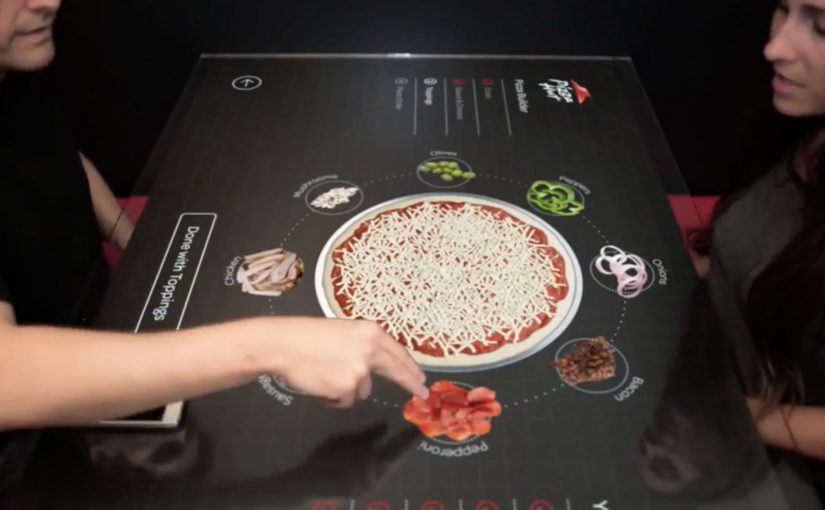
Pizza Hut Interactive Table: order by touch

Multi-touch media that uses highly engineered glass and companion technologies feels like the future. So Pizza Hut partners with Chaotic Moon Studios in the USA to create an interactive concept table that lets customers in retail outlets create and customize their pizzas on the spot.

The promise is simple: instead of a static menu, the table becomes the interface, turning ordering into something you can explore, assemble, and adjust with your hands.

A table that turns ordering into a build experience

The mechanism is a multi-touch tabletop UI that walks you through base, sauce, toppings, and sides as a sequence of visual choices. Your pizza is assembled live on-screen, so the product takes shape while you decide.

In quick-service restaurants, the easiest way to increase customization confidence is to make choices visual and immediate.

Why it lands: it reduces friction and adds play

Ordering pizza can be surprisingly error-prone: misheard toppings, unclear sizes, forgotten extras, awkward group decisions. A touch-first interface turns that into a shared, visible process where everyone can see what is being built before it is submitted.

Extractable takeaway: When customization is the product, make the build visible to everyone, so groups converge on one order with fewer misunderstandings.

What Pizza Hut is really trying to prove

Beyond “cool tech,” this kind of table concept signals modernity in the dine-in experience. It frames Pizza Hut as a place where the experience is part of the product, not only the food.

These interfaces are worth doing only when they reduce ordering errors and keep dine-in throughput intact.

The real question is whether turning ordering into a shared build process increases confidence without slowing the line.

Borrowable patterns for touch-first ordering

  • Make the product assemble itself. Visual construction beats textual configuration for speed and accuracy.
  • Design for groups, not only individuals. Shared screens turn indecision into collaboration.
  • Keep the interaction shallow. Limit the flow to a few obvious steps with minimal typing.
  • Let the interface do the upsell quietly. Sides and add-ons perform better when they appear as natural next steps.

A few fast answers before you act

What is the Pizza Hut Interactive Concept Table?

It is a multi-touch tabletop ordering concept designed to let dine-in customers build and customize pizzas directly on the table interface.

What problem does a touch-table solve in restaurants?

It reduces ordering friction by making customization visual, shared, and less dependent on staff hearing, memory, or paper menus.

Is this an ordering system or a marketing concept?

It is presented as a concept experience to demonstrate a possible future dine-in flow, with the interface itself acting as the headline.

Why is multi-touch a good fit for pizza customization?

Pizza is modular. When options can be added, removed, and previewed instantly, customers feel more confident and order faster.

What is the main takeaway for experience design?

If you want people to customize, make the choices tangible. Let them see the product changing as they decide.
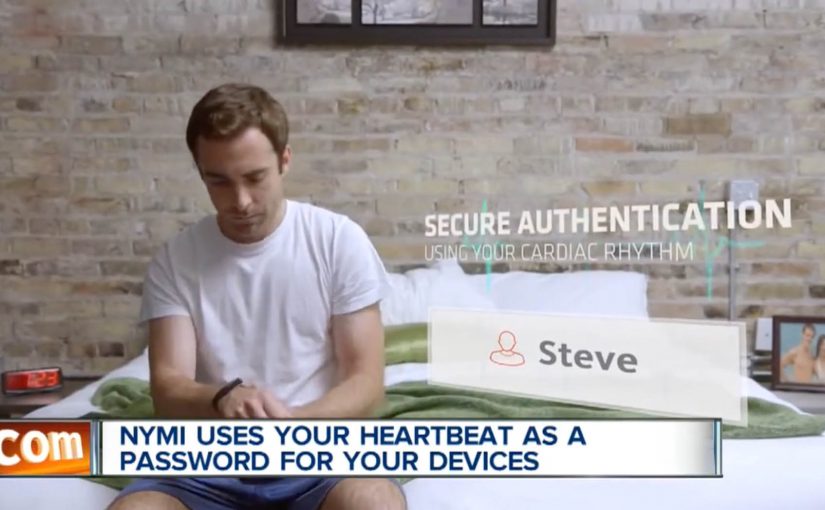
Replace your passwords with your heartbeat

Imagine never having to type a password, and never needing to pull out your credit card to make a payment ever again. A biometrics startup called Bionym is positioning exactly that future with Nymi, a sleek wristband that uses your heartbeat to authenticate your identity.

The promise is simple. If your identity can be verified passively, you can unlock everyday things without friction. Bionym presents Nymi as a way to unlock your favourite devices such as your computer, smartphone, and even your car. If this kind of wearable is adopted at scale, it becomes a first step toward replacing keys and passwords with something you already carry on you.

What is actually being launched

Nymi is positioned as a consumer-ready wristband with a clear job. Authenticate you, then unlock the devices and services you use most. The interesting part is not the form factor. It is the shift from remembering secrets to proving identity continuously.

In this context, “authenticate” means proving your identity without typing a secret. That shift matters because it removes repeated login interruptions from the moments you are trying to get something done.

In global consumer and enterprise environments where people move between devices, services, and locations all day, authentication friction becomes a quiet tax on usage.

Why passive identity is so tempting

Passwords and keys interrupt you at exactly the point you want momentum. A wearable that verifies you in the background reframes identity from an event (login) to a state (you are present), which makes everyday unlocks feel like flow instead of checkpoints.

Extractable takeaway: When identity proof becomes a background signal, you remove “stop and sign in” moments that quietly kill adoption.

The ecosystem requirement that decides whether it matters

A wearable authentication layer only becomes valuable when it works across many endpoints. That means third-party developers and partners need to build a thriving ecosystem of apps and devices that can use Nymi for access and verification.

The real question is whether “heartbeat as login” can become a shared standard across devices and services, because without broad integrations it stays a niche accessory.

Pre-order details

You can pre-order the Nymi for $79, but it is not going into production until later this year. Between now and launch, the real work is adoption. Getting integrations, partners, and use cases that make “heartbeat as login” feel normal.

Moves worth copying for frictionless login

  • Make the promise tangible. Give the product one clear job (unlock) instead of selling biometrics as a vague “future”.
  • Design for passive confirmation. Reduce prompts, but make the authenticated state obvious enough that people trust it.
  • Win integrations before awareness. Treat partners and endpoints as the product, because a single-device unlock story does not change behaviour.

A few fast answers before you act

What is Nymi?

A wristband from biometrics startup Bionym that uses your heartbeat to authenticate your identity and unlock devices.

What kinds of things can it unlock?

Bionym positions it as a way to unlock devices such as computers, smartphones, and cars, reducing the need for passwords and keys.

What has to happen for this to scale?

A strong third-party ecosystem of apps and device integrations, so the wristband works across many real-world use cases.

Is heartbeat authentication inherently safer than passwords?

It can reduce risks tied to memorized secrets, like reuse across services. Security still depends on how the wristband, the endpoints, and the fallback flows are implemented.

What should you look for before betting on a wearable login?

Look for real integrations with the devices and services you actually use, because the ecosystem decides whether this becomes a habit or a gimmick.

Macy’s iBeacon: Retail Enters Micro-Location

iBeacon moves from concept to real retail

Apple is working to bring iBeacon technology into retail stores. But the first real-world deployment lands fast.

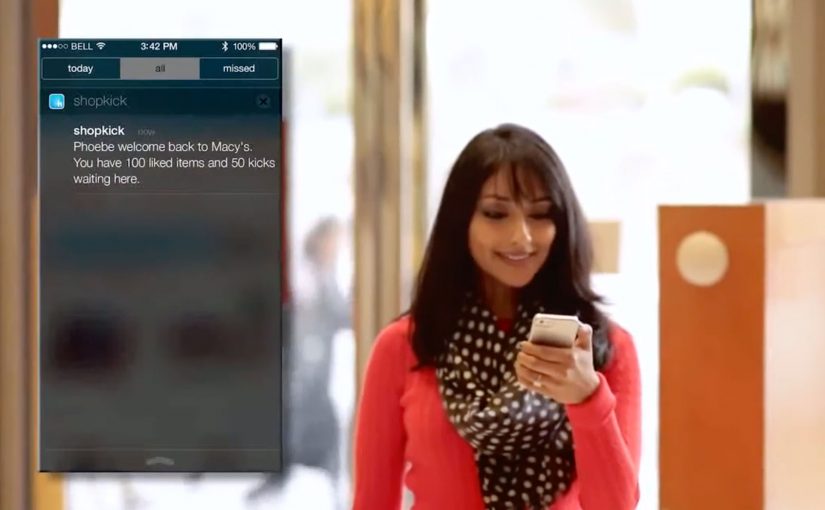
On November 20, Shopkick deploys an iBeacon system at Macy’s, effectively bringing beacon-driven retail experiences live before Apple’s own retail rollout becomes mainstream.

At Macy’s, the implementation is branded as shopBeacon, an iBeacon-based in-store experience.

What iBeacon makes possible in-store

iBeacon, introduced with iOS 7, uses Bluetooth Low Energy (BLE) signaling to enable micro-location services inside stores, meaning aisle-level positioning rather than GPS-level proximity.

That matters because it changes what mobile in-store experiences can do. Because the signal is precise inside the environment, experiences can trigger at the moment of intent, reducing the need for shoppers to search.

Stores can deliver information and value based on a shopper’s precise location inside the environment, not just on GPS-level proximity.

Micro-location enables location-specific deals and discounts, product recommendations by aisle or department, loyalty rewards triggered by presence, and contextual content that enhances the shopping journey.

The promise is simple. The store becomes a responsive, context-aware interface.

In brick-and-mortar retail, micro-location only matters when it is permissioned, useful, and tied to measurable in-store behavior change.

What makes Macy’s deployment noteworthy

This is not a lab demo. It is a live retail environment.

The shopBeacon trial runs as a closed beta at Macy’s Herald Square in New York and Macy’s Union Square in San Francisco.

This marks the shift from talking about beacons to operationally testing them in flagship stores, where footfall, density, and shopper intent are real.

The strategic signal for retailers and brands

Beacon technology is not another channel. It is an in-store intelligence layer that links a shopper’s physical context to digital triggers and measurement.

Extractable takeaway: Micro-location only becomes strategic when it turns permissioned context into real utility that changes behavior, not just into more messages.

The real question is whether you can turn aisle-level context into permissioned help that measurably changes in-store behavior.

If executed with permission and relevance, it can reduce friction in discovery and decision-making, increase the utility of mobile without forcing shoppers to search, and bridge physical browsing with digital personalization.

If executed poorly, it becomes noise. The win condition is not proximity. It is context plus permission plus usefulness.

What to borrow for your beacon pilot

  • Win permission first. Treat opt-in and relevance as the product, not an afterthought.
  • Design for usefulness at the moment of intent. Use aisle-level context to reduce discovery and decision friction, not to spam offers.
  • Make measurement non-negotiable. Track opt-in rates, perceived usefulness, and impact on dwell and conversion to prove behavior change.

A few fast answers before you act

What does “micro-location” mean in a store context?

It means detecting a shopper’s location at aisle or department level, not just “near the store”, enabling experiences that change based on where the shopper is standing.

Why is BLE central to iBeacon-style deployments?

Bluetooth Low Energy enables persistent, low-power proximity signals that make in-aisle triggers and experiences feasible without draining devices.

Is the main value just pushing offers?

No. Offers are one use case. The stronger value is contextual service, guidance, and relevance when it reduces shopping friction.

What should retailers measure in early pilots?

Opt-in rates, perceived usefulness, impact on dwell and conversion, and whether the experience feels helpful rather than intrusive.

What is the quickest way for this to fail?

When it becomes noisy, repetitive, or unpermissioned. Proximity alone is not value. Context and usefulness are the win condition.