Here is an action created by Leo Burnett Iberia for the Altius Foundation to raise money for the education of needy children in Latin America…
Q
Here is an action created by Leo Burnett Iberia for the Altius Foundation to raise money for the education of needy children in Latin America…
Q
Everyone loves cool ad executions, but some are clearly advertising for advertising people. This one shows up at exactly the right time. Award-show season.
The work comes out of Brazil for Kaiak, Natura’s men’s fragrance. Kaiak has been reformulated, and the brief is simple but brutal. How do you sell a new scent online when the one thing people want to do is smell it?
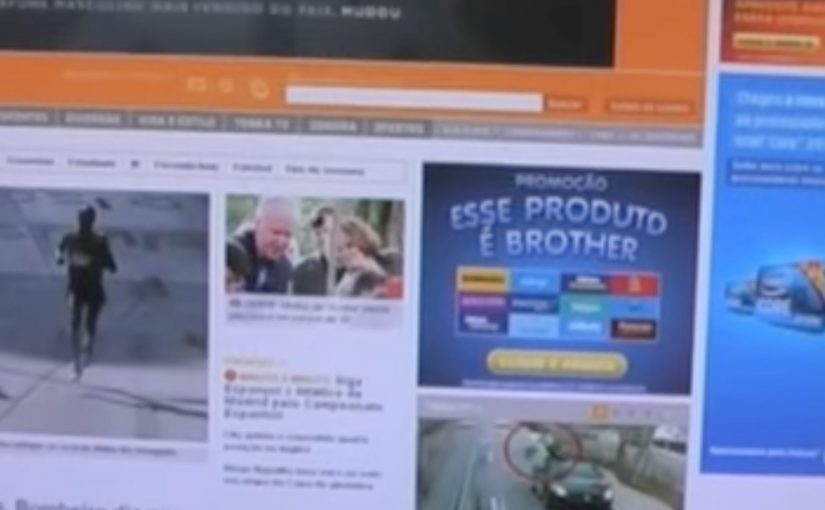
ID/TBWA solves it by building the missing sense into the media placement itself. Custom hardware is attached to computers in lan houses (cyber cafés) across Brazil. A special banner appears on the browser start page and reads, “The best selling men’s fragrance in the country just changed. Want to try it? Click this banner. It’s scented.”
When someone clicks, a scented strip physically emerges from the attached device. The digital impression turns into a real sample in the moment where “try” normally breaks down online.
In Brazilian urban markets where lan houses function as high-traffic digital hubs, turning a cyber café PC into a sampling machine creates mass trial without needing retail testers.
The reason it works is not novelty alone. It removes the biggest barrier in fragrance e-commerce. Confidence. Instead of asking the viewer to imagine a scent, it lets them verify it immediately. The click is not a promise. It is the delivery mechanism.
This is a trial engine dressed as a banner. The goal is to reduce hesitation around change, create fresh talk value around “it’s different now”, and push people toward purchase with a sensory proof point that normal digital formats cannot provide.
An online banner placed on cyber café computers that dispenses a physical scented strip when the viewer clicks, enabled by custom hardware attached to the PC.
Because fragrance requires sampling. The hardware turns a digital click into immediate product trial, removing the biggest barrier to buying scent online.
“Try now” is built into the media unit. The banner instruction is simple, and the click triggers a physical delivery moment that proves the claim.
If touch, smell, or taste drives purchase confidence, you need a credible bridge to real-world experience, not just better copy or imagery.
Identify the missing sense, then engineer a sampling moment where action and reward are tightly coupled and instantly legible.
In European public-space storytelling, the strongest initiatives do not ask people to remember. They make history physically reappear in the places where it happened.
The Go Beyond Borders Project was an initiative of Heimat Berlin and CNN International, in conjunction with Berlin tape artist El Bocho, created around the 20th anniversary of the fall of the Berlin Wall.
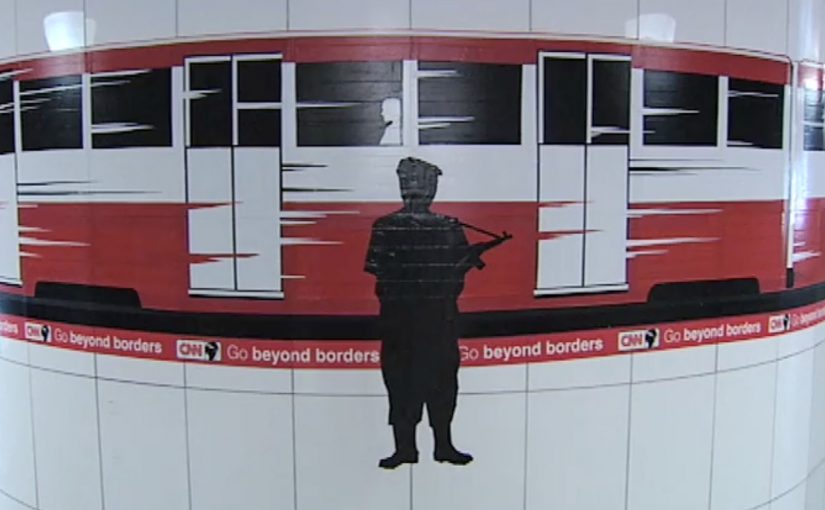
40 km of Go Beyond Borders tape was produced to mark the original position of the Berlin Wall, and eight street art installations told heroic stories of those who conquered the divide between East and West Berlin.
The mechanism combined two layers.
First, the tape traced the former Wall line, turning an invisible historical boundary into a visible path you could follow. Second, the street art installations anchored that path with human stories, making the line about people, not only geography.
It was simple enough to understand instantly, but large enough to feel unavoidable once you encountered it.
Most anniversaries stay inside ceremonies, speeches, and media coverage.
This one put the memory back into the street. The tape created a direct, physical confrontation with “where the divide was.” The art installations made the meaning legible by focusing on courage and crossing, not abstraction.
That shift matters because it turns history into presence, and presence into conversation.
The action also marked the launch of CNN’s new international slogan: Go Beyond Borders.
The business intent was to associate the brand with perspective, movement, and crossing divides, using a real-world symbol that already carries emotional weight. Rather than declaring what the slogan means, the initiative demonstrated it through a place-based experience people could encounter and share.
An initiative by Heimat Berlin and CNN International with artist El Bocho that used tape and street art to mark the former Berlin Wall line and tell stories of crossing East and West Berlin.
40 km of tape traced the Wall’s original position, while eight street art installations provided narrative anchors and human context.
Because it turned an abstract memory into a physical, walkable marker that people could encounter in everyday life.
Launching and giving meaning to CNN’s “Go Beyond Borders” slogan by demonstrating it through a culturally significant, real-world experience.
If you want a message to stick, embed it in a place people can experience, then reinforce it with stories that explain why it matters.