
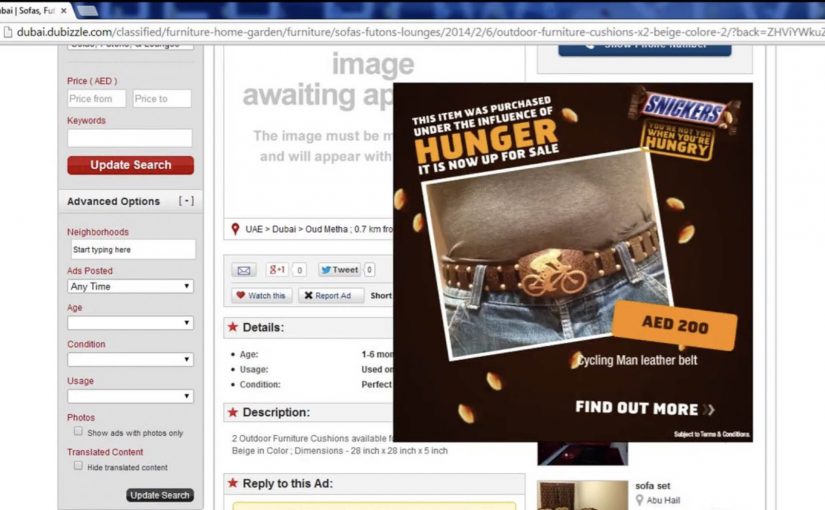
Snickers: Hungry Purchase Resale

The global Snickers platform “You’re not you when you’re hungry” has generated plenty of buzz. To extend it in Dubai, and make the downside of hunger feel more real, Impact BBDO created “Hungry Purchase Resale”.

The insight is simple. During big sales, people often buy things they later regret. Snickers pins these shopping bloopers on hunger and, in partnership with Dubizzle.com, lets shoppers upload the items they want to sell straight into Snickers branded banners that appear on the site’s homepage. Clicking the banner takes people directly to the classified listing so the item can be sold on.

Turning regret into a media unit

The clever bit is that the ad is not just an ad. It becomes a functional resale slot that people actually want, because it helps undo a mistake. This is the stronger move, because utility gives the audience a reason to use the format, not just notice it.

In high-velocity retail environments, the best digital ideas piggyback on existing intent surfaces, meaning the places where people are already ready to browse, compare, or buy, then give people a reason to interact that is bigger than “engage with our brand”.

The real question is how to turn a brand platform into a useful action inside the exact behavior it is commenting on.

Why it lands

The better approach here is to make the platform behave like a service, not a message. The audience is already on a classifieds site to browse, compare, and transact. By turning remorse into a shareable listing, the campaign earns attention inside the exact behavior it is commenting on.

Extractable takeaway: If your brand truth is behavioral, do not just illustrate it. Build a mechanic that lets people enact it in a familiar environment, and make the brand the enabler of a useful outcome.

What the results are described to show

Campaign reporting describes over 200 submissions in a week. It also describes the interactive banners achieving a click-through rate almost five times the industry standard, with 80% of posted items sold the same day.

What commerce teams should steal from this

  • Make the ad do a job. Utility beats persuasion when attention is scarce.
  • Put the idea where intent already exists. Classifieds, marketplaces, and search are “ready-to-act” contexts.
  • Let users supply the proof. Real submissions and real listings create credibility you cannot script.
  • Keep the action one-step. Upload, appear, click, sell. No extra hoops.

A few fast answers before you act

What is “Hungry Purchase Resale”?

It is a Snickers activation in Dubai where shoppers can upload regretted purchases into Snickers branded homepage banners on a classifieds site, linking directly to the resale listing.

What is the core insight behind it?

People often make irrational purchases during sales and later regret them. The campaign frames hunger as the trigger for those mistakes.

Why partner with a classifieds site?

Because it is where resale intent already lives. The campaign becomes actionable in-context instead of being a standalone brand message.

What makes the idea feel credible?

It routes real items from real people into a real marketplace flow, so the audience can see behavior, not just hear a claim.

How can another brand replicate the pattern?

Choose a partner platform that already hosts the behavior you are talking about, then build a simple mechanic that turns your brand message into a useful action.
Kaiak: The Online Banner You Could Smell

A banner that refuses to stay “just digital”

Everyone loves cool ad executions, but some are clearly advertising for advertising people. This one shows up at exactly the right time. Award-show season.

The work comes out of Brazil for Kaiak, Natura’s men’s fragrance. Kaiak has been reformulated, and the brief is simple but brutal. How do you sell a new scent online when the one thing people want to do is smell it?

Click the banner. Get the scent.

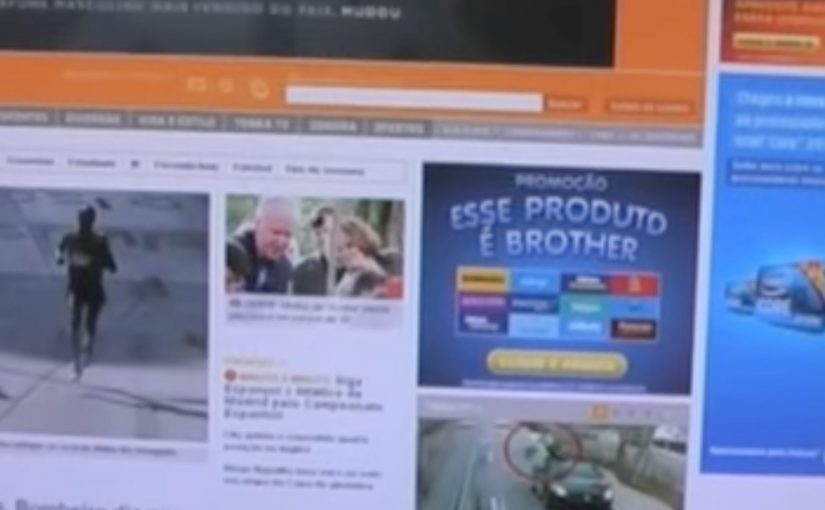
ID/TBWA solves it by building the missing sense into the media placement itself. Custom hardware is attached to computers in lan houses (cyber cafés) across Brazil. A special banner appears on the browser start page and reads, “The best selling men’s fragrance in the country just changed. Want to try it? Click this banner. It’s scented.”

When someone clicks, a scented strip physically emerges from the attached device. The digital impression turns into a real sample in the moment where “try” normally breaks down online.

In Brazilian urban markets where lan houses function as high-traffic digital hubs, turning a cyber café PC into a sampling machine creates mass trial without needing retail testers.

Why it lands: the medium becomes the product experience

The reason it works is not novelty alone. It removes the biggest barrier in fragrance e-commerce. Confidence. The real question is how you create purchase confidence for a sensory product when the screen cannot deliver the sensation. By turning the click into immediate sampling, the campaign makes the claim verifiable in the moment of intent, which is why it converts curiosity into trial. For sensory categories, the best digital work engineers a real trial moment, even if that means adding physical infrastructure. The click is not a promise. It is the delivery mechanism.

Extractable takeaway: If a product’s value depends on a sense the screen cannot deliver, redesign the media so “try” happens at the click, not after it.

The business intent: accelerate trial for a reformulated bestseller

This is a trial engine dressed as a banner. The goal is to reduce hesitation around change, create fresh talk value around “it’s different now”, and push people toward purchase with a sensory proof point that normal digital formats cannot provide.

How to make digital do something physical

  • Identify the missing sense. If the product relies on touch, smell, or taste, do not pretend pixels can replace it.
  • Build a credible “try now” moment. Sampling only works when the action and the reward are tightly coupled.
  • Choose distribution points with dwell time. Cyber cafés, waiting rooms, and shared devices can behave like miniature retail networks.
  • Keep the instruction brutally simple. The banner copy does not explain the tech. It explains the outcome.

A few fast answers before you act

What is the “scented banner” for Kaiak?

An online banner placed on cyber café computers that dispenses a physical scented strip when the viewer clicks, enabled by custom hardware attached to the PC.

Why build hardware for a banner campaign?

Because fragrance requires sampling. The hardware turns a digital click into immediate product trial, removing the biggest barrier to buying scent online.

What is the core mechanism?

“Try now” is built into the media unit. The banner instruction is simple, and the click triggers a physical delivery moment that proves the claim.

What does this teach about selling “sensory” products digitally?

If touch, smell, or taste drives purchase confidence, you need a credible bridge to real-world experience, not just better copy or imagery.

What is the most transferable takeaway?

Identify the missing sense, then engineer a sampling moment where action and reward are tightly coupled and instantly legible.