Mercedes-Benz: Golf Ball Catch World Record

Mercedes-Benz: Golf Ball Catch World Record

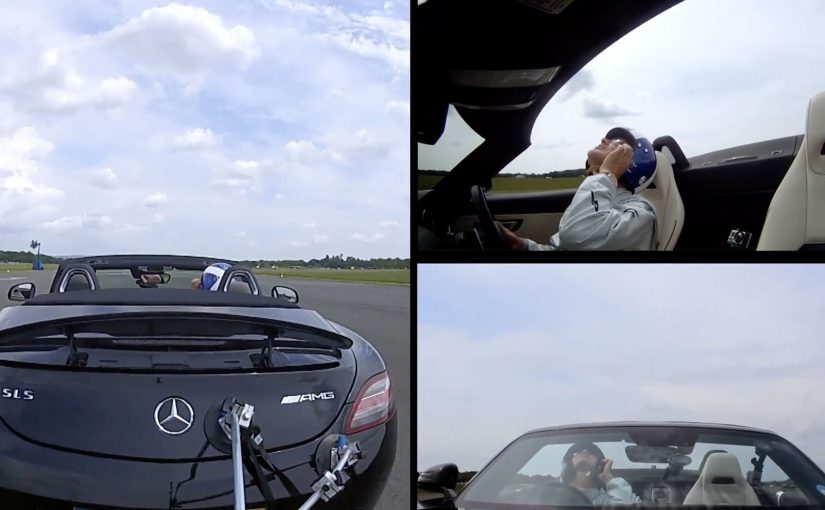
Mercedes-Benz recently uploaded a video of former Formula 1 driver David Coulthard and pro-golfer Jake Shepherd setting a Guinness World Record with a Mercedes-Benz SLS AMG Roadster.

To set the record, Coulthard caught a golf ball hit by Shepherd while driving. The ball was traveling at 178mph and was caught 275 metres from the tee, setting the record for the farthest golf shot caught in a moving car. At the time of posting, the video had already crossed the one-million-view mark within days.

A record attempt built on timing and trust

The mechanism is clean and measurable: a golfer launches a high-speed drive down a runway, a driver accelerates to meet its trajectory, and the open cockpit becomes the “catcher’s mitt”. If the car, speed, and timing are even slightly off, the attempt fails in a very visible way.

In performance-led automotive marketing, certified stunts turn engineering credibility into a piece of entertainment people want to pass on.

The real question is whether your proof is visible enough that the audience can judge it without trusting your narration.

Because you can clearly see whether it worked, the performance claim feels earned rather than explained.

Why it lands

It turns abstract performance into a single, replayable challenge with clear stakes, and then lets Guinness define what “success” means.

Extractable takeaway: World-record style stunts work as marketing when the measurement is simple, the failure mode is obvious, and third-party verification turns spectacle into credible proof.

It makes performance legible. Horsepower and handling are abstract until you attach them to a task with consequences. A moving catch at extreme speed is instantly understood.

It borrows external validation. The Guinness framing gives the clip a built-in reason to exist beyond “brand content”. It signals that this is not just a cool shot, it is a verified attempt with a defined outcome.

It is engineered for replay. The audience watches once for disbelief, then again for mechanics: speed, distance, and the exact moment the ball drops into the car.

Borrowable moves from the record attempt

  • Anchor the story to a number. Distance, speed, and a named record create instant stakes.
  • Make the “proof moment” unmissable. The catch is the single frame people share, and the decisive proof that the claim happened.
  • Use experts as the interface. Specialist talent makes the impossible feel attempted rather than faked.
  • Build the edit around clarity. Viewers should understand what success looks like before it happens.

A few fast answers before you act

What record did Mercedes-Benz, Coulthard, and Shepherd set?

The farthest golf shot caught in a moving car, using a Mercedes-Benz SLS AMG Roadster.

What were the headline numbers?

The drive was clocked at 178mph and was caught 275 metres from the tee.

Why does Guinness World Records matter here?

It provides an external definition of “success” and a trusted validation layer that separates a stunt from a simple brand claim.

What is the business intent behind a stunt like this?

To make vehicle performance feel tangible and memorable, while generating earned reach through a shareable “did you see that?” moment.

What is the most transferable lesson?

If you want proof to travel, wrap it in a single measurable challenge, show the decisive moment clearly, and keep the explanation simple enough to repeat.

McDonalds Hamburger Timetable

McDonalds Hamburger Timetable

You wait for a train at Warsaw’s Central Station and check the departure board. Everything looks normal at first. Destination, track number, platform. Then you notice the twist. The wait time is not shown in minutes. It is shown in hamburgers, cokes and fries.

The idea. Make waiting feel shorter by making it measurable

McDonalds in Poland finds a creative way to make waiting for the train less agonizing for passengers and more profitable for its trainside location. The board translates delay time into a simple, food-based unit people instantly understand.

How it works at the station

In cooperation with PKP (Polish State Railways), McDonalds installs a special timetable about 50 meters from the main hub of Warsaw’s Central Train Station. It displays departure time, destination, track number, and platform information as usual. The difference is the wait and delay time, which appears as burgers, cokes and fries.

In transit retail, waiting time is one of the few moments when attention and immediate purchase intent sit in the same place.

Why this lands as a smart retail nudge

Here, a retail nudge means a light prompt that changes the next action without forcing it. The mechanic does not interrupt. It reframes the moment. The real question is how to turn dead waiting time into a branded action without making the brand feel intrusive. Because the board converts minutes into food units, grabbing food becomes the obvious way to spend the time. McDonalds is right to keep this utility first, brand second, because that is what makes the prompt feel clever rather than pushy.

Extractable takeaway: When a brand translates spare time into a simple unit tied to an immediate action, the message feels useful first and persuasive second.

What the result signals

While making the train station a more enjoyable place for waiting passengers, McDonalds sees an increase of 4,500 customers in the first month itself. The business intent is clear: convert idle station time into store traffic at the moment of highest relevance.

What to steal for retail nudges in waiting moments

  • Translate time into a brand-shaped unit. When minutes become “one burger”, the next action becomes self-evident.
  • Place the nudge exactly at the decision point. The board sits in the flow of passengers, not in a separate ad zone.
  • Keep the mechanic utility-first. It still behaves like a timetable, so people accept it instead of resisting it.
  • Make the conversion instantly readable. If it takes explanation, the moment is already gone.

A few fast answers before you act

What is the McDonalds Hamburger Timetable?

It is a train timetable that displays delay and waiting time as McDonalds menu items, like burgers, fries and Coke, instead of minutes.

Why does converting minutes into food items influence behaviour?

Because it makes the wait feel like “time you can spend” rather than “time you lose”. It also provides a natural suggestion for what to do next without using a hard call-to-action.

What makes this feel helpful instead of salesy?

It behaves like a real timetable first and a brand cue second. That utility lowers resistance because the brand message is embedded in something people already need to read.

What is the core design lesson?

Translate a boring metric into a simple, brand-linked unit that is immediately understood, and place it exactly where the decision happens.

Where else can this pattern work?

Any waiting context with nearby commerce. Transit hubs, queues, ticketing areas, and event entry points all benefit when “time to kill” becomes “time to enjoy”.