
ActionAid: Donate Your Profile

ActionAid: Donate Your Profile

ActionAid is an organisation committed to many projects, like fighting hunger and poverty. But in Italy it is known primarily for sponsoring children.

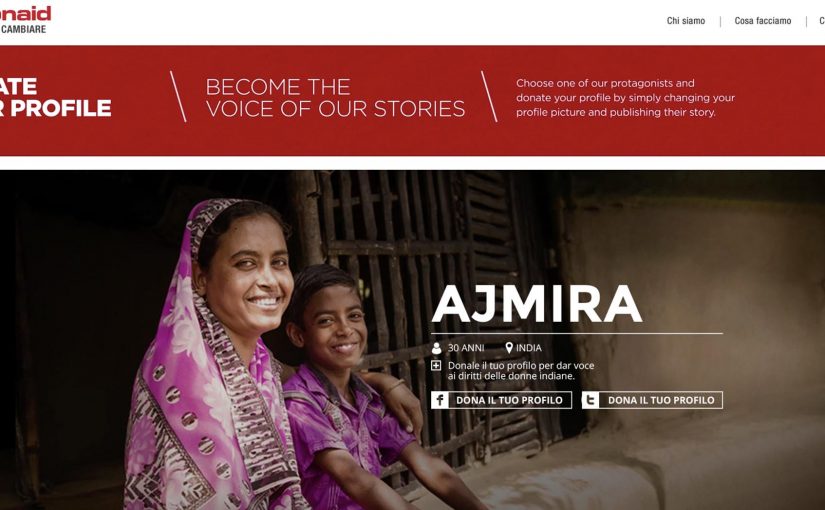
To communicate the broader work of ActionAid with a small media and production budget, DLV BBDO created “Donate Your Profile”. Participants donated their Facebook and Twitter profile pictures so that awareness could be generated for the stories of people ActionAid helped.

How “Donate Your Profile” worked

The mechanism is a simple identity swap. People hand over the most visible square in their social presence. Their profile photo. In return, they display a campaign image tied to a real person’s story, so every comment, like, and share carries that story into everyday social traffic.

Support from Radio 105, Radio Deejay, La Stampa, Marc Marquez and other Italian celebrities and brands helps normalise the behaviour. Once well-known accounts participate, the “donate your picture” action looks safe, easy, and socially endorsed.

In Italian cause marketing, borrowing social identity can outperform paid media when budgets are tight, because it turns personal networks into distribution.

The real question is how to turn a low-budget act of support into something people carry through their normal social behaviour.

Why the profile swap spreads

This works because it converts passive support into a visible, persistent signal. A profile picture is not a post that disappears in a feed. It is a durable badge that travels wherever you show up online, and it prompts questions that naturally lead to explanation and sharing.

Extractable takeaway: If you need earned reach without heavy spend, move the call to action from “share a post” to “change a default”. When people change a default surface, the campaign rides along with their normal behaviour.

The reported impact

The project was described as becoming the 5th most trending topic on Twitter and generating over 79 million media impressions, with more people joining in as the support network grew.

What to borrow from the profile-swap pattern

  • Pick a high-frequency surface. Defaults like profile photos travel more than one-off posts.
  • Make the action reversible. People participate faster when the commitment feels temporary.
  • Seed with credible partners. Media brands and recognisable faces reduce hesitation.
  • Turn participation into a conversation starter. The best mechanics invite questions, not just clicks.

A few fast answers before you act

What is “Donate Your Profile”?

It is a campaign where people replace their Facebook and Twitter profile pictures with a campaign image, so ActionAid stories gain awareness through everyday social interactions.

Why use profile pictures instead of posts?

A profile picture is persistent and high-visibility. It shows up repeatedly across comments and interactions, so the message travels without requiring constant re-posting.

How did the campaign scale beyond early participants?

Reportedly through support from media brands and celebrities, which makes the behaviour feel normal and increases follow-on participation.

What results were reported?

Reported results included reaching the 5th most trending topic on Twitter and generating over 79 million media impressions.

What is the main risk with this pattern?

Trust. If people are unclear about what is being changed, for how long, and what they are authorising, participation drops. The exchange must be transparent and easy to undo.

Corona Extra: Luna Corona

Corona Extra: Luna Corona

Corona Extra and their ad agency Cramer-Krasselt worked with astronomers, planetariums, and universities in the USA to calculate the positioning of the moon, aiming to capture a moment where it would align perfectly with an image of a Corona Extra beer.

The moment was timed so the billboard’s “missing lime” is completed by the moon’s crescent alignment on the nights of June 14 and 15.

When the sky completes the creative

The mechanism is engineered perspective plus a fixed window in time. The billboard artwork is designed so that from a specific viewing position, the crescent moon appears exactly where a lime wedge would normally sit on a Corona bottle. The media placement then turns into a scheduled viewing, because the “full ad” only exists when the moon cooperates.

In out-of-home advertising, aligning a message with a real-world phenomenon can turn a static placement into a time-limited event people actively seek out.

Why it lands

This works because it makes a familiar brand ritual feel discovered rather than advertised. The payoff is not a new claim. It is a real-world moment that feels improbably perfect, which gives people a reason to stop, watch, and tell someone else where and when it happened. The real question is how far a brand can make the physical world do the storytelling for it. The stronger move here is using the moon to deliver the brand cue instead of adding more message.

Extractable takeaway: If you can make the environment complete your creative, you turn passive exposure into participation. That participation becomes the distribution.

What to steal from Luna Corona

  • Design for one unmistakable illusion: one clean visual trick beats multiple clever details.
  • Use time as a feature: a narrow viewing window creates urgency without discounts or gimmicks.
  • Make the “rule” explainable: people should be able to describe it in one sentence.
  • Choose a ritual people already associate with you: the lime wedge is an instantly legible brand cue.
  • Capture proof: the video is not decoration. It is how the idea travels beyond the street corner.

A few fast answers before you act

What is “Luna Corona”?

It is an out-of-home idea where a Corona billboard is positioned and designed so the crescent moon visually becomes the lime wedge on the bottle during a specific time window.

Why involve astronomers and universities?

Because the illusion depends on precise timing and angle. You need accurate lunar position predictions to know when the crescent will “land” in the right spot from the viewer’s perspective.

Is this interactive?

Not in the device sense. The interaction is physical. People move into position, wait for the right moment, and witness the alignment as it happens.

What makes it more than a clever billboard?

The scarcity. It only “works” at certain times, so it behaves like an event, not just media inventory.

What’s the biggest risk with ideas like this?

Fragility. If weather, timing, sightlines, or location details are off, the reveal fails. The planning and production tolerance must be treated like a live event.

Beaming Rocket: LG MiniBeam Street Projections

Beaming Rocket: LG MiniBeam Street Projections

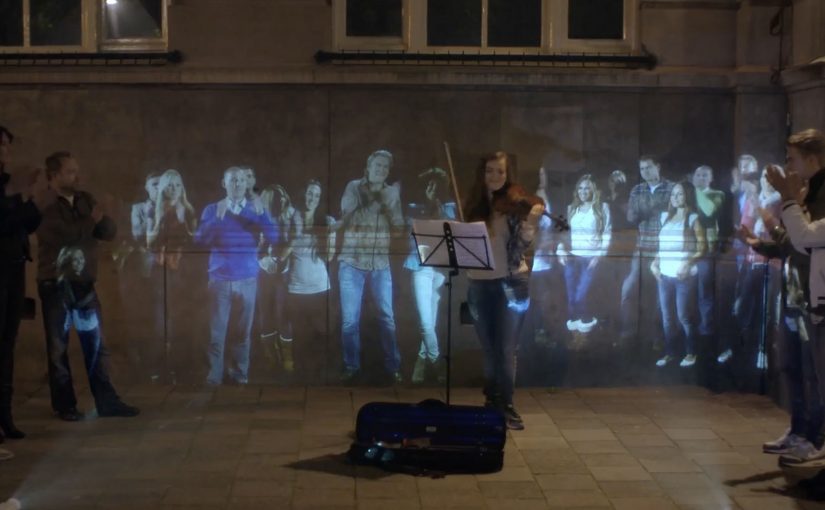
LG, to make everyday life more fun and exciting, decided to bring a few surprises to the street. They found Juan, a video artist who took his hobby to another level with LG’s portable projectors. Together they surprised and entertained people in ways never expected.

Portable projection as street-level theatre

The mechanism is the point. A small, mobile projector turns almost any surface into a temporary screen, and that mobility lets the experience pop up where people least expect it. Instead of asking people to come to a venue, the “venue” appears around them for a few seconds, then moves on.

In consumer electronics marketing, the fastest way to prove portability is to show the product leaving the living room and creating value in public spaces.

Why it lands

This works because it turns a spec sheet into a story. Brightness and portability are hard to communicate in words, but they become self-evident when a projection transforms a wall, a street corner, or a passing moment into something shareable. If you want the benefit to stick, make the demo do the explaining.

Extractable takeaway: When a product benefit is experiential, demonstrate it through a simple, repeatable scene that makes the benefit visible without explanation.

What LG is really selling here

Beaming Rocket is the LG MiniBeam film built around a video artist using portable street projections to make portability and brightness feel obvious.

The real question is whether your demo makes the benefit self-evident in the first five seconds, without relying on narration or specs.

The film is doing more than showcasing “fun.” It is positioning a portable projector as a creative tool, not just a gadget. That widens the audience beyond home viewing into creators, event moments, and spontaneous social experiences.

Steal this street-projection pattern

  • Demonstrate the core benefit in the real world. If mobility is the claim, the story needs movement.
  • Keep the format lightweight. Short, surprising moments travel better than long, complex narratives in public.
  • Use people as the proof layer. Real reactions sell the experience faster than product copy.
  • Make surfaces part of the idea. The environment should feel like a collaborator, not a backdrop.
  • Design for repeatability. If the concept can happen in many places, it scales as a content engine.

A few fast answers before you act

What is “Beaming Rocket” in one sentence?

It is an LG MiniBeam film built around a video artist who uses a portable projector to create surprising street projections and spontaneous moments for passers-by.

What product truth does the film demonstrate?

Portability and ease of use. The projector can be carried, set up quickly, and used on everyday surfaces without a formal venue.

Why is street projection a strong demo format?

It makes brightness, scale, and immediacy visible in a single scene, and it naturally generates bystander attention and shareable reactions.

What is the main execution risk if you copy this approach?

Weak payoff. If the projected content is not instantly legible or delightful, the “surprise” becomes confusion and people walk on.

What should you measure if you run a similar activation?

Dwell time, crowd build rate, social sharing volume, sentiment, and whether the content creates downstream lift in search or product page visits.