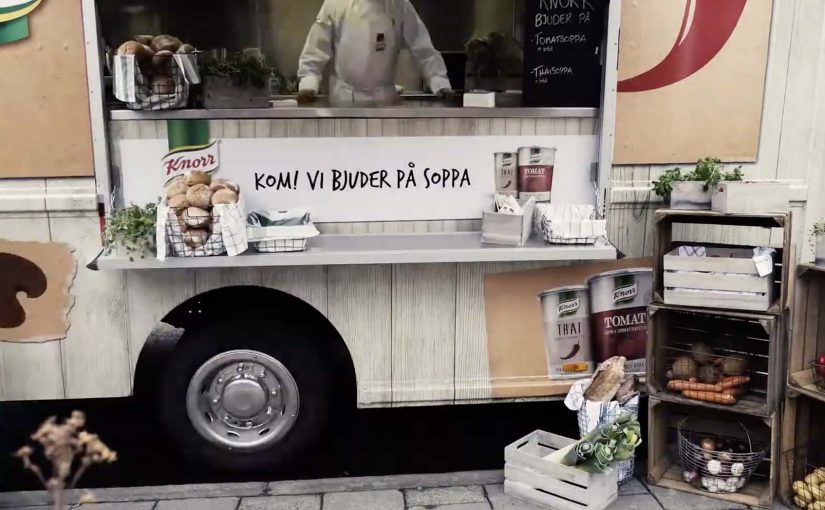
In November, a Knorr food truck in chilly Stockholm offers free warm samples of the brand’s tomato and Thai soups. Visitors can eat it on the spot or take home the samples.
To ensure visitors can also be retargeted through relevant mobile ads, Knorr equips the truck and the sampling team with battery-powered iBeacons. Through these beacons, visitors who already have the Swedish newspaper Aftonbladet app installed are registered as having been there. Instead of pushing a coupon immediately, the campaign waits until the next time the user opens the Aftonbladet app, then serves the offer as a mobile ad on the start screen.
Physical retargeting is the practice of using a real-world visit as the trigger for a later digital message, so the follow-up feels connected to what the person actually did offline.
Why the timing choice matters more than the beacon
In FMCG sampling, delayed retargeting works best when the message arrives in a natural “open app” moment, not as an intrusive push at the street corner. The iBeacons are the plumbing, but the experience design is the restraint. The campaign avoids interrupting the sampling moment and instead chooses a later point of attention when the person is already browsing content. That shift makes the offer feel more like a relevant reminder than a forced conversion attempt. Brands should treat iBeacons as infrastructure and invest the real effort in timing and creative that respects the sampling moment.
Extractable takeaway: Treat the offline moment as the relationship builder, then use the next self-initiated “open app” moment as the conversion window.
What the campaign proves, beyond “we can target”
The real question is whether your follow-up arrives at a moment of attention the user has already chosen. Sampling often struggles with attribution. This approach creates a cleaner bridge between the street interaction and a measurable mobile impression, without requiring a QR scan or a form fill at the truck.
A repeatable offline-to-mobile loop
- Separate experience from conversion. Let the street moment stay human, then follow up later in a calmer context.
- Use a trigger the user already understands. “When I open the app, I see it” is easier than “enable Bluetooth, accept three prompts”.
- Keep the reward aligned. A soup sample followed by a soup coupon is a coherent loop.
- Design for opt-in environments. The cleanest versions of this pattern run inside existing app ecosystems where ads are already expected.
A few fast answers before you act
What is Knorr “physical retargeting” in this example?
It is an offline-to-online marketing loop where visiting the soup truck becomes the trigger for receiving a relevant offer later inside a mobile app.
Why not show the coupon immediately at the truck?
Because immediate prompting can feel invasive and can disrupt the sampling experience. Waiting until the next app open delivers the offer in a more natural attention moment.
What role does the Aftonbladet app play?
It is the environment where the follow-up ad appears. People who already have the app installed can be recognized as having visited and later see the offer when they reopen the app.
What is the core benefit for the brand?
It links a real-world sampling touchpoint to a measurable, relevant mobile follow-up, improving recall and making conversion more likely.
What is the biggest failure mode for this tactic?
If the follow-up arrives too late or feels unrelated, it reads as generic targeting. The timing and message match are what make it feel earned.