
Air China “Facebook Check Ins”

Air China “Facebook Check Ins”

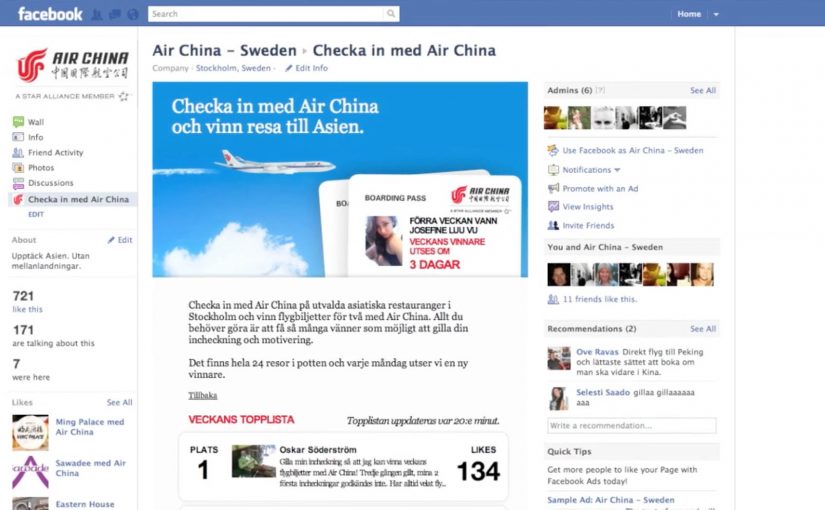
You visit a popular Asian restaurant in Sweden, check in with Air China on Facebook, and instantly become part of a live leaderboard. The more you check in, the higher you climb. Each week, the top check-in users earn two complimentary tickets to Asia.

Air China flies not only to China but also throughout Asia. The challenge is how Air China raises Swedish consumers’ awareness about this fact. In response, their ad agency Rodolfo creates a Facebook check-ins campaign.

How the campaign works in the real world

A select number of popular Asian restaurants in Sweden are transformed into ambassadors for Air China. At the restaurants, guests are encouraged to check in with Air China on Facebook.

What makes it competitive and shareable

The check-ins are aggregated on the Air China Facebook page, and a complete leader board of the highest number of check-ins and the most popular restaurants is displayed. Each week, the users with the highest number of check-ins are awarded two complimentary tickets to Asia.

In market categories where route awareness is broader than one destination, brands need a way to move from static claims to lived proof in everyday settings.

Why this format fits airline awareness

The activation connects everyday behaviour to a clear brand message. Because the action happens in Asian restaurants and the leaderboard makes repeat visits visible, the idea of “Asia access”, meaning one airline that can take you to multiple destinations across Asia, feels immediate, social, and measurable without needing a hard sell in the moment.

Extractable takeaway: When a brand promise is broader than what people currently remember, attach it to a repeatable action in a context that already signals the message.

The real question is whether the brand can turn ordinary social behaviour into repeated proof of a broader route network. The business intent is to expand Air China’s mental availability beyond China and into Asia as a travel network. This is a smart awareness play because the reward, venue, and social mechanic all reinforce the same message.

What to steal from this airline check-in mechanic

  • Use context as your media: Turn partner venues into “brand ambassadors” when the venue naturally signals your message, here Asian restaurants reinforcing broader Asia access.
  • Design for 10-second participation: Use a repeatable, low-friction action, check-in, that people can do in seconds, in a context where sharing already feels normal.
  • Add a progress mechanic: Include a visible scoreboard, leaderboard, so the behaviour has a reason to repeat, not just a reason to start.
  • Run on a clear cadence: Weekly winners keep urgency high and create multiple chances to participate without complexity.
  • Make the reward reinforce the promise: Align incentives tightly to the brand claim, tickets to Asia, so every mention strengthens recall.

A few fast answers before you act

What is the core idea of this campaign?

Turn physical venues into social triggers. Restaurants prompt people to check in with Air China, and the accumulated check-ins become the campaign scoreboard.

Why use restaurants as campaign ambassadors?

They are culturally relevant touchpoints for Asia in Sweden, with built-in footfall and a natural reason for people to share where they are.

What role does the leaderboard play?

It creates a simple competition loop. People see progress, compare against others, and repeat the behaviour to climb. That repetition drives reach and recall.

What is the incentive design lesson here?

Make the reward perfectly aligned with the promise. Tickets to Asia are a direct reinforcement of Air China’s broader Asian network, not a generic prize.

What should a brand copy first from this format?

Start with the triad, not the platform: a relevant venue, a low-friction repeat action, and a reward that proves the brand promise. That is the reusable structure.

Amnesty International: Sound of Amnesty

Amnesty International: Sound of Amnesty

This year, charity and human rights organization Amnesty International France turns its signatures petition drive at www.marathondessignatures.com into a musical “hymn to freedom” with Paris-based agency La Chose.

The campaign behaves like a normal petition drive, with one twist: every digital signature releases the next note of an exclusively written song, “The Sound of Amnesty”. To push the idea further, Shazam is used as a distribution channel. When Shazam fails to recognise a song, the app displays a call-to-action message alongside a case story, including: “Valentina Rosendo Cantu could not make herself heard either. Assaulted by soldiers, she asked for justice but the authorities refused to investigate”.

Why the “next note” mechanic works

Most petitions are emotionally important but mechanically flat: sign, share, done. Here, the signature becomes a trigger with immediate feedback. The song becomes a living progress indicator, and every participant can feel they are adding something tangible, not just adding their name to a counter. Because each signature produces an instant, shared “next note” payoff, participation feels consequential, which makes repeat shares and completion more likely.

This is a stronger petition pattern than a static signature counter because it turns support into a felt moment of progress.

Why Shazam is the clever amplifier

Shazam normally appears when you are already paying attention to music. By placing the petition inside the “recognition failed” moment, meaning when the app cannot match a track, the campaign catches people at a point of curiosity and mild frustration. The message reframes that friction as a metaphor for unheard voices, then gives users something concrete to do.

Extractable takeaway: Borrow an existing attention ritual, then use the moment’s friction to make the cause legible and the next action immediate.

In digital petition drives, tying each signature to a shared artifact that literally progresses can turn passive support into collective anticipation.

The real question is whether your petition makes progress feel personal, or just counts people.

Results and escalation

Reportedly, the campaign collected 150,000 signatures, described as a 500% increase from the previous year. The track was also produced on CD and sent to Amnesty’s targeted authorities, turning digital participation into a physical advocacy artifact.

Patterns to copy in petition drives

  • Give every action an immediate consequence. “You unlocked the next note” beats “thanks for signing”.
  • Use an existing habit. Hijacking a familiar moment inside a popular app can outperform building a new destination experience.
  • Make progress audible or visible. A petition counter is abstract. A song evolving over time is memorable.
  • Connect the mechanic to the meaning. The “not recognised” moment mirrors the core human-rights theme: not being heard.

A few fast answers before you act

What is “The Sound of Amnesty” in one line?

A petition drive where each signature unlocks the next note of an original song, turning advocacy into a progressively revealed “hymn to freedom”.

How is Shazam used in the campaign?

When Shazam cannot recognise a song, it displays an Amnesty message and invitation to sign, using the failure moment as a metaphor for silenced voices.

Why does the “unlock the next note” mechanic increase participation?

It adds instant feedback and a shared sense of progress, making signatures feel like contributions to a collective outcome.

Do you need Shazam to replicate the pattern?

No. The transferable move is to piggyback on an existing user habit and turn an ordinary support action into a small, satisfying reveal that people want to share.

What is the most transferable lesson?

If you want more signatures, do not only ask for support. Turn the act of signing into a small experience people can feel and share.

Windows of Opportunity: Smart Car Windows

Windows of Opportunity: Smart Car Windows

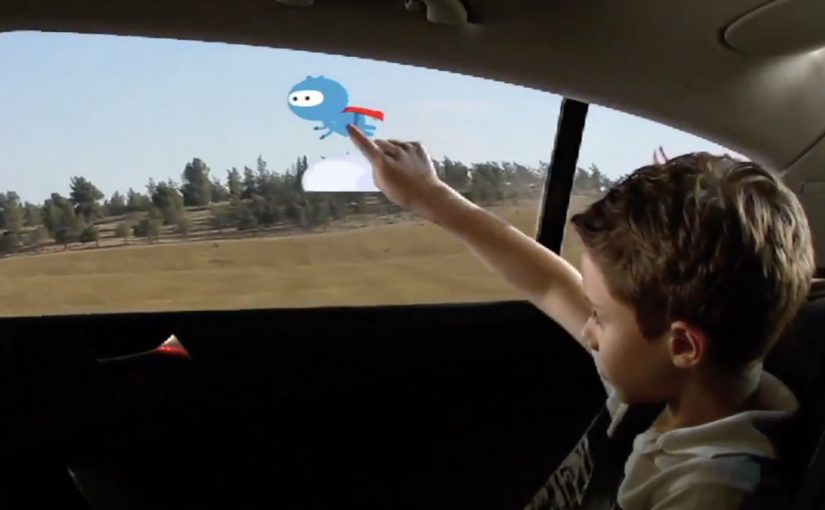
Got backseat boredom? DVD players and Game Boys are so five years ago, but a concept in rear-seat entertainment that uses the windows themselves could replace squirming and snoozing with interactive scribbling, sweeping, and pinching.

General Motors Research and Development put up a challenge to researchers and students from the Future Lab at Bezalel Academy of Art and Design in Israel. The task was to conceptualize new ways to help rear-seat passengers, particularly children, have a richer experience on the road.

The outcome is shown below, even though GM is described as having no immediate plans to put this smart glass technology into vehicles. Here, “smart glass” means the window can act as a display surface and detect touch or gestures.

When the window becomes the interface

The mechanism is simple to grasp. Treat the rear side window as a transparent display surface, then add touch and gesture interaction so passengers can draw, play, and manipulate content directly on the glass while still looking out at the world passing by. Because it is the same surface passengers already look through, the interaction stays outward-facing rather than becoming another head-down screen.

In family car journeys, rear-seat attention is a hard constraint, and experiences that keep kids engaged without isolating them from the ride reduce friction for everyone.

What the brief is really asking for

This is not “more screens”. It is a different relationship between passengers and their surroundings. The concept is described as using the outside view as the canvas. Instead of escaping the trip, you interact with it.

The real question is whether you can turn the outside world into content without disconnecting passengers from the journey.

Why it lands

The idea feels fresh because it upgrades a dead surface into something active without adding another device to hold or another head-down screen to stare at. It also creates a shared backseat dynamic. Multiple passengers can point, draw, and react together, which changes the feel of long trips. This is the right direction for in-car entertainment because it replaces device-based distraction with shared, context-linked play.

Extractable takeaway: The best in-car entertainment does not only distract. It connects passengers to the context they are already in, and makes the journey itself part of the experience.

What GM is buying by running a concept challenge

Even without production intent, the exercise is useful. It expands the idea space around “smart glass” and passenger experience, and it generates prototypes and interaction patterns that can later inform other interfaces, materials, and interior design decisions.

Practical steals for smart-glass passenger UX

  • Use the environment as content. Overlay and interact with what is already outside rather than inventing a separate world.
  • Design for low instruction. If it cannot be understood in seconds, kids will abandon it and parents will ignore it.
  • Favor shared play. Multi-user interactions create calm through engagement, not through isolation.
  • Keep interaction lightweight. Short loops beat long missions in a moving vehicle.
  • Prototype early. Concepts like this live or die on latency, glare, and ergonomics, not on storyboard polish.

A few fast answers before you act

What is “Windows of Opportunity” in one sentence?

It is a GM concept project that turns rear side windows into interactive “smart glass” displays so passengers can draw, play, and explore during the ride.

Why use windows instead of adding more screens?

Because windows are already where passengers look. Turning them interactive can keep attention outward and shared, rather than head-down and isolated.

What makes this feel useful for families?

It targets the real pain point, keeping children engaged on long journeys, while preserving a sense of connection to the trip and to each other.

What are the biggest practical risks?

Glare and readability in daylight, touch accuracy on glass, latency, durability, and avoiding distraction for the driver through reflections or overly bright visuals.

What would you measure in a pilot?

Engagement duration, repeat use, whether it reduces restlessness and conflict, and whether it avoids unintended driver distraction in real driving conditions.