
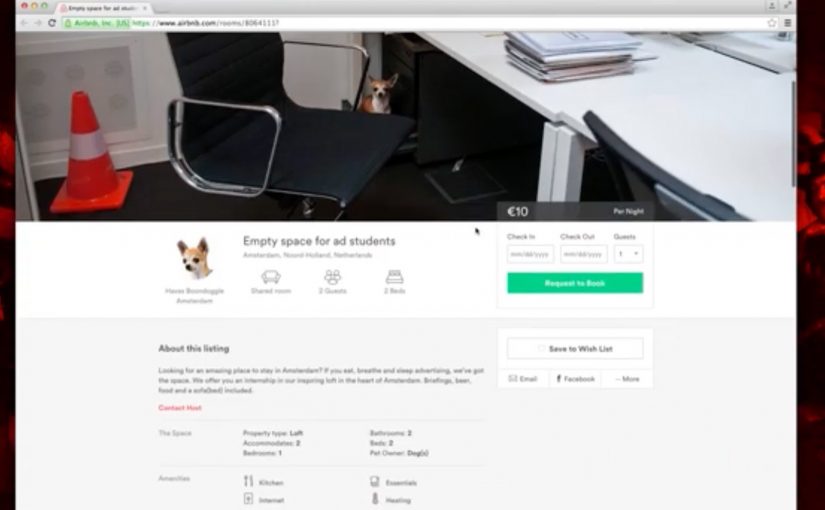
Havas Boondoggle Amsterdam recruits via Airbnb

Havas Boondoggle Amsterdam recruits via Airbnb

An advertising student books a couch in Amsterdam for €10 a night. The listing is not a side hustle. It is the recruitment funnel. The booking is the application step. In exchange for budget accommodation, the intern works at Havas Boondoggle Amsterdam during the day and explores the city at night.

The move. Recruiting interns through a booking behavior

Advertising students and recent graduates are hungry for a taste of agency experience. More so when it comes with a bit of adventure. Havas Boondoggle Amsterdam recruits interns who are both creative and worldly through Airbnb by renting out its couch for €10 a night.

The real question is whether your recruiting can start with a real behavior candidates choose, instead of an application step they tolerate.

This is a smart move when the internship demands initiative and follow-through.

How it works. A stay that converts into an internship

  • The agency lists its couch on Airbnb for €10 per night.
  • The stay is available for a minimum of one night and a maximum of one week.
  • Hand-picked interns work at the agency during the day.
  • They explore Amsterdam at night.

In European creative agencies, junior hiring works best when the first step happens where candidates already make real decisions.

Why it works. A simple trade with a strong story

The exchange is easy to understand and hard to ignore. A real booking. A real stay. A real internship. The “couch” becomes the headline, but the point is selection. Because the mechanic requires a candidate to commit in the real world, it filters for people who can decide, show up, and do the work.

Extractable takeaway: When you turn a native platform action into a real-world commitment with a clear value exchange, you get attention plus a self-selecting applicant pool.

How to borrow the pattern for your next hire

  • Start where they already behave: Put the first step on a platform your candidates already use for something real.
  • Make the exchange explicit: State the give and the get in one plain sentence.
  • Let commitment do the screening: Build a first step that requires follow-through, not just interest.
  • Keep the story one-line simple: If people can repeat it, they will spread it.

A few fast answers before you act

What is Havas Boondoggle Amsterdam’s Airbnb recruitment idea?

Havas Boondoggle Amsterdam lists its office couch on Airbnb and uses the booking and stay as the entry point to recruit interns.

What does the intern get?

The intern gets budget accommodation in Amsterdam and an on-site internship experience at the agency during the stay.

What does the agency get?

The agency gets a recruitment funnel that self-selects for motivated, adventurous candidates, plus a story that travels.

How long can the stay be?

The stay is available for a minimum of one night and a maximum of one week.

What is the transferable pattern?

Put recruiting where the audience already behaves. Then turn that behavior into an application mechanic with a clear value exchange.

Lexus Hoverboard: Engineering a Brand Moment

Lexus Hoverboard: Engineering a Brand Moment

Lexus builds a hoverboard. On purpose.

Lexus did not build a hoverboard to sell it. They built it to show what the brand stands for when you strip away the brochure.

The real question is whether you can prove engineering credibility in public without turning it into an ad.

The Lexus Hoverboard is presented as a rideable board that levitates above the ground using magnetic levitation. The campaign frames it as engineered, tested, and demonstrated rather than simulated.

This is brand storytelling executed through engineering, not advertising copy.

How the hoverboard is described to work

The hoverboard uses magnetic levitation technology. Magnetic levitation means the board is held up by magnetic forces rather than wheels or air pressure.

Superconductors inside the board are described as being cooled with liquid nitrogen. When placed above a specially designed magnetic track, the board “locks” into position and floats.

The result is controlled levitation. Not free roaming, but stable, directional hovering that makes riding possible. The constraint becomes part of the proof, because it makes the mechanism legible to viewers.

In premium automotive and consumer technology categories, the fastest path to trust is often a visible demonstration of real capability rather than another layer of messaging.

Why it feels like engineering, not hype

Lexus positions itself around precision, control, and advanced engineering. The hoverboard compresses those values into a single, highly visual artifact. You do not need to read a brochure to understand it. You see it.

Extractable takeaway: If you want people to believe a capability, build a demonstration where the constraints are obvious and the work is hard to fake.

By putting professional skateboarders on a levitating board in a purpose-built environment, Lexus turns technical credibility into a cultural moment.

What Lexus is really doing here

The hoverboard is not positioned as a prototype for future mobility. It is a brand signal.

By “brand signal,” I mean a deliberate proof point that tells the market what you are capable of, even when no one can buy the thing you built.

Lexus frames the execution as complex technology made real and presented with control rather than chaos. In categories where trust in engineering is everything, that framing is the product.

Demonstrations beat declarations when your differentiation is engineering, because they create belief before the copywriting starts.

What this says about modern brand building

Brands increasingly compete on what they can demonstrate, not what they can claim. When technology is real, visible, and difficult to fake, it carries more weight than messaging.

The Lexus Hoverboard works as a brand moment because it is unnecessary. It exists only to make a point.

What to steal for your next credibility play

  • Choose a proof, not a promise. Build one artifact that makes the capability undeniable.
  • Make the constraints visible. If people can see what makes it hard, it reads as real.
  • Turn the demo into a scene. Put the proof in a context people recognize and want to share.
  • Separate “signal” from “SKU.” Treat this as brand equity work, not product pipeline.
  • Design for replay. Aim for a story people can retell in one sentence.

A few fast answers before you act

Is the Lexus Hoverboard real or CGI?

In the campaign, it is presented as a real levitating board demonstrated in-camera, not a visual effects sequence.

How does the hoverboard create levitation?

It is described as using superconductors cooled with liquid nitrogen over a magnetic track, producing magnetic levitation.

Why does it only work in specific locations?

Because the magnetic infrastructure is part of the system. Without the track, the “hover” mechanism has nothing to levitate against.

What is Lexus actually selling with this stunt?

Confidence in engineering. The point is to compress precision, control, and advanced capability into one unforgettable proof moment.

What makes this kind of demo believable to audiences?

Visible constraints plus visible performance. When the audience can see what makes it hard to fake, the claim carries more weight.

When should a brand copy this pattern?

When your differentiation is technical credibility and your category runs on trust. Build a proof artifact that makes the capability obvious in seconds.

Instagram Powered Thread Screen by Forever 21

Instagram Powered Thread Screen by Forever 21

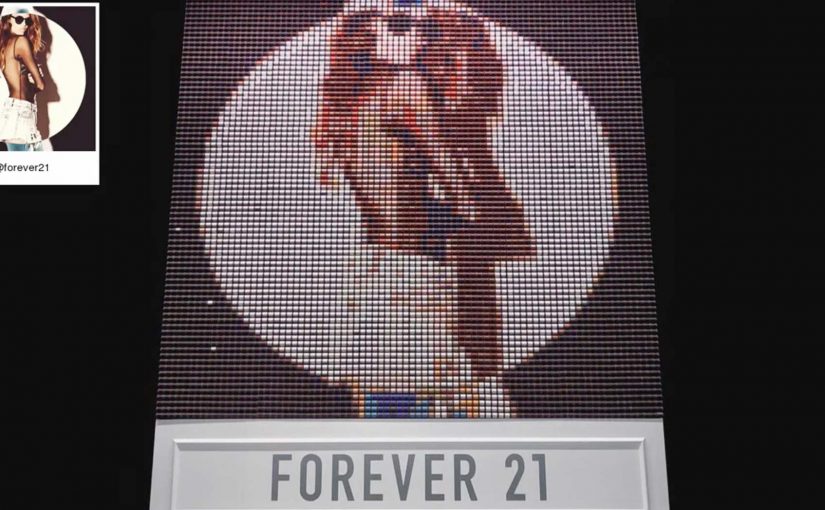
The F21 Thread Screen is a 2,000 pound machine that uses 6,400 mechanical spools of thread to display Instagrams hashtagged with #F21ThreadScreen. Melding fashion and technology, the Thread Screen is truly beautiful and unique. Hashtag an Instagram of you and your friends and see yourselves in a way unlike anything you’ve seen before…

Why this installation is so compelling

The idea is simple. Post with a hashtag. But the output is unexpected. Instead of a screen showing pixels, you get a physical, mechanical interpretation that feels handcrafted, even though it is powered by a heavy machine.

Extractable takeaway: When a familiar action produces a materially different output, people stop, watch, and share the surprise.

Because the installation turns a normal Instagram post into a moving, thread-based image, the same content earns attention as an in-store spectacle.

  • Digital input, physical output. A social post becomes a tangible display.
  • Participation is effortless. The only requirement is a hashtag, which fits existing behavior.
  • It creates a new kind of “share”. People share twice. First on Instagram. Then again when the installation shows them back in a surprising format.

In retail environments, where foot traffic is finite and attention is fragmented, turning social participation into a physical moment can convert passers-by into participants.

How to reuse the Thread Screen pattern

The real question is how you take a familiar social mechanic and make the payoff feel materially different in the real world.

Retail and fashion brands should not just “display social” in-store. They should translate participation into a physical moment people want to watch and capture.

  • Change the medium of the reward. Keep the action familiar (a hashtag), but make the output unexpected enough to feel handcrafted.
  • Design for dwell time. Here, dwell time means the extra time people stay near the installation to see themselves appear and change.
  • Build in the second share. Give people a reason to post again, because the physical result looks nothing like a normal screen.

A few fast answers before you act

What is the Forever 21 Thread Screen?

It is a large-scale mechanical installation that uses thousands of thread spools to display Instagram posts tagged with #F21ThreadScreen as a physical, moving thread-based image.

How does a visitor participate?

They post an Instagram photo with the hashtag #F21ThreadScreen, which the installation then pulls into the display.

Why is this effective for retail and fashion brands?

It turns social participation into an in-store spectacle, giving people a reason to engage, watch, and share again from the physical experience.

What is the key takeaway?

Do not just “display social”. Transform it. The more unexpected the medium, the more memorable the experience becomes.