
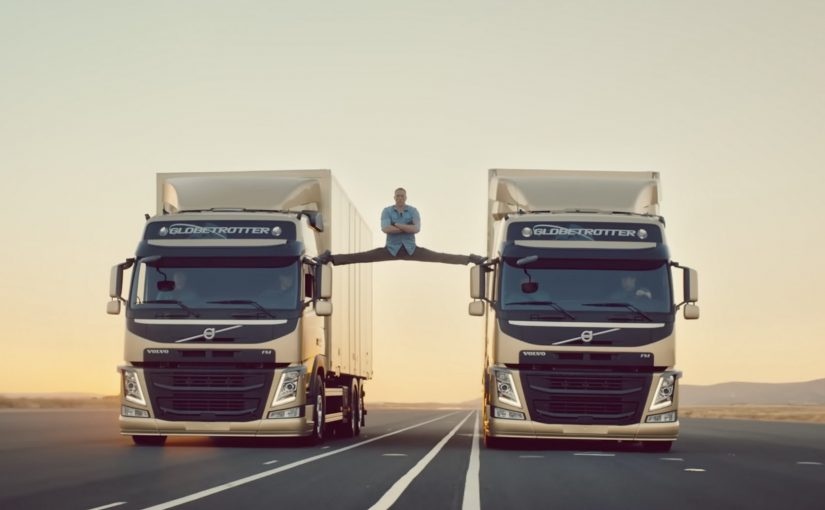
Volvo Trucks: The Epic Split

Brands all over the world are trying to create branded content. Volvo did that with great success last month when they filmed a hamster drive their entire truck up a mountain.

Now, Volvo demonstrates the precision and directional stability of its dynamic steering by getting Jean-Claude Van Damme to carry out his famous split between two reversing Volvo FM trucks. Here, “dynamic steering” refers to the steering system helping the truck hold a steady line under motion. The video, since release, is reported to have already passed 7 million views.

A feature demo disguised as spectacle

The mechanism is as clean as it gets. Take a technical claim, steering stability under motion. Express it in one unmistakable image that needs no explanation. Two trucks moving backwards in sync, a human balancing point-to-point between them, and the steering system as the silent hero.

In global industrial and automotive marketing, the most reusable branded content is engineered proof that compresses a technical benefit into a single, legible visual.

By “engineered proof,” I mean a demonstration where the product capability is the only plausible explanation for what you see.

Why the internet did the media buy for them

This lands because it is instantly readable and instantly arguable. People share it to say “this is real.” People share it to say “this is impossible.” Either way, the product claim travels with the argument.

Extractable takeaway: If your product advantage is hard to feel in a 30-second explanation, translate it into a one-frame “impossible” moment. The real question is “what made that possible.” Then let the audience debate the stunt while your feature becomes the answer.

It also avoids the common branded-content trap of overstorytelling. The brand stays in the background, the demonstration stays in the foreground, and the audience does the meaning-making in their own words.

How to borrow this pattern without a movie star

  • Start with one feature you can prove. Pick a claim that can be demonstrated, not merely asserted.
  • Design for instant comprehension. If a still frame cannot tell the story, simplify the setup.
  • Make the proof self-contained. The audience should not need a voiceover to understand what is being tested.
  • Keep the brand restraint. Overbranding weakens believability. Let the test carry the persuasion.

A few fast answers before you act

What is Volvo’s “The Epic Split” demonstrating?

It is designed to demonstrate the precision and directional stability of Volvo’s dynamic steering by showing two reversing trucks holding a steady path while Jean-Claude Van Damme performs a split between them.

Why does this count as branded content instead of “just an ad”?

The primary value is the demonstration itself. The content is built to be watched and shared as a feat, with the product benefit embedded in the feat rather than delivered as a sales message.

What makes a stunt like this more shareable than a typical product film?

Instant readability plus high stakes. A single image communicates the premise, and the audience immediately wants to test whether it is real, which drives sharing and discussion.

How do you know the spectacle is actually proving the feature?

If the moment works as a still frame, stays understandable without voiceover, and the technical claim is the only plausible explanation, then the spectacle is doing real demonstration work, not just decoration.

How can smaller brands apply the same approach?

Reduce the ambition, not the logic. Prove one feature with one clear test, make it understandable in one glance, and remove anything that distracts from the proof.
Hevesh5: Domino Tricks Screenlink

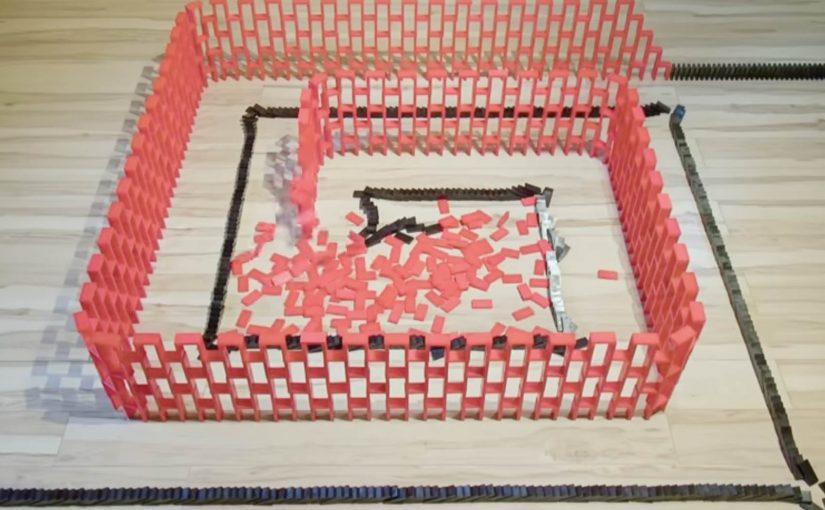
Hevesh5 and MillionDollarBoy spent three months organizing more than 20,000 dominoes into a tight masterpiece of clicks and clatters.

The video uses a technique known as “screenlink”. Each section is constructed separately, then edited together to look like one continuous setup.

What “screenlink” enables

Screenlink is a production workaround that unlocks variety without requiring one gigantic, fragile, single-take build. You can design multiple high-risk moments, film them when they work, and then stitch them so the viewer experiences an uninterrupted flow.

In creator-led visual content, this is a scalable way to deliver “impossible” continuity while keeping build time, failure risk, and resets manageable.

The real question is how you preserve the thrill of continuous payoff without turning practical craft into a production liability. The strongest choice here is to protect momentum for the viewer, even when the build itself has to stay modular.

Why this lands

This works because it preserves the dopamine loop of a perfect domino run. No downtime, no rebuild fatigue, just consecutive payoffs. The editing is invisible enough that the craft still feels physical and earned, which keeps the satisfaction of practical effects intact.

Extractable takeaway: If your content depends on fragile real-world execution, design it as modular sections, capture each section at its best, and stitch the sequence so the audience gets continuous momentum instead of production reality.

What to steal from screenlink production

  • Modularize the build. Treat each “wow” moment as its own unit you can perfect.
  • Edit for perceived continuity. The viewer cares about flow, not your reset count.
  • Make the craft legible. Even with editing, keep the physical logic visible so it feels real.
  • Use collaboration to expand the idea space. Two builders can generate more distinct tricks faster than one.

A few fast answers before you act

What is a “screenlink” domino video?

It’s a domino compilation where separate sections are built and filmed individually, then edited together to appear like one continuous run.

Why not build it as one continuous setup?

A single setup is more fragile and time-consuming to reset. Screenlink reduces risk while enabling more variety.

Does screenlink mean it is fake?

No. The domino physics are real per section. The continuity is created in editing so the overall sequence feels seamless.

What makes a good screenlink edit?

Consistent pacing, clean transition points, and visual continuity cues so cuts are not distracting.

When should brands use this kind of technique?

When you need repeated “wow” moments with practical credibility, but the real-world build is too fragile or costly to execute as one uninterrupted take.

ActionAid: Donate Your Profile

ActionAid is an organisation committed to many projects, like fighting hunger and poverty. But in Italy it is known primarily for sponsoring children.

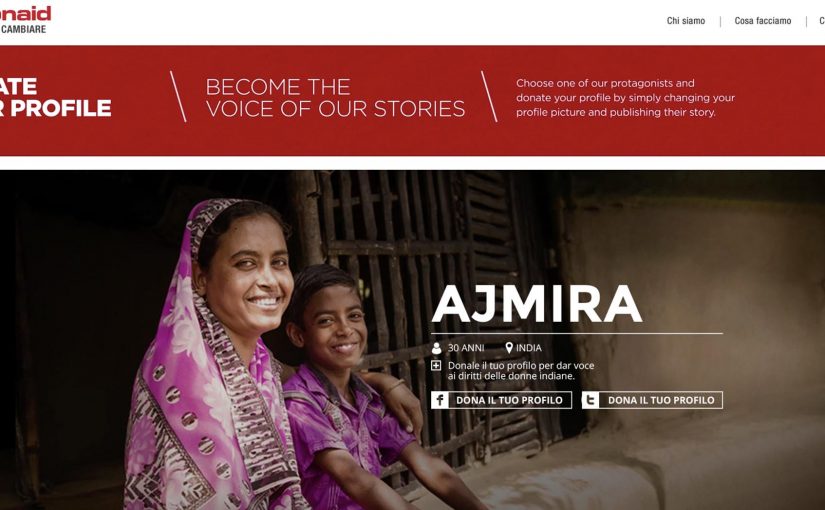
To communicate the broader work of ActionAid with a small media and production budget, DLV BBDO created “Donate Your Profile”. Participants donated their Facebook and Twitter profile pictures so that awareness could be generated for the stories of people ActionAid helped.

How “Donate Your Profile” worked

The mechanism is a simple identity swap. People hand over the most visible square in their social presence. Their profile photo. In return, they display a campaign image tied to a real person’s story, so every comment, like, and share carries that story into everyday social traffic.

Support from Radio 105, Radio Deejay, La Stampa, Marc Marquez and other Italian celebrities and brands helps normalise the behaviour. Once well-known accounts participate, the “donate your picture” action looks safe, easy, and socially endorsed.

In Italian cause marketing, borrowing social identity can outperform paid media when budgets are tight, because it turns personal networks into distribution.

The real question is how to turn a low-budget act of support into something people carry through their normal social behaviour.

Why the profile swap spreads

This works because it converts passive support into a visible, persistent signal. A profile picture is not a post that disappears in a feed. It is a durable badge that travels wherever you show up online, and it prompts questions that naturally lead to explanation and sharing.

Extractable takeaway: If you need earned reach without heavy spend, move the call to action from “share a post” to “change a default”. When people change a default surface, the campaign rides along with their normal behaviour.

The reported impact

The project was described as becoming the 5th most trending topic on Twitter and generating over 79 million media impressions, with more people joining in as the support network grew.

What to borrow from the profile-swap pattern

  • Pick a high-frequency surface. Defaults like profile photos travel more than one-off posts.
  • Make the action reversible. People participate faster when the commitment feels temporary.
  • Seed with credible partners. Media brands and recognisable faces reduce hesitation.
  • Turn participation into a conversation starter. The best mechanics invite questions, not just clicks.

A few fast answers before you act

What is “Donate Your Profile”?

It is a campaign where people replace their Facebook and Twitter profile pictures with a campaign image, so ActionAid stories gain awareness through everyday social interactions.

Why use profile pictures instead of posts?

A profile picture is persistent and high-visibility. It shows up repeatedly across comments and interactions, so the message travels without requiring constant re-posting.

How did the campaign scale beyond early participants?

Reportedly through support from media brands and celebrities, which makes the behaviour feel normal and increases follow-on participation.

What results were reported?

Reported results included reaching the 5th most trending topic on Twitter and generating over 79 million media impressions.

What is the main risk with this pattern?

Trust. If people are unclear about what is being changed, for how long, and what they are authorising, participation drops. The exchange must be transparent and easy to undo.